

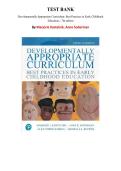
TEST BANK
Developmentally Appropriate Curriculum: Best Practices in Early Childhood
Education, | 7th edition
By Marjorie Kostelnik, Anne Soderman
TU
TO
R
G
U
R
U
, kjhgfdsa
Table of Contents
Introduction iv
Chapter 1: Developmentally Appropriate Practice: An Evolving Framework
for Teaching Young Children 1
Chapter 2: Teaching and Learning in Developmentally Appropriate Programs 6
Chapter 3: Planning and Implementing Effective Small-Group Activities 10
TU
Chapter 4: Planning and Implementing Effective Group-Time Activities 15
Chapter 5: Organizing Space and Materials 20
Chapter 6: Child Guidance in Early Childhood Classrooms 25
TO
Chapter 7: Assessing and Evaluating Children’s Learning 29
Chapter 8: Strengthening Developmentally Appropriate Programs Through Family
Engagement 33
R
Chapter 9: The Aesthetic Domain 38
Chapter 10: The Affective Domain 43
G
Chapter 11: The Cognitive Domain 47
Chapter 12: The Language Domain 51
U
Chapter 13: The Physical Domain 55
R
Chapter 14: The Social Domain 60
Chapter 15: Integrating Curriculum Through Pretend and Construction Play 65
U
Chapter 16: Organizing Children’s Learning Over Time 70
Answer Key 75
oiuytre
, kjhgfdsa
Introduction
Multiple Choice Questions
Circle the best answer.
1. An early childhood professional is someone who works with children ages:
a. Preschool to third grade
b. Four to eight
c. Birth to eight
d. Birth to five
TU
2. The population of the United States is changing. Which of the following conditions is
identified in your textbook as one of the conditions created by these circumstances?
a. Parents are less interested in their children’s education than was true in the past.
b. The number of families with young children who are living in poverty is growing.
c. The number of children who speak a language other than English at home was growing,
TO
but is now leveling off.
d. The number of children living in single parent families has stabilized.
3. According to the NAEYC Code of Ethical Conduct, which one of the following
responsibilities is most important?
a. We shall support the rights of children with special needs.
R
b. Above all, we shall not harm children.
c. We shall not participate in practices that discriminate against children and families.
d. We shall respect the uniqueness of each child.
G
4. "The professional is never a ‘finished’ product." Select the most appropriate interpretation of
this statement.
a. Professionals go to school off and on their entire careers.
U
b. Professionals continuously work to stay current in the field by reading, reflecting, and
attending professional development activities.
c. Professionals must obtain a CDA credential and then update it every five years.
R
d. The professional must work to attain the highest early childhood level – Level VI.
5. What statement best describes the role of families in the early education process?
U
a. Parents follow the lead of professionals in educating children.
b. The role varies as children mature.
c. Families are considered children’s first teachers.
d. How involved parents are in their child’s program depends on the parents’ education.
6. Which of the following would be considered an early childhood education program?
a. Fourth grade class
b. Neonatal unit in a hospital
c. Second grade class
d. Boy Scouts
iuytrew
, kjhgfdsa
7. Which of these is a distinguishing characteristic of an early childhood professional?
a. Working with young children.
b. Being paid a higher salary than that the dollars paid to non-professionals.
c. A college degree.
d. Specialized training in early childhood.
8. Which of these would be the best indicator of a high quality program for children?
a. The curriculum supports whole child learning.
b. There are 12 children in the class.
c. The teacher has experience in the elementary grades.
d. The program director likes children.
TU
9. Which of the following statements is NOT true about children who experience low quality
programs?
a. They are often children from low-income families.
b. They do okay as long as their parents spend a lot of extra time with them at home.
TO
c. They are likely to have poor social skills.
d. They tend to exhibit behavior problems.
10. What is true about the learning that occurs in families?
a. It is most significant during the first three years of life.
b. It is an important element of children’s education.
R
c. It is significant for social learning, but has little impact on academics.
d. It is often of lower quality than the learning children experience in school.
G
Short Answer Questions
Give a short, concise answer to each statement.
11. Name three characteristics of high quality early childhood programs.
U
12. Name 3 benefits to children enrolled in high quality early childhood programs.
R
13. Name 3 drawbacks to children enrolled in poor quality early childhood programs.
14. Identify 5 characteristics of an early childhood professional.
U
15. Name 5 different types of early childhood programs.
iuytrew
Developmentally Appropriate Curriculum: Best Practices in Early Childhood
Education, | 7th edition
By Marjorie Kostelnik, Anne Soderman
TU
TO
R
G
U
R
U
, kjhgfdsa
Table of Contents
Introduction iv
Chapter 1: Developmentally Appropriate Practice: An Evolving Framework
for Teaching Young Children 1
Chapter 2: Teaching and Learning in Developmentally Appropriate Programs 6
Chapter 3: Planning and Implementing Effective Small-Group Activities 10
TU
Chapter 4: Planning and Implementing Effective Group-Time Activities 15
Chapter 5: Organizing Space and Materials 20
Chapter 6: Child Guidance in Early Childhood Classrooms 25
TO
Chapter 7: Assessing and Evaluating Children’s Learning 29
Chapter 8: Strengthening Developmentally Appropriate Programs Through Family
Engagement 33
R
Chapter 9: The Aesthetic Domain 38
Chapter 10: The Affective Domain 43
G
Chapter 11: The Cognitive Domain 47
Chapter 12: The Language Domain 51
U
Chapter 13: The Physical Domain 55
R
Chapter 14: The Social Domain 60
Chapter 15: Integrating Curriculum Through Pretend and Construction Play 65
U
Chapter 16: Organizing Children’s Learning Over Time 70
Answer Key 75
oiuytre
, kjhgfdsa
Introduction
Multiple Choice Questions
Circle the best answer.
1. An early childhood professional is someone who works with children ages:
a. Preschool to third grade
b. Four to eight
c. Birth to eight
d. Birth to five
TU
2. The population of the United States is changing. Which of the following conditions is
identified in your textbook as one of the conditions created by these circumstances?
a. Parents are less interested in their children’s education than was true in the past.
b. The number of families with young children who are living in poverty is growing.
c. The number of children who speak a language other than English at home was growing,
TO
but is now leveling off.
d. The number of children living in single parent families has stabilized.
3. According to the NAEYC Code of Ethical Conduct, which one of the following
responsibilities is most important?
a. We shall support the rights of children with special needs.
R
b. Above all, we shall not harm children.
c. We shall not participate in practices that discriminate against children and families.
d. We shall respect the uniqueness of each child.
G
4. "The professional is never a ‘finished’ product." Select the most appropriate interpretation of
this statement.
a. Professionals go to school off and on their entire careers.
U
b. Professionals continuously work to stay current in the field by reading, reflecting, and
attending professional development activities.
c. Professionals must obtain a CDA credential and then update it every five years.
R
d. The professional must work to attain the highest early childhood level – Level VI.
5. What statement best describes the role of families in the early education process?
U
a. Parents follow the lead of professionals in educating children.
b. The role varies as children mature.
c. Families are considered children’s first teachers.
d. How involved parents are in their child’s program depends on the parents’ education.
6. Which of the following would be considered an early childhood education program?
a. Fourth grade class
b. Neonatal unit in a hospital
c. Second grade class
d. Boy Scouts
iuytrew
, kjhgfdsa
7. Which of these is a distinguishing characteristic of an early childhood professional?
a. Working with young children.
b. Being paid a higher salary than that the dollars paid to non-professionals.
c. A college degree.
d. Specialized training in early childhood.
8. Which of these would be the best indicator of a high quality program for children?
a. The curriculum supports whole child learning.
b. There are 12 children in the class.
c. The teacher has experience in the elementary grades.
d. The program director likes children.
TU
9. Which of the following statements is NOT true about children who experience low quality
programs?
a. They are often children from low-income families.
b. They do okay as long as their parents spend a lot of extra time with them at home.
TO
c. They are likely to have poor social skills.
d. They tend to exhibit behavior problems.
10. What is true about the learning that occurs in families?
a. It is most significant during the first three years of life.
b. It is an important element of children’s education.
R
c. It is significant for social learning, but has little impact on academics.
d. It is often of lower quality than the learning children experience in school.
G
Short Answer Questions
Give a short, concise answer to each statement.
11. Name three characteristics of high quality early childhood programs.
U
12. Name 3 benefits to children enrolled in high quality early childhood programs.
R
13. Name 3 drawbacks to children enrolled in poor quality early childhood programs.
14. Identify 5 characteristics of an early childhood professional.
U
15. Name 5 different types of early childhood programs.
iuytrew

