
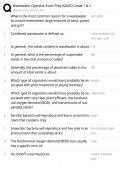
Wastewater Operator Exam Prep AZDEQ Grade 1 & 2
Study online at https://quizlet.com/_eifhrl
1. What is the most common reason for a wastewater storm events
to contain intermittent large amounts of sand, gravel,
and grit?
2. Combined wastewater is defined as: sanitary wastewater and
storm water runoff
3. In general , the solids content in wastewater is about: 0.1%
4. In general, what is the percentage of suspended 30%
solids in the total amount of solids?
5. Generally, the percentage of dissolved solids in the 70%
amount of total solids is about:
6. Which type of organisms would most probably be as- amoebas
sociated with poor treatment or young biomass?
7. Which type of organisms would most probably be as- stalked ciliates
sociated with very clear plant effluent, low biochem-
ical oxygen demand (BOD), and low amounts of sus-
pended solids?
8. Aerobic bacteria will reproduce and live in an environ- oxygen
ment that contains only:
9. Anaerobic bacteria will reproduce and live only in an free or dissolved oxygen
environment that completely lacks: (DO)
10. The biochemical oxygen demand (BOD) test usually 5 days
has a specific time of:
11. An Imhoff cone measures: a volume of settleable
solids
, Wastewater Operator Exam Prep AZDEQ Grade 1 & 2
Study online at https://quizlet.com/_eifhrl
12. Septic conditions are caused by: anaerobic bacteria
13. Scum is usually removed in the _________ treatment primary
stage.
14. When domestic wastewater enters natural waters, aerobic bacteria
what species deplete most of the oxygen?
15. Once the oxygen is depleted in a natural body of water, anaerobic bacteria
which organisms take over?
16. The major gas produced by anaerobic decomposition methane
is:
17. When organic wastes are discharged to receiving wa- bacteria
ters, oxygen is depleted by:
18. Coliform bacteria are: indicators
19. Which indicates a good quality domestic activated brown color and musty
sludge? odor
20. Common settling times in wastewater treatment 2 to 4 hours
plants range from:
21. Which gas is produced in anaerobic digesters and can methane
be used as a fuel?
22. The rock in most trickling filters is placed: on a system of tile under-
drains
23. What is the purpose of heating and mixing a primary to increase the digestion
anaerobic digester? rate
, Wastewater Operator Exam Prep AZDEQ Grade 1 & 2
Study online at https://quizlet.com/_eifhrl
24. The following device is used to measure the flow of parshall flume
wastewater:
25. What does healthy activated sludge smell like? earthy
26. What is a biomass? a mass of organic mater-
ial consisting of living or-
ganisms that feed on the
wastes of sewage
27. What could cause a sudden drop in pH of the influent? acidic chemical in the in-
fluent
28. Which of the following is typically treated by biological dissolved and non-sett-
processes? lable organic material
29. What impact does temperature have on the reaction reaction rate doubles with
rate of microorganism in wastewater? every 18 degree Fahren-
heit increase in tempera-
ture until higher tempera-
ture inhibits biological ac-
tivity
30. What is true during the colder winter months? modify operations to in-
crease solids under aera-
tion to provide more mi-
croorganisms to treat the
BOD
31. What are commonly used to control chlorine feed rate flow and chlorine residual
for disinfection?
32. What is used to control filamentous organisms? chlorine
Study online at https://quizlet.com/_eifhrl
1. What is the most common reason for a wastewater storm events
to contain intermittent large amounts of sand, gravel,
and grit?
2. Combined wastewater is defined as: sanitary wastewater and
storm water runoff
3. In general , the solids content in wastewater is about: 0.1%
4. In general, what is the percentage of suspended 30%
solids in the total amount of solids?
5. Generally, the percentage of dissolved solids in the 70%
amount of total solids is about:
6. Which type of organisms would most probably be as- amoebas
sociated with poor treatment or young biomass?
7. Which type of organisms would most probably be as- stalked ciliates
sociated with very clear plant effluent, low biochem-
ical oxygen demand (BOD), and low amounts of sus-
pended solids?
8. Aerobic bacteria will reproduce and live in an environ- oxygen
ment that contains only:
9. Anaerobic bacteria will reproduce and live only in an free or dissolved oxygen
environment that completely lacks: (DO)
10. The biochemical oxygen demand (BOD) test usually 5 days
has a specific time of:
11. An Imhoff cone measures: a volume of settleable
solids
, Wastewater Operator Exam Prep AZDEQ Grade 1 & 2
Study online at https://quizlet.com/_eifhrl
12. Septic conditions are caused by: anaerobic bacteria
13. Scum is usually removed in the _________ treatment primary
stage.
14. When domestic wastewater enters natural waters, aerobic bacteria
what species deplete most of the oxygen?
15. Once the oxygen is depleted in a natural body of water, anaerobic bacteria
which organisms take over?
16. The major gas produced by anaerobic decomposition methane
is:
17. When organic wastes are discharged to receiving wa- bacteria
ters, oxygen is depleted by:
18. Coliform bacteria are: indicators
19. Which indicates a good quality domestic activated brown color and musty
sludge? odor
20. Common settling times in wastewater treatment 2 to 4 hours
plants range from:
21. Which gas is produced in anaerobic digesters and can methane
be used as a fuel?
22. The rock in most trickling filters is placed: on a system of tile under-
drains
23. What is the purpose of heating and mixing a primary to increase the digestion
anaerobic digester? rate
, Wastewater Operator Exam Prep AZDEQ Grade 1 & 2
Study online at https://quizlet.com/_eifhrl
24. The following device is used to measure the flow of parshall flume
wastewater:
25. What does healthy activated sludge smell like? earthy
26. What is a biomass? a mass of organic mater-
ial consisting of living or-
ganisms that feed on the
wastes of sewage
27. What could cause a sudden drop in pH of the influent? acidic chemical in the in-
fluent
28. Which of the following is typically treated by biological dissolved and non-sett-
processes? lable organic material
29. What impact does temperature have on the reaction reaction rate doubles with
rate of microorganism in wastewater? every 18 degree Fahren-
heit increase in tempera-
ture until higher tempera-
ture inhibits biological ac-
tivity
30. What is true during the colder winter months? modify operations to in-
crease solids under aera-
tion to provide more mi-
croorganisms to treat the
BOD
31. What are commonly used to control chlorine feed rate flow and chlorine residual
for disinfection?
32. What is used to control filamentous organisms? chlorine

