

NURS 251 - Pharmacology Module 6
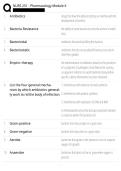
1. Antibiotics drugs that have the ability to destroy or interfere with the
development of bacteria
2. Bacteria Resistance the ability of some bacteria to resist the actions of antibi-
otics.
3. Bactericidal antibiotics that work by killing the bacteria
4. Bacteriostatic antibiotics that do not actually kill bacteria, but only in-
hibit their growth.
5. Empiric therapy the administration of antibiotics based on the practition-
er's judgment of pathogens most likely to be causing
an apparent infection to avoid treatment delay before
specific culture information has been obtained
6. List the four general mecha- 1. Interference with bacterial cell wall synthesis
nism by which antibiotics general-
ly work to rid the body of infection. 2. Interference with protein synthesis
3. Interference with replication of DNA and RNA
4. Antimetabolite action that disrupts important metabol-
ic reactions within the bacterial cell
7. Gram-positive bacteria that stain purple on a gram stain.
8. Gram-negative bacteria that stain pink on a gram stain.
9. Aerobe bacterium that grows in the presence of air or requires
oxygen for growth.
10. Anaerobe bacterium that does not live or grow when oxygen is
present.
1/8
, NURS 251 - Pharmacology Module 6
11. common Gram- positive bacteria staphylococcus aureus
streptococcus pyogenes
enterococcus faecalis
12. common Gram-negative bacteria Pseudomonas aeruginosa
Klebsiella pneumoniae
Escherichia Coli
Enterobacter species
13. What does MRSA stand for? methicillin-resistance Staphylococcus aureus
14. Examples of sulfonamides sulfamethoxazole-trimethoprim
15. Examples of penicillin penicillin, cloxacillin, amoxicillin, or piperacillin/tazobac-
tam
16. Examples of Cephalosporin cephalexin, cefoxitin, ceftazidime, cefepime, or ceftaro-
line
17. Examples of macrolides erythromycin, azithromycin, or clarithromycin
18. Examples of tetracycline doxycycline, minocycline, or tigecycline
19. Examples of aminoglycosides Amikacin, tobramycin
20. Examples of fluoroquinolone ciprofloxacin, levofloxacin, moxifloxacin.
21. Define Beta Lactam antibiotics. Beta Lactam antibiotics include penicillins and
cephalosporins. Beta Lactam Antibiotics are named such
because of the presence of a beta-lactam ring as a part of
2/8
1. Antibiotics drugs that have the ability to destroy or interfere with the
development of bacteria
2. Bacteria Resistance the ability of some bacteria to resist the actions of antibi-
otics.
3. Bactericidal antibiotics that work by killing the bacteria
4. Bacteriostatic antibiotics that do not actually kill bacteria, but only in-
hibit their growth.
5. Empiric therapy the administration of antibiotics based on the practition-
er's judgment of pathogens most likely to be causing
an apparent infection to avoid treatment delay before
specific culture information has been obtained
6. List the four general mecha- 1. Interference with bacterial cell wall synthesis
nism by which antibiotics general-
ly work to rid the body of infection. 2. Interference with protein synthesis
3. Interference with replication of DNA and RNA
4. Antimetabolite action that disrupts important metabol-
ic reactions within the bacterial cell
7. Gram-positive bacteria that stain purple on a gram stain.
8. Gram-negative bacteria that stain pink on a gram stain.
9. Aerobe bacterium that grows in the presence of air or requires
oxygen for growth.
10. Anaerobe bacterium that does not live or grow when oxygen is
present.
1/8
, NURS 251 - Pharmacology Module 6
11. common Gram- positive bacteria staphylococcus aureus
streptococcus pyogenes
enterococcus faecalis
12. common Gram-negative bacteria Pseudomonas aeruginosa
Klebsiella pneumoniae
Escherichia Coli
Enterobacter species
13. What does MRSA stand for? methicillin-resistance Staphylococcus aureus
14. Examples of sulfonamides sulfamethoxazole-trimethoprim
15. Examples of penicillin penicillin, cloxacillin, amoxicillin, or piperacillin/tazobac-
tam
16. Examples of Cephalosporin cephalexin, cefoxitin, ceftazidime, cefepime, or ceftaro-
line
17. Examples of macrolides erythromycin, azithromycin, or clarithromycin
18. Examples of tetracycline doxycycline, minocycline, or tigecycline
19. Examples of aminoglycosides Amikacin, tobramycin
20. Examples of fluoroquinolone ciprofloxacin, levofloxacin, moxifloxacin.
21. Define Beta Lactam antibiotics. Beta Lactam antibiotics include penicillins and
cephalosporins. Beta Lactam Antibiotics are named such
because of the presence of a beta-lactam ring as a part of
2/8

