BIOD 121 module 3 exam latest
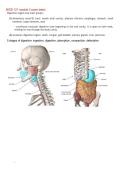
Digestive organs two main groups:
(1) alimentary canal/GI tract: mouth (oral cavity), pharynx (throat), esophagus, stomach, small
intestine, large intestine, anus
- continuous muscular digestive tube beginning in the oral cavity. It is open at both ends,
winding its way through the body cavity.
(2) accessory digestive organs: teeth, tongue, gall bladder, salivary glands, liver, pancreas
5 stages of digestion: ingestion, digestion, absorption, compaction, defecation
1
,BIOD 121 module 3 exam latest
1
,BIOD 121 module 3 exam latest
MOUTH (start of GI tract, alimentary canal)
STRUCTURE:
Opening – lips
Floor – tongue: muscle that attaches to
hyoid bone, mandible,
lingual frenulum
Wall – cheeks
Roof – hard and soft palates Posterior
Border – uvula: hangs inferiorly from its
attachment to the soft palate
Food is mixed and moistened with saliva from the
salivary glands. The salivary glands contain
enzymes (amylase) breaking down starches /carbs
through chemical digestion.
TEETH (accessory organ)
- Mechanical digestion – mastication
is chewing food
- thirty-two teeth in the human
mouth
- upper arch of teeth is located
within the maxilla (hard palate)
- the lower arch of teeth located on
the movable, lower mandible -
three parts:
1. crown - visible portion of
the tooth and lies above the
gum line
2. neck - located within the
upper portion of the gums (gingiva)
3. root - largest portion of each tooth located within the alveolar process of the jaw bone
- pulp cavity: center of the tooth contains nerves and blood vessels to feel sensations of heat,
cold, and pain, fills cavity in the gums
- Dentin: bone-like substance composing
most of each tooth
- Enamel: hard connective tissue that
protects the rest of the tooth located on
the surface of the crown, covers the
dentine and
hardest substance in the body
four types to chew both a vegetable and meat
diet. One-half of each jaw has
1
, BIOD 121 module 3 exam latest
- 2 chisel-shaped incisors – biting, cutting
- 1 pointed canine – tearing, puncture, shredding
- 2 increasingly flat pre-molars - grinding
- 3 flat molars - crushing
TONGUE ( accessory organ)
- grips the food and constantly
repositions it between the teeth
to make bolus ( compact mass of
chewed food)
- pushes the bolus back to the
pharynx to begin the process of
swallowing
- lingual frenulum : vertical
mucous membrane attaches
tongue body to the floor of the
mouth
papillae: raised bumps on the tongue to help grip food
1. circumvallate – contain taste buds
2. fungiform – contain taste buds
3. filiform
Taste buds: chemical receptors that are
stimulated by the chemical composition of
food
- found on the tongue, surface of the
mouth, the wall of the pharynx
PHARYNX (throat, alimentary canal)
- connects the mouth to the esophagus
- three parts:
1
Digestive organs two main groups:
(1) alimentary canal/GI tract: mouth (oral cavity), pharynx (throat), esophagus, stomach, small
intestine, large intestine, anus
- continuous muscular digestive tube beginning in the oral cavity. It is open at both ends,
winding its way through the body cavity.
(2) accessory digestive organs: teeth, tongue, gall bladder, salivary glands, liver, pancreas
5 stages of digestion: ingestion, digestion, absorption, compaction, defecation
1
,BIOD 121 module 3 exam latest
1
,BIOD 121 module 3 exam latest
MOUTH (start of GI tract, alimentary canal)
STRUCTURE:
Opening – lips
Floor – tongue: muscle that attaches to
hyoid bone, mandible,
lingual frenulum
Wall – cheeks
Roof – hard and soft palates Posterior
Border – uvula: hangs inferiorly from its
attachment to the soft palate
Food is mixed and moistened with saliva from the
salivary glands. The salivary glands contain
enzymes (amylase) breaking down starches /carbs
through chemical digestion.
TEETH (accessory organ)
- Mechanical digestion – mastication
is chewing food
- thirty-two teeth in the human
mouth
- upper arch of teeth is located
within the maxilla (hard palate)
- the lower arch of teeth located on
the movable, lower mandible -
three parts:
1. crown - visible portion of
the tooth and lies above the
gum line
2. neck - located within the
upper portion of the gums (gingiva)
3. root - largest portion of each tooth located within the alveolar process of the jaw bone
- pulp cavity: center of the tooth contains nerves and blood vessels to feel sensations of heat,
cold, and pain, fills cavity in the gums
- Dentin: bone-like substance composing
most of each tooth
- Enamel: hard connective tissue that
protects the rest of the tooth located on
the surface of the crown, covers the
dentine and
hardest substance in the body
four types to chew both a vegetable and meat
diet. One-half of each jaw has
1
, BIOD 121 module 3 exam latest
- 2 chisel-shaped incisors – biting, cutting
- 1 pointed canine – tearing, puncture, shredding
- 2 increasingly flat pre-molars - grinding
- 3 flat molars - crushing
TONGUE ( accessory organ)
- grips the food and constantly
repositions it between the teeth
to make bolus ( compact mass of
chewed food)
- pushes the bolus back to the
pharynx to begin the process of
swallowing
- lingual frenulum : vertical
mucous membrane attaches
tongue body to the floor of the
mouth
papillae: raised bumps on the tongue to help grip food
1. circumvallate – contain taste buds
2. fungiform – contain taste buds
3. filiform
Taste buds: chemical receptors that are
stimulated by the chemical composition of
food
- found on the tongue, surface of the
mouth, the wall of the pharynx
PHARYNX (throat, alimentary canal)
- connects the mouth to the esophagus
- three parts:
1