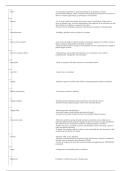
Stress: -An automatic psychologic or emotional response to an internal or external
environmental challenge, which is automatic and typically beyond a person's resources or
ability to response (physiologic, psychological, sociocultural).
Stressor: -An event of stimulus that disrupts the person's sense of equilibrium. People react to
stress in different ways, which are determined by their appraisal of the stressful event and
their self-perceived ability to respond to the stressor.
-Stressors may be exhibited as physical or psychosocial symptoms or through denial.
Nonverbal stress: -Irritability, agitation, anxiety, and poor eye contact.
Stress can be caused by: -Loss of job, the death of a family member or friend, the diagnosis of an illness, finances,
being a caregiver, relationships, and caring for children.
-The nurse should observe caregivers for symptoms of stress to determine the strength of
patient support systems.
Sense of coherence (SOC): -Characteristics of personality that references one's perception of the world as
comprehensible, manageable, and meaningful.
Strong SOC: -Likely to recognize and utilize resources in a stressful situation.
Low SOC: -Likely to be overwhelmed.
Coping: -Dynamic cognitive and behavioral efforts to manage demands (internal or external).
Defence mechanisms: -Unconscious, protective methods.
Coping strategies: -Problem-focused techniques aimed at altering or removing the stressor.
-Emotion-focused coping strategies work to ease emotional distress.
Coping skills: -Denial, projection, rationalization.
-Successful coping is both problem and emotion focused.
-Focused on successful strategies that have been helpful with past stressors.
Crisis intervention: -Short-term, problem-solving oriented assistance provided at a time of physical or
emotional upheaval with the goal of helping the person is distress to regain equilibrium.
This reduces the risk of long-term ineffective coping and negative outcomes.
-Simple, innovative, accessible, practical, and immediate actions that ensure a person's
safety and mental well-being.
-Example: Encouraging a person to drive as soon as possible after involvement in a fatal
accident that took the life of a friend.
Anxiety: -Intensity: mild, severe, and panic.
-Disorders: Generalized anxiety disorder (GAD), Social anxiety, Obsessive-compulsive
disorder, and post-traumatic stress disorders (PTSD).
-Anxiety is a response to stress that causes uncertainty and apprehension. IMPENDING
DANGER!
Anger: -Antagonism toward another person or situation.
Depression: Feelings of worthlessness, guilt, or hopelessness.
, Mild anxiety: -Motivational, foster creativity, increase a person's ability to think clearly/remember
things.
Moderate anxiety: Narrows focus, dulls perceptions and may challenge a person to pay attention or use
problem solving skills. Moderate and mild anxiety are considered normal- these are
experienced on a regular basis!
Severe anxiety: -Inability to make decisions, solve problems.
Panic: -Highest level of anxiety: associated with a multitude of physiologic changes and feelings
of extreme terror or dread. Can immobilize a person- they cannot communicate,
concentrate or think in any rational manner.
-S/S: sweating, chest pain, SOB and palpations.
Nurse burnout: -It is important for nurses to maintain a work-life balance. Fostering healthy, meaningful
relationships both in and out of the workplace are critical component to address
compassion fatigue and burnout.
-Burnout: a mental or physical exhaustion due to constant stress or anxiety.
-Decreased job satisfaction.
-To care more effectively for others, nurses must first take time to care for themselves.
-Healthy coping strategies: exercise, balanced nutrition, and mindfulness therapy.
Alarm: -Hypothalamic and pituitary excitation.
-Adrenal cortex.
-Adrenal medula stimulation.
Review what chemicals are responsible for what assessment
findings you see!
-Hypothalamic and Pituitary Excitation: -High ADH.
-High ACTH.
Adrenal Cortex: -High cortisol.
-Gbuconeogensis.
-Fat and protein catabolism.
-High aldosterone.
-High water and sodium retention.
-High potassium excretion.
Adrenal medulla stimulation: -High epinephrine.
-High heart rate.
-High oxygen intake.
-High blood glucose.
-High mental activity.
-High norepinephrine.
-High arterial BP.
-High blood flow to skeletal muscles.
Resistance: -Attempts to stabilize.
-High parasympathetic activity.
-Adaptation to demand.
Resolution/Recovery: -Return to pre-demand state.
Exhaustion: -Decreasing energy as resources are depleted.
-Inability to adapt.
-Death.
environmental challenge, which is automatic and typically beyond a person's resources or
ability to response (physiologic, psychological, sociocultural).
Stressor: -An event of stimulus that disrupts the person's sense of equilibrium. People react to
stress in different ways, which are determined by their appraisal of the stressful event and
their self-perceived ability to respond to the stressor.
-Stressors may be exhibited as physical or psychosocial symptoms or through denial.
Nonverbal stress: -Irritability, agitation, anxiety, and poor eye contact.
Stress can be caused by: -Loss of job, the death of a family member or friend, the diagnosis of an illness, finances,
being a caregiver, relationships, and caring for children.
-The nurse should observe caregivers for symptoms of stress to determine the strength of
patient support systems.
Sense of coherence (SOC): -Characteristics of personality that references one's perception of the world as
comprehensible, manageable, and meaningful.
Strong SOC: -Likely to recognize and utilize resources in a stressful situation.
Low SOC: -Likely to be overwhelmed.
Coping: -Dynamic cognitive and behavioral efforts to manage demands (internal or external).
Defence mechanisms: -Unconscious, protective methods.
Coping strategies: -Problem-focused techniques aimed at altering or removing the stressor.
-Emotion-focused coping strategies work to ease emotional distress.
Coping skills: -Denial, projection, rationalization.
-Successful coping is both problem and emotion focused.
-Focused on successful strategies that have been helpful with past stressors.
Crisis intervention: -Short-term, problem-solving oriented assistance provided at a time of physical or
emotional upheaval with the goal of helping the person is distress to regain equilibrium.
This reduces the risk of long-term ineffective coping and negative outcomes.
-Simple, innovative, accessible, practical, and immediate actions that ensure a person's
safety and mental well-being.
-Example: Encouraging a person to drive as soon as possible after involvement in a fatal
accident that took the life of a friend.
Anxiety: -Intensity: mild, severe, and panic.
-Disorders: Generalized anxiety disorder (GAD), Social anxiety, Obsessive-compulsive
disorder, and post-traumatic stress disorders (PTSD).
-Anxiety is a response to stress that causes uncertainty and apprehension. IMPENDING
DANGER!
Anger: -Antagonism toward another person or situation.
Depression: Feelings of worthlessness, guilt, or hopelessness.
, Mild anxiety: -Motivational, foster creativity, increase a person's ability to think clearly/remember
things.
Moderate anxiety: Narrows focus, dulls perceptions and may challenge a person to pay attention or use
problem solving skills. Moderate and mild anxiety are considered normal- these are
experienced on a regular basis!
Severe anxiety: -Inability to make decisions, solve problems.
Panic: -Highest level of anxiety: associated with a multitude of physiologic changes and feelings
of extreme terror or dread. Can immobilize a person- they cannot communicate,
concentrate or think in any rational manner.
-S/S: sweating, chest pain, SOB and palpations.
Nurse burnout: -It is important for nurses to maintain a work-life balance. Fostering healthy, meaningful
relationships both in and out of the workplace are critical component to address
compassion fatigue and burnout.
-Burnout: a mental or physical exhaustion due to constant stress or anxiety.
-Decreased job satisfaction.
-To care more effectively for others, nurses must first take time to care for themselves.
-Healthy coping strategies: exercise, balanced nutrition, and mindfulness therapy.
Alarm: -Hypothalamic and pituitary excitation.
-Adrenal cortex.
-Adrenal medula stimulation.
Review what chemicals are responsible for what assessment
findings you see!
-Hypothalamic and Pituitary Excitation: -High ADH.
-High ACTH.
Adrenal Cortex: -High cortisol.
-Gbuconeogensis.
-Fat and protein catabolism.
-High aldosterone.
-High water and sodium retention.
-High potassium excretion.
Adrenal medulla stimulation: -High epinephrine.
-High heart rate.
-High oxygen intake.
-High blood glucose.
-High mental activity.
-High norepinephrine.
-High arterial BP.
-High blood flow to skeletal muscles.
Resistance: -Attempts to stabilize.
-High parasympathetic activity.
-Adaptation to demand.
Resolution/Recovery: -Return to pre-demand state.
Exhaustion: -Decreasing energy as resources are depleted.
-Inability to adapt.
-Death.