

Escrito por estudiantes que aprobaron Inmediatamente disponible después del pago Leer en línea o como PDF ¿Documento equivocado? Cámbialo gratis 4,6 TrustPilot
logo-home
Document preview thumbnail
Vista previa 2 fuera de 15 páginas
Examen

AAMI Accounting 2 (ACCT102) – 86 Final Exam Questions and Answers on Inventory Valuation, Depreciation, Payroll & Financial Ratios

Document preview thumbnail
Vista previa 2 fuera de 15 páginas

This document contains a structured collection of 86 final exam questions with verified answers for AAMI Accounting 2 (ACCT102) for the 2026 academic year. The material focuses on intermediate-level financial accounting topics that build upon introductory accounting principles. Key areas covered include inventory valuation methods (FIFO, LIFO, Weighted Average, and Specific Identification), cost of goods sold calculations, revenue determination, and the effects of inflation and deflation on financial reporting and taxable income. The study material also introduces working capital analysis, liquidity concepts, and ratio analysis used to evaluate a company's financial health. In addition to inventory accounting, the document explores asset cost allocation concepts including depreciation, depletion, and amortization. Students review the major depreciation methods such as Straight-Line, Units of Output, Sum-of-the-Years’ Digits, and Double Declining Balance, as well as related concepts like salvage value, book value, accumulated depreciation, and capitalized costs. The content also explains the use of contra-accounts and the presentation of depreciation expense in financial statements. The document further covers payroll accounting fundamentals including gross pay, net pay, payroll taxes, FICA contributions, W-2 and W-4 forms, and employee payroll deductions. Students also review merchandising transactions and journal entries related to purchasing inventory, purchase discounts, purchase returns, freight charges, and sales transactions including cash sales, credit sales, discounts, and sales returns. These entries demonstrate how merchandising companies record transactions in their accounting records. Financial performance and liquidity measurement is another major component of the document. Important analytical metrics such as working capital, current ratio, quick ratio (acid-test ratio), inventory turnover, accounts receivable turnover, and average collection period are explained and tested through exam-style questions. These measures are commonly used to assess a company’s short-term solvency, operational efficiency, and ability to meet its current obligations. The topics covered in this document align closely with the merchandising operations, inventory systems, payroll accounting, long-term assets, and financial statement analysis chapters found in widely used accounting textbooks such as Financial Accounting by Jerry J. Weygandt, Paul D. Kimmel, and Donald E. Kieso. Because the material is presented in a clear question-and-answer format, it serves as an effective exam preparation resource for students reviewing key accounting concepts and calculations. This study resource may be particularly useful for students enrolled in courses such as: Accounting 2 Principles of Accounting II Intermediate Financial Accounting Merchandising and Inventory Accounting Financial Accounting for Business It may also benefit students studying in programs including: Accounting Business Administration Finance Economics Management Entrepreneurship Business Studies Keywords: inventory valuation methods, fifo lifo weighted average specific identification, cost of goods sold accounting, merchandising transactions journal entries, purchase discounts accounting, sales returns and allowances, depreciation methods accounting, straight line depreciation, double declining balance depreciation, payroll accounting fundamentals, fica payroll tax accounting, working capital analysis, liquidity ratios accounting, current ratio quick ratio, inventory turnover ratio, accounts receivable turnover, financial accounting exam questions

Vista previa del contenido

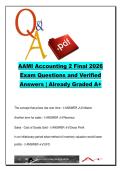
AAMI Accounting 2 Final 2026
Exam Questions and Verified
Answers | Already Graded A+


The concept that prices rise over time - 🧠 ANSWER ✔✔Inflation


Another term for sales - 🧠 ANSWER ✔✔Revenue


Sales - Cost of Goods Sold - 🧠 ANSWER ✔✔Gross Profit


In an inflationary period what method of inventory valuation would lower

profits - 🧠 ANSWER ✔✔LIFO

, In an inflationary period what method of inventory valuation would increase

profits - 🧠 ANSWER ✔✔FIFO


In a deflationary period what method of inventory valuation would lower

profits - 🧠 ANSWER ✔✔FIFO


In a deflationary period what method of inventory valuation would higher

profits - 🧠 ANSWER ✔✔LIFO


What method of inventory valuation would we use as funeral directors - 🧠

ANSWER ✔✔Specific Identification


Sales-CGS-All other operating expenses - 🧠 ANSWER ✔✔Net Profit


Total cost/Total units available for sale - 🧠 ANSWER ✔✔Weighted Average


Best method of inventory valuation - 🧠 ANSWER ✔✔Specific Identification


Revenue-Expenses - 🧠 ANSWER ✔✔Net Income


What method on inventory valuation raises your taxable income - 🧠

ANSWER ✔✔FIFO


What method of inventory valuation lowers your taxable income - 🧠

ANSWER ✔✔LIFO

Información del documento

Subido en
4 de marzo de 2026
Número de páginas
15
Escrito en
2025/2026
Tipo
Examen
Contiene
Preguntas y respuestas
$15.99

¿Documento equivocado? Cámbialo gratis Dentro de los 14 días posteriores a la compra y antes de descargarlo, puedes elegir otro documento. Puedes gastar el importe de nuevo.
Escrito por estudiantes que aprobaron
Inmediatamente disponible después del pago
Leer en línea o como PDF

Seller avatar
Los indicadores de reputación están sujetos a la cantidad de artículos vendidos por una tarifa y las reseñas que ha recibido por esos documentos. Hay tres niveles: Bronce, Plata y Oro. Cuanto mayor reputación, más podrás confiar en la calidad del trabajo del vendedor.
NinjaNerd
3.4
(78)
Vendido
417
Seguidores
6
Artículos
15895
Última venta
4 días hace


Por qué los estudiantes eligen Stuvia

Creado por compañeros estudiantes, verificado por reseñas

Calidad en la que puedes confiar: escrito por estudiantes que aprobaron y evaluado por otros que han usado estos resúmenes.

¿No estás satisfecho? Elige otro documento

¡No te preocupes! Puedes elegir directamente otro documento que se ajuste mejor a lo que buscas.

Paga como quieras, empieza a estudiar al instante

Sin suscripción, sin compromisos. Paga como estés acostumbrado con tarjeta de crédito y descarga tu documento PDF inmediatamente.

Student with book image

“Comprado, descargado y aprobado. Así de fácil puede ser.”

Alisha Student

Preguntas frecuentes
