

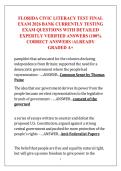
FLORIDA CIVIC LITERACY TEST FINAL
EXAM 2026 BANK CURRENTLY TESTING
EXAM QUESTIONS WITH DETAILED
EXPERTLY VERIFIED ANSWERS (100%
CORRECT ANSWERS /ALREADY
GRADED A+
pamphlet that advocated for the colonies declaring
independence from Britain; supported the need for a
democratic government where the people had
representation - ....ANSWER...Common Sense by Thomas
Paine
The idea that our government derives its power from the
people because we elect representatives to the legislative
branch of government - ....ANSWER...consent of the
governed
a series of essays written to counter and defeat the
proposed U.S. Constitution; argued against a strong
central government and pushed for more protection of the
people's rights - ....ANSWER...Anti-Federalist Papers
The belief that people are free and equal by natural right,
but will give up some freedom to give power to the
1
,government so that the government can protect their
rights. - ....ANSWER...Social Contract Theory
Article VI of the Constitution, which makes the
Constitution the supreme law of the land and states that
states cannot pass laws that conflict with federal laws. -
....ANSWER...Supremacy Clause
supreme court decides if laws passed by Congress or
President are constitutional - ....ANSWER...Judical
Review (Marbury vs. Madison)
head of a city's government elected by the people who are
citizens of that city - ....ANSWER...mayor
movement in the United States beginning in the 1960s to
establish civil rights - ....ANSWER...Civil Rights
Movement
law requiring men to register for military service -
....ANSWER...Selective Service Act
war between Great Britain and its American colonies, by
which the colonies won their independence -
2
,....ANSWER...American Revolution
A belief that ultimate power resides in the people. The
people rule. - ....ANSWER...Popular Sovereignty
3
, The Supreme Court overruled Plessy v. Ferguson, declared
that racially segregated facilities are inherently unequal
and ordered all public schools desegregated. -
....ANSWER...Brown v. Board of Education (1954)
powers Congress has that are not specifically stated in the
Constitution - ....ANSWER...implied powers
the branch of government that interprets the law; made
up the U.S. Supreme Court and lower federal courts -
....ANSWER...Judicial Branch
the branch that makes the laws; This is the branch the
founders gave the most powers to because it is made up of
many representatives elected directly by the people. -
....ANSWER...Legislative Branch (Congress)
power lies with the people - ....ANSWER...popular
sovereignty
the opening section of the Constitution; brief introductory
statement of the fundamental purposes and guiding
principles that the Constitution is meant to serve -
4
EXAM 2026 BANK CURRENTLY TESTING
EXAM QUESTIONS WITH DETAILED
EXPERTLY VERIFIED ANSWERS (100%
CORRECT ANSWERS /ALREADY
GRADED A+
pamphlet that advocated for the colonies declaring
independence from Britain; supported the need for a
democratic government where the people had
representation - ....ANSWER...Common Sense by Thomas
Paine
The idea that our government derives its power from the
people because we elect representatives to the legislative
branch of government - ....ANSWER...consent of the
governed
a series of essays written to counter and defeat the
proposed U.S. Constitution; argued against a strong
central government and pushed for more protection of the
people's rights - ....ANSWER...Anti-Federalist Papers
The belief that people are free and equal by natural right,
but will give up some freedom to give power to the
1
,government so that the government can protect their
rights. - ....ANSWER...Social Contract Theory
Article VI of the Constitution, which makes the
Constitution the supreme law of the land and states that
states cannot pass laws that conflict with federal laws. -
....ANSWER...Supremacy Clause
supreme court decides if laws passed by Congress or
President are constitutional - ....ANSWER...Judical
Review (Marbury vs. Madison)
head of a city's government elected by the people who are
citizens of that city - ....ANSWER...mayor
movement in the United States beginning in the 1960s to
establish civil rights - ....ANSWER...Civil Rights
Movement
law requiring men to register for military service -
....ANSWER...Selective Service Act
war between Great Britain and its American colonies, by
which the colonies won their independence -
2
,....ANSWER...American Revolution
A belief that ultimate power resides in the people. The
people rule. - ....ANSWER...Popular Sovereignty
3
, The Supreme Court overruled Plessy v. Ferguson, declared
that racially segregated facilities are inherently unequal
and ordered all public schools desegregated. -
....ANSWER...Brown v. Board of Education (1954)
powers Congress has that are not specifically stated in the
Constitution - ....ANSWER...implied powers
the branch of government that interprets the law; made
up the U.S. Supreme Court and lower federal courts -
....ANSWER...Judicial Branch
the branch that makes the laws; This is the branch the
founders gave the most powers to because it is made up of
many representatives elected directly by the people. -
....ANSWER...Legislative Branch (Congress)
power lies with the people - ....ANSWER...popular
sovereignty
the opening section of the Constitution; brief introductory
statement of the fundamental purposes and guiding
principles that the Constitution is meant to serve -
4

