

NR 606 Week 8 Final Exam (2025/2026)
LATEST |COMPLETE QUESTIONS AND VERIFIED
ANSWERS (GRADED A+) DETAILED ANSWERS!!
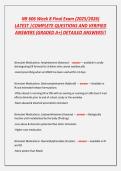
Stimulant Medications: Amphetamine (Adzenys) - - answer ---available in orally
disintegrating ER formula for children who cannot swallow pills
-Avoid prescribing when an MAOI has been used within 14 days
Stimulant Medications: Dextroamphetamine (Adderall) - - answer ---Available in
IR and extended-release formulations
-Often dosed in morning (IR or XR) with an evening or evening prn (IR) dose if med
effects diminish prior to end of school, study or the workday
-Most abused & diverted prescription stimulant
Stimulant Medications: Lisdexamfetamine (Vyvanse) - - answer ---Biologically
inactive until metabolized by the body (Prodrug)
-Less abuse & diversion potential than other stimulants
-Higher-cost medication
Stimulant Medications: Dexmethylphenidate (Focalin) - - answer ---Available in IR
and ER
-More potent than Ritalin
,-High risk of adverse effects
ACE: Abuse -Sexual Abuse & Sexual Violence - - answer ---Sexual Abuse & Sexual
Violence
• any interaction between a child and an adult or another child in which the child
is used for the sexual gratification of the perpetrator or an observer
• approx 7% of child maltreatment cases
• may include touching and non-touching behaviors
• long-term consequences for physical & mental health: increased risk for
substance abuse, engagement in risky sexual behaviors, self-cutting or suicidal
behavior, PTSD, depression, anxiety
ACE: Neglect - - answer ---most common forms of child maltreatment
• approx 60% of cases investigated by CPS
-occurs when a parent/caregiver fails to provide for a child's age-appropriate
needs
• food, shelter, clothing, education, medical care, supervision, emotional needs
-can result in long-lasting physical or psychological harm
-often tied to poverty
-may present with poor hygiene, inadequate weight gain, clothing that fits
poorly/is inappropriate for weather
-can disrupt healthy development
ACE: Household Instability - - answer ---may be caused by: parental mental illness,
stress, substance abuse, suicide, presence of violence toward the mother in the
family
,-Children exposed to family instability may struggle socially, cognitively, or
behaviorally.
-instability from the loss of a parent or caregiver due to death, divorce,
abandonment, or incarceration
• 2022, >5.2 million children worldwide lost a parent/caregiver due to COVID
ACE: Cultural Challenges - - answer ---Community Violence
• exposure of a child to acts of interpersonal violence in a public setting by
individuals not intimately connected to the child
• Ex: shootings in public areas, fights, bullying, war or warlike conditions, terrorist
attacks
• often occurs suddenly, without warning
-Bullying
• AKA peer victimization
• form of aggression or harassment
• inflicts social, emotional, physical, or psychological harm on someone a
perpetrator perceives to be less powerful
• Cyberbullying: via text, email, or social media.
-Racism and Structural Racism
• assigning value and providing opportunity based on physical properties such as
skin color
• hate crimes, slurs, discrimination, marginalization, prejudice
• major life stressor for Black youth
, Effects of Bullying - - answer ---Stress, anxiety, or depression
-Traumatic stress reactions
-Anger or frustration
-Isolation or loneliness
-Poor self-esteem or self-image
-School avoidance or poor school performance
-Separation anxiety
-Health complaints
-Self-injury
-Eating disorders
-Suicidal or homicidal ideations or actions
Consequences of ACEs - - answer --Untreated, short- & long-term health
outcomes
-immediate physical danger
-cumulative & prolonged stress
-Toxic stress can disrupt brain development
• negative forms of stress
• cortisol produced
-stress response system constantly activated and other neuropathways not
getting as much energy
-Parts of the brain that might be weakened, those regulating complex functions
like:
• emotional self-regulation
• social interactions
LATEST |COMPLETE QUESTIONS AND VERIFIED
ANSWERS (GRADED A+) DETAILED ANSWERS!!
Stimulant Medications: Amphetamine (Adzenys) - - answer ---available in orally
disintegrating ER formula for children who cannot swallow pills
-Avoid prescribing when an MAOI has been used within 14 days
Stimulant Medications: Dextroamphetamine (Adderall) - - answer ---Available in
IR and extended-release formulations
-Often dosed in morning (IR or XR) with an evening or evening prn (IR) dose if med
effects diminish prior to end of school, study or the workday
-Most abused & diverted prescription stimulant
Stimulant Medications: Lisdexamfetamine (Vyvanse) - - answer ---Biologically
inactive until metabolized by the body (Prodrug)
-Less abuse & diversion potential than other stimulants
-Higher-cost medication
Stimulant Medications: Dexmethylphenidate (Focalin) - - answer ---Available in IR
and ER
-More potent than Ritalin
,-High risk of adverse effects
ACE: Abuse -Sexual Abuse & Sexual Violence - - answer ---Sexual Abuse & Sexual
Violence
• any interaction between a child and an adult or another child in which the child
is used for the sexual gratification of the perpetrator or an observer
• approx 7% of child maltreatment cases
• may include touching and non-touching behaviors
• long-term consequences for physical & mental health: increased risk for
substance abuse, engagement in risky sexual behaviors, self-cutting or suicidal
behavior, PTSD, depression, anxiety
ACE: Neglect - - answer ---most common forms of child maltreatment
• approx 60% of cases investigated by CPS
-occurs when a parent/caregiver fails to provide for a child's age-appropriate
needs
• food, shelter, clothing, education, medical care, supervision, emotional needs
-can result in long-lasting physical or psychological harm
-often tied to poverty
-may present with poor hygiene, inadequate weight gain, clothing that fits
poorly/is inappropriate for weather
-can disrupt healthy development
ACE: Household Instability - - answer ---may be caused by: parental mental illness,
stress, substance abuse, suicide, presence of violence toward the mother in the
family
,-Children exposed to family instability may struggle socially, cognitively, or
behaviorally.
-instability from the loss of a parent or caregiver due to death, divorce,
abandonment, or incarceration
• 2022, >5.2 million children worldwide lost a parent/caregiver due to COVID
ACE: Cultural Challenges - - answer ---Community Violence
• exposure of a child to acts of interpersonal violence in a public setting by
individuals not intimately connected to the child
• Ex: shootings in public areas, fights, bullying, war or warlike conditions, terrorist
attacks
• often occurs suddenly, without warning
-Bullying
• AKA peer victimization
• form of aggression or harassment
• inflicts social, emotional, physical, or psychological harm on someone a
perpetrator perceives to be less powerful
• Cyberbullying: via text, email, or social media.
-Racism and Structural Racism
• assigning value and providing opportunity based on physical properties such as
skin color
• hate crimes, slurs, discrimination, marginalization, prejudice
• major life stressor for Black youth
, Effects of Bullying - - answer ---Stress, anxiety, or depression
-Traumatic stress reactions
-Anger or frustration
-Isolation or loneliness
-Poor self-esteem or self-image
-School avoidance or poor school performance
-Separation anxiety
-Health complaints
-Self-injury
-Eating disorders
-Suicidal or homicidal ideations or actions
Consequences of ACEs - - answer --Untreated, short- & long-term health
outcomes
-immediate physical danger
-cumulative & prolonged stress
-Toxic stress can disrupt brain development
• negative forms of stress
• cortisol produced
-stress response system constantly activated and other neuropathways not
getting as much energy
-Parts of the brain that might be weakened, those regulating complex functions
like:
• emotional self-regulation
• social interactions

