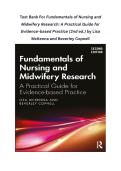
Test Bank For Fundamentals of Nursing and
Midwifery Research: A Practical Guide for
Evidence-based Practice (2nd ed.) by Lisa
McKenna and Beverley Copnell
,Section 1: How Do I Find and Use Evidence?
● Chapter 1: What is evidence and why do I need to understand research?
● Chapter 2: Locating evidence
Section 2: How Can I Make Sense of Research Evidence?
● Chapter 3: Understanding how research is done
● Chapter 4: Understanding quantitative research approaches
● Chapter 5: Understanding qualitative research approaches
Section 3: How Do I Critically Evaluate Research Studies?
● Chapter 6: Critiquing research
● Chapter 7: Ethics and research in nursing and midwifery
Section 4: How Do I Use Evidence to Inform My Practice?
● Chapter 8: Applying evidence in practice
● Chapter 9: Writing effective reviews of literature
● Chapter 10: Sharing research
Section 5: How Do I Pursue a Nursing or Midwifery Research Future?
● Chapter 11: Research pathways for nurses and midwives
,Chapter 1: What is evidence and why do I need to understand
research?
1. A nurse is reviewing a new clinical guideline for post-operative wound care.
According to the textbook's definition of "evidence" in nursing and midwifery, what
is the primary source of this information?
A. The shared clinical experiences of senior nursing staff on the ward.
B. Information generated through research that supports practice.
C. Traditional practices that have been passed down through pre-registration courses.
D. Direct instructions provided by the hospital’s surgical department.
Correct Answer: B
Explanation: The textbook explicitly defines evidence as "information, generated through
research, that supports nursing and midwifery practice". While other factors like traditional
knowledge exist, they are no longer considered appropriate as the sole basis for
contemporary care.
2. A midwife decides to continue using a traditional birthing technique simply
because "it has always been done this way," despite new research suggesting a
more effective method. What is the primary risk of this decision?
A. The midwife will be unable to mentor junior staff effectively.
B. Patients may receive inappropriate or ineffective care.
C. The hospital may lose its accreditation for midwifery services.
D. The midwife will be required to undergo immediate remedial training.
Correct Answer: B
Explanation: When health professionals choose to continue with outdated practices
rather than adopting new evidence, patients are put at risk of receiving inappropriate or
ineffective care, or may face an increased risk of complications.
3. When following the consistent and systematic research process, what is the
primary purpose of conducting a literature review before starting a new study?
A. To fulfill the requirements for ethical approval from a committee.
B. To identify a gap in the existing literature indicating a need for new research.
C. To determine the mathematical calculations needed for data analysis.
, D. To recruit potential participants from previously published studies.
Correct Answer: B
Explanation: A literature review is conducted to explore existing studies to see if a
problem has already been addressed. If a gap is found, it provides the justification and
background for a new study to be developed.
4. According to professional practice standards in Australia (NMBA, 2016), which
statement best describes the responsibility of a Registered Nurse (RN) regarding
evidence?
A. RNs must conduct original primary research at least once every three years.
B. RNs use the best available evidence to make decisions and provide safe, quality
practice.
C. RNs should only use evidence if they have been specifically trained in statistical
analysis.
D. RNs are primarily responsible for generating new evidence rather than using it.
Correct Answer: B
Explanation: The Registered Nurse Standards for Practice (2016) in Australia state that
"RNs use a variety of thinking strategies and the best available evidence in making
decisions and providing safe, quality nursing practice".
5. A nursing student is learning about the hierarchy of evidence. Which of the
following sources is generally considered the most credible and sits at the top of the
evidence pyramid?
A. Editorials and letters to the editor.
B. Case controlled studies and case reports.
C. Systematic reviews and meta-analyses.
D. Expert opinion and discussion papers.
Correct Answer: C
Explanation: In the hierarchy of evidence, the highest level of credibility is usually
accorded to systematic reviews and meta-analyses.
6. A researcher is planning a study that involves interviewing patients about their
experiences. Which step in the research process is mandatory to ensure
participants' rights are adhered to and they are not put at unnecessary risk?
Midwifery Research: A Practical Guide for
Evidence-based Practice (2nd ed.) by Lisa
McKenna and Beverley Copnell
,Section 1: How Do I Find and Use Evidence?
● Chapter 1: What is evidence and why do I need to understand research?
● Chapter 2: Locating evidence
Section 2: How Can I Make Sense of Research Evidence?
● Chapter 3: Understanding how research is done
● Chapter 4: Understanding quantitative research approaches
● Chapter 5: Understanding qualitative research approaches
Section 3: How Do I Critically Evaluate Research Studies?
● Chapter 6: Critiquing research
● Chapter 7: Ethics and research in nursing and midwifery
Section 4: How Do I Use Evidence to Inform My Practice?
● Chapter 8: Applying evidence in practice
● Chapter 9: Writing effective reviews of literature
● Chapter 10: Sharing research
Section 5: How Do I Pursue a Nursing or Midwifery Research Future?
● Chapter 11: Research pathways for nurses and midwives
,Chapter 1: What is evidence and why do I need to understand
research?
1. A nurse is reviewing a new clinical guideline for post-operative wound care.
According to the textbook's definition of "evidence" in nursing and midwifery, what
is the primary source of this information?
A. The shared clinical experiences of senior nursing staff on the ward.
B. Information generated through research that supports practice.
C. Traditional practices that have been passed down through pre-registration courses.
D. Direct instructions provided by the hospital’s surgical department.
Correct Answer: B
Explanation: The textbook explicitly defines evidence as "information, generated through
research, that supports nursing and midwifery practice". While other factors like traditional
knowledge exist, they are no longer considered appropriate as the sole basis for
contemporary care.
2. A midwife decides to continue using a traditional birthing technique simply
because "it has always been done this way," despite new research suggesting a
more effective method. What is the primary risk of this decision?
A. The midwife will be unable to mentor junior staff effectively.
B. Patients may receive inappropriate or ineffective care.
C. The hospital may lose its accreditation for midwifery services.
D. The midwife will be required to undergo immediate remedial training.
Correct Answer: B
Explanation: When health professionals choose to continue with outdated practices
rather than adopting new evidence, patients are put at risk of receiving inappropriate or
ineffective care, or may face an increased risk of complications.
3. When following the consistent and systematic research process, what is the
primary purpose of conducting a literature review before starting a new study?
A. To fulfill the requirements for ethical approval from a committee.
B. To identify a gap in the existing literature indicating a need for new research.
C. To determine the mathematical calculations needed for data analysis.
, D. To recruit potential participants from previously published studies.
Correct Answer: B
Explanation: A literature review is conducted to explore existing studies to see if a
problem has already been addressed. If a gap is found, it provides the justification and
background for a new study to be developed.
4. According to professional practice standards in Australia (NMBA, 2016), which
statement best describes the responsibility of a Registered Nurse (RN) regarding
evidence?
A. RNs must conduct original primary research at least once every three years.
B. RNs use the best available evidence to make decisions and provide safe, quality
practice.
C. RNs should only use evidence if they have been specifically trained in statistical
analysis.
D. RNs are primarily responsible for generating new evidence rather than using it.
Correct Answer: B
Explanation: The Registered Nurse Standards for Practice (2016) in Australia state that
"RNs use a variety of thinking strategies and the best available evidence in making
decisions and providing safe, quality nursing practice".
5. A nursing student is learning about the hierarchy of evidence. Which of the
following sources is generally considered the most credible and sits at the top of the
evidence pyramid?
A. Editorials and letters to the editor.
B. Case controlled studies and case reports.
C. Systematic reviews and meta-analyses.
D. Expert opinion and discussion papers.
Correct Answer: C
Explanation: In the hierarchy of evidence, the highest level of credibility is usually
accorded to systematic reviews and meta-analyses.
6. A researcher is planning a study that involves interviewing patients about their
experiences. Which step in the research process is mandatory to ensure
participants' rights are adhered to and they are not put at unnecessary risk?