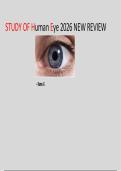
STUDY OF Human Eye 2026 NEW REVIEW
- Ramu G
, SENSORY RECEPTION AND PROCESSING
▪ Have you ever thought how do you see an
object and its color?
• The sensory organs detect all types of
changes in the environment and send
appropriate signals to the CNS, where
all the inputs are processed and
analyzed.
• Signals are then sent to different
parts/centers of the brain.
• This is how you can sense changes in
the environment.
, EYE - Photoreceptor
▪ Eyes are photosensitive organs.
▪ Human eye ball is a hallow ball like situated in the eye orbits of lachrymal bone in the skull.
▪ Only 1/5th part of eye ball is visible from out side in between the eye lashes
▪ Remaining 4/5th part is in the eye orbit.
Orbit
Nictitating
membrane
A normal eye looks like..
NOTE:
Upper eyelid- Movable
Lower eyelid -Immovable
Third eyelid - Plica semilunaris or nictitating membrane(vestigial)
, Eye ball muscles:
▪ 6 skeletal muscles help in rotation
of eye ball within the eye orbit.
▪ These are controlled by III, IV & IV
cranial nerves.
▪ They are:
• 4 rectus muscles
• 2 oblique muscles
- Ramu G
, SENSORY RECEPTION AND PROCESSING
▪ Have you ever thought how do you see an
object and its color?
• The sensory organs detect all types of
changes in the environment and send
appropriate signals to the CNS, where
all the inputs are processed and
analyzed.
• Signals are then sent to different
parts/centers of the brain.
• This is how you can sense changes in
the environment.
, EYE - Photoreceptor
▪ Eyes are photosensitive organs.
▪ Human eye ball is a hallow ball like situated in the eye orbits of lachrymal bone in the skull.
▪ Only 1/5th part of eye ball is visible from out side in between the eye lashes
▪ Remaining 4/5th part is in the eye orbit.
Orbit
Nictitating
membrane
A normal eye looks like..
NOTE:
Upper eyelid- Movable
Lower eyelid -Immovable
Third eyelid - Plica semilunaris or nictitating membrane(vestigial)
, Eye ball muscles:
▪ 6 skeletal muscles help in rotation
of eye ball within the eye orbit.
▪ These are controlled by III, IV & IV
cranial nerves.
▪ They are:
• 4 rectus muscles
• 2 oblique muscles