
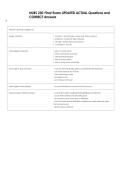
NURS 230 Final Exam UPDATED ACTUAL Questions and
CORRECT Answers
)
Infection Control (4) & Hygiene (3)
Stages of Infection 1. incubation - after pathogen invades body, before symptoms
2. prodromal - nonspecific signs of disease
3. full stage - specific signs and symptoms
4. convalescent - recovery
Hand Hygiene: 5 Moments 1. before touching patient
2. before clean/aseptic procedure
3. after body fluid exposure
4. after touching a patient
5. after touching patient surroundings
Hand Hygiene: Soap and Water - must use when hands visibly soiled or contaminated with body fluids
- rub hands vigorously for 15-20 sec
- rinse under running water
- dry fingers to wrist
- turn off faucet with towel
Hand Hygiene: Alcohol-based - use recommended amount and rub till hands are dry
Surgical Asepsis: "Sterile Technique" - avoid staff or patient coughing/sneezing/talking over sterile field
- touch sterile materials only with sterile gloves
- do not reach across or turn back on sterile field
- one-inch border around sterile field considered non-sterile; discard any item
that touches border
- all items above waist-level
, Standard Precaution - use with all patients
- applies to all body fluids (except sweat),
nonintact skin, and mucous membranes
- protects patient, nurse, and other patients
Standard Precaution: Nursing Interventions - hand hygiene
- clean gloves when touching all body fluids, nonintact skin, mucous membranes,
contaminated equipment and articles
- remove gloves and complete hand hygiene between each client
- mask, eye protection, face shield when
splashing may occur
- properly clean equipment, bag laundry
- needle safety
Transmission Precautions - standard precautions plus additional level of precaution
- client specific - based on specific pathogen
- aka isolation precautions
- requires private room
Transmission Precautions: Types - contact
- droplet
- airborne
*wear PPE upon entry; remove after leaving; hand hygiene
Contact Precaution - used for known or suspected
contagious disease
- multidrug resistant organisms
(MDROs), draining wounds, enteric
diseases
- required PPE: gown, gloves
- limit movement of the patient out of
the room
- avoid sharing patient-care
equipment
Contact Precaution: Common MDROs - MRSA: methicillin resistant staphylococcus aureus
- VRE: vancomycin reistant enterococcus
Droplet Precautions - infections spread by large-
particle droplets
- influenza, rubella, mumps
- transport patient out of room
only when necessary; place
surgical mask on patient
- may have room to door open
- require PPE: surgical mask
Airborne Precautions - infections spread through air (TB, varicella, measles)
- patient placed in negative pressure room
- keep door closed
- transport patient out of room only when necessary (place surgical mask on
patient)
- require PPE: N95 mask or respirator
CORRECT Answers
)
Infection Control (4) & Hygiene (3)
Stages of Infection 1. incubation - after pathogen invades body, before symptoms
2. prodromal - nonspecific signs of disease
3. full stage - specific signs and symptoms
4. convalescent - recovery
Hand Hygiene: 5 Moments 1. before touching patient
2. before clean/aseptic procedure
3. after body fluid exposure
4. after touching a patient
5. after touching patient surroundings
Hand Hygiene: Soap and Water - must use when hands visibly soiled or contaminated with body fluids
- rub hands vigorously for 15-20 sec
- rinse under running water
- dry fingers to wrist
- turn off faucet with towel
Hand Hygiene: Alcohol-based - use recommended amount and rub till hands are dry
Surgical Asepsis: "Sterile Technique" - avoid staff or patient coughing/sneezing/talking over sterile field
- touch sterile materials only with sterile gloves
- do not reach across or turn back on sterile field
- one-inch border around sterile field considered non-sterile; discard any item
that touches border
- all items above waist-level
, Standard Precaution - use with all patients
- applies to all body fluids (except sweat),
nonintact skin, and mucous membranes
- protects patient, nurse, and other patients
Standard Precaution: Nursing Interventions - hand hygiene
- clean gloves when touching all body fluids, nonintact skin, mucous membranes,
contaminated equipment and articles
- remove gloves and complete hand hygiene between each client
- mask, eye protection, face shield when
splashing may occur
- properly clean equipment, bag laundry
- needle safety
Transmission Precautions - standard precautions plus additional level of precaution
- client specific - based on specific pathogen
- aka isolation precautions
- requires private room
Transmission Precautions: Types - contact
- droplet
- airborne
*wear PPE upon entry; remove after leaving; hand hygiene
Contact Precaution - used for known or suspected
contagious disease
- multidrug resistant organisms
(MDROs), draining wounds, enteric
diseases
- required PPE: gown, gloves
- limit movement of the patient out of
the room
- avoid sharing patient-care
equipment
Contact Precaution: Common MDROs - MRSA: methicillin resistant staphylococcus aureus
- VRE: vancomycin reistant enterococcus
Droplet Precautions - infections spread by large-
particle droplets
- influenza, rubella, mumps
- transport patient out of room
only when necessary; place
surgical mask on patient
- may have room to door open
- require PPE: surgical mask
Airborne Precautions - infections spread through air (TB, varicella, measles)
- patient placed in negative pressure room
- keep door closed
- transport patient out of room only when necessary (place surgical mask on
patient)
- require PPE: N95 mask or respirator

