
UBC CHEM 123 PS04: Entropy and Gibbs Free Energy Page 1 of 13
For all questions, assume that the given values are good to 4 significant figures.
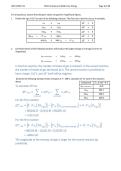
1. Predict the sign of ∆S° for each of the following reactions. The first one is done for you as an example.
I2(s) → I2(g) ∆S° > 0
Cl2(g) → 2 Cl(g) ∆S° > 0
H2O(g) → H2O(l) ∆S° < 0
Ag+(aq) + Cl– (aq) → AgCl(s) ∆S° < 0
NH4Cl(s) → NH4+(aq) + Cl– (aq) ∆S° > 0
2. (a) Predict which of the following reactions will produce the largest change in entropy (in terms of
magnitude).
S8(s, orthorhombic) + 8 O2(g) → 8 SO2(g)
S8(s, orthorhombic) + 12 O2(g) → 8 SO3(g)
In the first reaction, the number of moles of gas is constant. In the second reaction,
the number of moles of gas decreases by 4. The second reaction is predicted to
have a larger |∆S°|, and ∆S° itself will be negative.
(b) Given the following standard molar entropies at T = 298 K, calculate ∆S° for each of the reactions
above. Compound S° (J mol–1 K–1) m
To calculate ∆S°rxn: S8(s, orthorhombic) 31.8
O2(g) 205.1
∆𝑆𝑆°𝑟𝑟𝑟𝑟𝑟𝑟 = � 𝑣𝑣𝑖𝑖 ∆𝑆𝑆°𝑚𝑚 − � 𝑣𝑣𝑖𝑖 ∆𝑆𝑆°𝑚𝑚
SO2(g) 248.2
𝑖𝑖=𝑝𝑝𝑝𝑝𝑝𝑝𝑝𝑝 𝑖𝑖=𝑟𝑟𝑟𝑟𝑟𝑟𝑟𝑟𝑟𝑟
SO3(g) 256.8
For the first reaction:
∆𝑆𝑆°𝑟𝑟𝑟𝑟𝑟𝑟 = �8 ∙ 𝑆𝑆°𝑚𝑚 �𝑆𝑆𝑂𝑂2 (𝑔𝑔) �� − �𝑆𝑆°𝑚𝑚 �𝑆𝑆8 (𝑠𝑠,𝑜𝑜𝑜𝑜𝑜𝑜ℎ𝑜𝑜𝑜𝑜ℎ𝑜𝑜𝑜𝑜𝑜𝑜𝑜𝑜𝑜𝑜) � + 8 ∙ 𝑆𝑆°𝑚𝑚 �𝑂𝑂2 (𝑔𝑔) ��
= (8)(248.2) – [(1)(31.8) + (8)(205.1)]
= +313.0 J/K
For the first reaction:
∆𝑆𝑆°𝑟𝑟𝑟𝑟𝑟𝑟 = �8 ∙ 𝑆𝑆°𝑚𝑚 �𝑆𝑆𝑂𝑂3 (𝑔𝑔) �� − �𝑆𝑆°𝑚𝑚 �𝑆𝑆8 (𝑠𝑠,𝑜𝑜𝑜𝑜𝑜𝑜ℎ𝑜𝑜𝑜𝑜ℎ𝑜𝑜𝑜𝑜𝑜𝑜𝑜𝑜𝑜𝑜) � + 12 ∙ 𝑆𝑆°𝑚𝑚 �𝑂𝑂2 (𝑔𝑔) ��
= (8)(256.8) – [(1)(31.8) + (12)(205.1)]
= –438.6 J/K
The magnitude of the entropy change is larger for the second reaction (as
predicted).
, UBC CHEM 123 PS04: Entropy and Gibbs Free Energy Page 2 of 13
3. For each of the following hypothetical processes, indicate the signs of ∆Ssys, ∆Ssurr, and ∆Suniv as positive (+),
negative (–), or zero (0). In the last column, indicate if the process would be spontaneous under these
conditions.
Sign of Sign of Sign of Spontaneous?
Process
∆Ssys ∆Ssurr ∆Suniv Yes or No
An ice cube (the system) melting at T = 298 K
and P = 1 atm. + – + Yes
A block of dry ice, CO2(s), (the system) subliming into
CO2(g) at T = 298 K and P = 1 atm. + – + Yes
An ice cube (the system) subliming (s → g)
at T = 298 K and P = 1 atm. + – – No
4. The change in enthalpy associated with boiling 1.00 mole of water at T = 100°C and P = 1.00 atm is ∆H° =
+40.7 kJ. What are ∆Ssys, ∆Ssurr, and ∆Suniv for this reversible process?
For a constant pressure process, q = ∆H = +40.7 kJ
For a constant temperature process:
qrev,sys +40700 J
∆Ssys = = = +109 J/K
Tsys 373 K
Since this process is reversible, ∆Suniv = 0, and so ∆Ssurr = –∆Ssys = –109 J/K.
[Note: you could also calculate ∆Ssurr using qsys = –qsurr, and then calculate ∆Suniv.]
5. The equilibrium melting point of p-nitrotoluene is T = 324.8 K at P = 1.00 atm. The standard molar
enthalpy of fusion (melting) is 16.81 kJ/mol. Calculate ∆Ssys, ∆Ssurr, and ∆Suniv for the complete melting of
one mole of p-nitrotoluene under equilibrium conditions.
For a constant pressure process, q = ∆H = +16.81 kJ
For a constant temperature process:
qrev,sys +16810 J
∆Ssys = = = +51.75 J/K
Tsys 324.8 K
Since this process is reversible, ∆Suniv = 0, and so ∆Ssurr = –∆Ssys = –51.75 J/K.
[Note: you could also calculate ∆Ssurr using qsys = –qsurr, and then calculate ∆Suniv.]

