

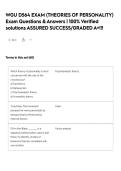
WGU D564 EXAM (THEORIES OF PERSONALITY)
Exam Questions & Answers | 100% Verified
solutions ASSURED SUCCESS/GRADED A+!!!
Save
Terms in this set (60)
Which theory of personality is most Psychoanalytic theory
concerned with the role of the
unconscious?
a) Trait theory
b) Behaviorism
c) Psychoanalytic theory
d) Humanistic theory
True/False: The humanistic False
perspective views personality as
being primarily influenced by
external factors
Fill-in-the-Blank: ___________ is a Factor analysis
statistical method often used in trait
theory to identify clusters of
behaviors that are correlated with
one another.
, Which of the following is not a key Collective unconscious
component of Bandura's social
cognitive theory?
a) Reciprocal determinism
b) Self-efficacy
c) Collective unconscious
d) Observational learning
True/False: The Big Five personality True
traits are openness,
conscientiousness, extraversion,
agreeableness, and neuroticism.
Fill-in-the-Blank: The ___________ Oedipus
complex is a concept in
psychoanalytic theory that refers to a
child's feelings of desire for the
opposite-sex parent and jealousy
toward the same-sex parent.
Which personality assessment tool is Thematic Apperception Test (TAT)
based on the projective hypothesis?
a) Minnesota Multiphasic Personality
Inventory (MMPI) b) Thematic
Apperception Test (TAT)c) Myers-
Briggs Type Indicator (MBTI)d) 16
Personality Factor Questionnaire
(16PF
True/False: According to Erikson's False
stages of psychosocial development,
trust versus mistrust is the stage that
occurs during adolescence.
Exam Questions & Answers | 100% Verified
solutions ASSURED SUCCESS/GRADED A+!!!
Save
Terms in this set (60)
Which theory of personality is most Psychoanalytic theory
concerned with the role of the
unconscious?
a) Trait theory
b) Behaviorism
c) Psychoanalytic theory
d) Humanistic theory
True/False: The humanistic False
perspective views personality as
being primarily influenced by
external factors
Fill-in-the-Blank: ___________ is a Factor analysis
statistical method often used in trait
theory to identify clusters of
behaviors that are correlated with
one another.
, Which of the following is not a key Collective unconscious
component of Bandura's social
cognitive theory?
a) Reciprocal determinism
b) Self-efficacy
c) Collective unconscious
d) Observational learning
True/False: The Big Five personality True
traits are openness,
conscientiousness, extraversion,
agreeableness, and neuroticism.
Fill-in-the-Blank: The ___________ Oedipus
complex is a concept in
psychoanalytic theory that refers to a
child's feelings of desire for the
opposite-sex parent and jealousy
toward the same-sex parent.
Which personality assessment tool is Thematic Apperception Test (TAT)
based on the projective hypothesis?
a) Minnesota Multiphasic Personality
Inventory (MMPI) b) Thematic
Apperception Test (TAT)c) Myers-
Briggs Type Indicator (MBTI)d) 16
Personality Factor Questionnaire
(16PF
True/False: According to Erikson's False
stages of psychosocial development,
trust versus mistrust is the stage that
occurs during adolescence.

