
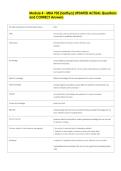
Module 4 - MBA 703 (Sadhya) UPDATED ACTUAL Questions
and CORRECT Answers
The third comp9onent of an information system Data
Data the raw facts, and may be devoid of context or intent. Can be quantitative
(numerical) or qualitative (descriptive)
Information Processed data that possess context, relevance, and
purpose.
involves the manipulation of raw data to obtain an
indication of magnitude, trends, in patterns in the data for a purpose
Knowledge Human beliefs or perceptions about relationships among facts or concepts
relevant to that area.
information that facilitates action: can be used to make decisions, set policies, and
even spark innovation
Explicit knowledge Refers to knowledge that can be expressed into words or numbers
Tacit knowledge includes insights and intuitions, and is difficult to transfer to another person by
means of simple communications
Wisdom the combination of knowledge and experience to produce a deeper
understanding of a topic.
2 types of knowledge explicit and tacit
Big Data Massively large data sets that conventional data processing technologies do not
have sufficient power to analyze them.
Goal of many ISs transform data into information in order to generate knowledge that can be used
for decision making
Common defects in data resource management 1. No control of redundant data (challenging updates)
2. Violation of data integrity (consistency among the stored data)
3. Relying on human memory to store and to search needed data
database a collection of organized data that allows access, retrieval, and use of data
a spreadsheet does not replace this, but can be a good tool or analyzing stored
data
, data model of a database The logical structure of data items and their relationships.
Types:
1. relational database (most used)
2.Hierarchal database
3. document-centric database
4. NoSQL database
Relational database Data is organized into tables (or relations). Each table has a set of fields (columns)
which define the structure of the data stored in the table.
A record is one instance of a set of fields (row or tuple) in a table.
Every table in the database should have a field in common with at least one other
table (in other words, they should have relationships with each other)
Primary Key A field (or group of fields) that uniquely identifies a given entity in a table. - the
unique identifier.
Relational Database design 1. determine the tables needed in the database
2. determine the specific data needed to be in each of the tables
3. Establish a common with at least 1 other table for all tables
4. select a primary key for each table (either a single field or combination of fields)
5. identify and make the relationships between the tables so that you can pull the
data together in meaningful ways via a foreign key
foreign key A primary key of one table that appears as an attribute in another table and acts
to provide a logical relationship between the two tables
Normalization Design of a database that: 1) reduces data redundancy; and 2) ensure data
integrity.
Data Type Required to be assigned to every field in a database.
Common data types 1. Text: non-numeric data typically <256 characters
2. Number
3. Boolean
4. Date/Time (special number format)
5. Currency (special number format)
6. paragraph text (text >256 characters)
7. Object (data that cannot be entered via a keyboard)
Boolean a data type with only two possible values, such as 0 or
1, "true" or "false", "yes" or "no".
2 reasons why is it important to define the data type 1. a data type tells the database what
functions can be performed with the data.
2. the proper amount of storage space is allocated for our data
In order for the data in the database to be stored, read, a software program must access it.
changed, added, or removed,.....
and CORRECT Answers
The third comp9onent of an information system Data
Data the raw facts, and may be devoid of context or intent. Can be quantitative
(numerical) or qualitative (descriptive)
Information Processed data that possess context, relevance, and
purpose.
involves the manipulation of raw data to obtain an
indication of magnitude, trends, in patterns in the data for a purpose
Knowledge Human beliefs or perceptions about relationships among facts or concepts
relevant to that area.
information that facilitates action: can be used to make decisions, set policies, and
even spark innovation
Explicit knowledge Refers to knowledge that can be expressed into words or numbers
Tacit knowledge includes insights and intuitions, and is difficult to transfer to another person by
means of simple communications
Wisdom the combination of knowledge and experience to produce a deeper
understanding of a topic.
2 types of knowledge explicit and tacit
Big Data Massively large data sets that conventional data processing technologies do not
have sufficient power to analyze them.
Goal of many ISs transform data into information in order to generate knowledge that can be used
for decision making
Common defects in data resource management 1. No control of redundant data (challenging updates)
2. Violation of data integrity (consistency among the stored data)
3. Relying on human memory to store and to search needed data
database a collection of organized data that allows access, retrieval, and use of data
a spreadsheet does not replace this, but can be a good tool or analyzing stored
data
, data model of a database The logical structure of data items and their relationships.
Types:
1. relational database (most used)
2.Hierarchal database
3. document-centric database
4. NoSQL database
Relational database Data is organized into tables (or relations). Each table has a set of fields (columns)
which define the structure of the data stored in the table.
A record is one instance of a set of fields (row or tuple) in a table.
Every table in the database should have a field in common with at least one other
table (in other words, they should have relationships with each other)
Primary Key A field (or group of fields) that uniquely identifies a given entity in a table. - the
unique identifier.
Relational Database design 1. determine the tables needed in the database
2. determine the specific data needed to be in each of the tables
3. Establish a common with at least 1 other table for all tables
4. select a primary key for each table (either a single field or combination of fields)
5. identify and make the relationships between the tables so that you can pull the
data together in meaningful ways via a foreign key
foreign key A primary key of one table that appears as an attribute in another table and acts
to provide a logical relationship between the two tables
Normalization Design of a database that: 1) reduces data redundancy; and 2) ensure data
integrity.
Data Type Required to be assigned to every field in a database.
Common data types 1. Text: non-numeric data typically <256 characters
2. Number
3. Boolean
4. Date/Time (special number format)
5. Currency (special number format)
6. paragraph text (text >256 characters)
7. Object (data that cannot be entered via a keyboard)
Boolean a data type with only two possible values, such as 0 or
1, "true" or "false", "yes" or "no".
2 reasons why is it important to define the data type 1. a data type tells the database what
functions can be performed with the data.
2. the proper amount of storage space is allocated for our data
In order for the data in the database to be stored, read, a software program must access it.
changed, added, or removed,.....

