
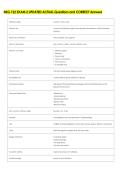
NSG 122 EXAM 2 UPDATED ACTUAL Questions and CORRECT Answers
Infectious agent bacteria, viruses, fungi
Portal of exit a way for the infectious agent to escape from the reservoir in which it has been
growing
Reservoirs of infection Natural habitat of the organism
Means of transmission direct contact, indirect contact, airborne route
Infection cycle Steps 1. Infectious agent
2. Reservoir
3. Portal of exit
4. Means of transmission
5. Portal of entry
6. Susceptible host
Portal of entry Part of the body where organisms enter
Susceptible host a person likely to get an infection or disease
Transmission barriers help prevent the transporting of pathogens from the infected person to the
general environment.
Common Portals of Exit -Respiratory
-Gastrointestinal
-Genitourinary tracts
-Breaks in skin
-Blood and tissue
Most common infectious agent bacteria, virus, fungi
bacteria most significant and most prevalent in hospital settings
virus smallest of all microorganisms; can be seen only by using an electron microscope
Fungi Plant-like organisms present in air, soil, and water
Stages of Infection Incubation period
Prodromal stage
Full stage illness
Convalescent period
Incubation period organism growing and multiplying
Prodromal stage person is most infectious
, Full stage illness Presence of specific signs and symptoms of disease
Convalescent period Recovery from the infection
Hand hygiene is the priority intervention for decreasing the spread of infection.
Prodromal Stage During which stage of infection is the patient most contagious
Body's Defense Against Infection -Normal flora in the body
-Inflammatory response
-Immune response
Cardinal Sign of Acute Infection -Redness
-Heat
-Swelling
-Pain
-Loss of function
Data Indicating Infection -Elevated white blood cells count from 5,00-10,000
-Increase in specific types of white blood cells
-Elevated erythrocyte sedimentation rate
-Presence of pathogen in urine, blood, sputum, or draining cultures
Vancomycin resistant enterococcus is spread by direct contact, so use of a gown to prevent contact with the client or
client-contaminated items is appropriate
Four categories Responsible for Majority of Hospital- -Catheter-associated urinary tract infection (CAUTI)
Acquired Infections -Surgical site infection (SSI)
-Central-line associated bloodstream infection (CLABSI)
-Ventilator-associated pneumonia (VAP)
Types of Hospital Acquired Infections -Bloodstream Infection
-Ventilator-associated Pneumonia
-UTI
Transmission Based Precautions -Airborne
-Droplet
-Contact
Airborne examples -TB
-Varicella (Chicken pox)
-Rubeola (Measles)
Droplet Examples -Flu
-Meningitis
-Mumps
-Pneumonia
Contact Example -Methicillin-resistant staphylococcus aureus (MRSA)
-Vancomycin-resistant enterococcus
-C.Diff
Infectious agent bacteria, viruses, fungi
Portal of exit a way for the infectious agent to escape from the reservoir in which it has been
growing
Reservoirs of infection Natural habitat of the organism
Means of transmission direct contact, indirect contact, airborne route
Infection cycle Steps 1. Infectious agent
2. Reservoir
3. Portal of exit
4. Means of transmission
5. Portal of entry
6. Susceptible host
Portal of entry Part of the body where organisms enter
Susceptible host a person likely to get an infection or disease
Transmission barriers help prevent the transporting of pathogens from the infected person to the
general environment.
Common Portals of Exit -Respiratory
-Gastrointestinal
-Genitourinary tracts
-Breaks in skin
-Blood and tissue
Most common infectious agent bacteria, virus, fungi
bacteria most significant and most prevalent in hospital settings
virus smallest of all microorganisms; can be seen only by using an electron microscope
Fungi Plant-like organisms present in air, soil, and water
Stages of Infection Incubation period
Prodromal stage
Full stage illness
Convalescent period
Incubation period organism growing and multiplying
Prodromal stage person is most infectious
, Full stage illness Presence of specific signs and symptoms of disease
Convalescent period Recovery from the infection
Hand hygiene is the priority intervention for decreasing the spread of infection.
Prodromal Stage During which stage of infection is the patient most contagious
Body's Defense Against Infection -Normal flora in the body
-Inflammatory response
-Immune response
Cardinal Sign of Acute Infection -Redness
-Heat
-Swelling
-Pain
-Loss of function
Data Indicating Infection -Elevated white blood cells count from 5,00-10,000
-Increase in specific types of white blood cells
-Elevated erythrocyte sedimentation rate
-Presence of pathogen in urine, blood, sputum, or draining cultures
Vancomycin resistant enterococcus is spread by direct contact, so use of a gown to prevent contact with the client or
client-contaminated items is appropriate
Four categories Responsible for Majority of Hospital- -Catheter-associated urinary tract infection (CAUTI)
Acquired Infections -Surgical site infection (SSI)
-Central-line associated bloodstream infection (CLABSI)
-Ventilator-associated pneumonia (VAP)
Types of Hospital Acquired Infections -Bloodstream Infection
-Ventilator-associated Pneumonia
-UTI
Transmission Based Precautions -Airborne
-Droplet
-Contact
Airborne examples -TB
-Varicella (Chicken pox)
-Rubeola (Measles)
Droplet Examples -Flu
-Meningitis
-Mumps
-Pneumonia
Contact Example -Methicillin-resistant staphylococcus aureus (MRSA)
-Vancomycin-resistant enterococcus
-C.Diff

