
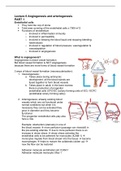
Lecture 6 Angiogenesis and arteriogenesis
PART 1
Endothelial cells
They look like cop of stone
Total area covering of the endothelial cells ± 7000 m^2
Functions of endothelium
o Involved in inflammation immunity
o Involved in permeability
o Involved in keeping the blood liquid and stopping bleeding;
haemostasis
o Involved in regulation of blood pressure; vasoregulation &
vasoadaptation
o Involved in angiogenesis
What is angiogenesis?
Angiogenesis is blood vessel formation
But blood vessel formation is NOT angiogenesis
because there are more forms of blood vessel formation
3 ways of blood vessel formation (neovascularization):
1. Vasculogenesis;
a. Takes place during embryonic
development: all the blood islands are
fused together to form blood vessels
b. Takes place in adult; in the bone marrow
there is production of progenitor
endothelial cells (CFU-EC (colony forming units of EC) / ECFC
(endothelial colony forming cells))
2. Arteriogenesis; already existing blood
vessels which are not functional under
normal conditions but when it is
necessary they can be activated they
grow in diameter and they become
functional.
The progenitor endothelial cells play also
here a role.
Example: obstruction (stenosis) in one of
the blood vessels more perfusion (passage van vloeistof) in
the pre-existing arteriole due to more perfusion there is an
increase in shear stress shear stress activates the
endothelial cells to be adherent for monocytes (ICAM-1)
monocytes migrate from blood stream into the tissue become
macrophages helps to mature the collaterals (widen up)
now the flow can be restored
Adhesion molecule endothelial cell: ICAM-1
Adhesion molecule monocyte: Mac-1
, When they interact the monocyte can migrate into the tissue and they can stop
proliferation and can have lot of production of growth factors and these will
finally end up in activation of endothelial cells so that they will become mature
collateral arteries.
3. Angiogenesis; formation of new blood vessels from
existing blood vessels
The progenitor endothelial cells play also here a role.
Example: An ischemic area (area with lack of oxygen
(hypoxia)) will induce the formation of new sprouts
from the already existing blood vessels.
Why is angiogenesis important / possible applications
Important because involved in:
Development of the fetus; don’t do anything
Female reproduction system; don’t do anything or block anterogenesis (they
become infertile)
Bone and (chronic) wound healing; stimulate anterogenesis
Healing of ischemic tissues and skin ulcers (huidzweren); stimulate
anterogenesis
Growth of many tumors; block anterogenesis
Formation of tissue between jones of rheumatoid arthritis
patients; block anterogenesis
Diabetic retinopathy (blindness); block anterogenesis
Tissue engineering; stimulate anterogenesis
Too much angiogenesis? Lead to blindness of eye
Too little angiogenesis? Lead to non-healing wound
3 forms of angiogenesis:
1. Development angiogenesis: development of the brain,
spleen, kidneys – it is controlled
2. Physiological angiogenesis: female reproduction
system and normal wound healing – it is controlled
3. Repair-associated or pathological angiogenesis:
chronic wound healing, tumor growth, arthritis and
diabetic retinopathy – in this you always find
inflammatory cells, vascular leakage, presence of
fibrin and lack of control
How does angiogenesis take place
Under normal conditions there is no angiogenesis!
Tumor is growing critical tumor mass is formed causes
hypoxia (lack of oxygen) hypoxia activate the whole
system -- infiltration of leukocytes tumor cells and
leukocytes produce inflammatory mediators and angiogenic
growth factors (1 endothelial activation)

