
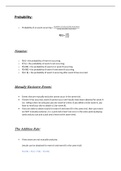
Probability:
𝑛𝑢𝑚𝑏𝑒𝑟 𝑜𝑓 𝑠𝑢𝑐𝑐𝑒𝑠𝑠𝑓𝑢𝑙 𝑜𝑢𝑡𝑐𝑜𝑚𝑒𝑠
o Probability of an event occurring = 𝑡𝑜𝑡𝑎𝑙 𝑝𝑜𝑠𝑠𝑖𝑏𝑙𝑒 𝑜𝑢𝑡𝑐𝑜𝑚𝑒𝑠
𝒏[𝑬]
P[E] = 𝒏 [𝑺]
Notation:
o P[A] = the probability of event A occurring.
o P[‘A] = the probability of event A not occurring.
o P[AUB] = the probability of event A or event B occurring.
o P[AՈB] = the probability of event A and event B occurring.
o P[A I B] = the probability of event A occurring after event B has occurred.
Mutually Exclusive Events:
• Events that are mutually exclusive cannot occur in the same trial.
• If event A has occurred, event B cannot occur until results have been obtained for event A
(i.e. rolling a dice can only give you one result at a time. If you obtain a 6 for event A, you
have to reroll your dice to obtain a 2 for event B).
• If you are able to obtain results for event A and event B in the same trial, then your event
are NOT mutually exclusive. (i.e. a jack and a heart can occur in the same pack of playing
cards and you can pick a jack and a heart at the same time).
The Addition Rule:
▪ If two event are not mutually exclusive:
(results can be obtained for event A and event B in the same trial)
P(AUB) = P[A] + P[B] – P[AՈB]
, ▪ If two event are mutually exclusive:
(results for event A and event B are obtained separately)
P[AՈB] = 0
P[AUB] = P[A] + P[B] – P[AՈB]
= P[A] + P[B] + [0]
= P[A] + P[B]
Complementary Events:
If two event are complementary:
• P[‘A] = 1 – P[A]
For events to be complementary, two conditions have to be true:
1. The events have to be mutually exclusive.
2. P[A] + P[B] = 1
Dependent and Independent events:
➢ Two events are said to be independent if the outcome of the first event does NOT affect the
outcome of the second event.
Replacement takes place.
➢ Two events are said to be dependent if the outcome of the first event DOES affect the
outcome of the second event.
Replacement does NOT take place.
The Product Rule:
➢ If the events are independent:
P[AՈB] = P[A] X P[A]

