

Ray Optics and Optical Instrument
1. With the help of a suitable ray diagram derive the mirror formula for a concave mirror.
2. Draw a ray diagram to show that image formation by a concave mirror when the object is kept between its
focus and the pole. Using this diagram, derive the magnification formula for the image formed.
3. Calculate the distance of an object of height h from a concave mirror of focal length 10 cm so as to obtain a
real image of magnification 2.
4. Use the mirror equation to show that
(i) An object placed between f and 2f of a concave mirror produces a real image beyond 2f.
(ii) A convex mirror always produces a virtual image independent of the location of the object.
(iii)An object placed between the pole and focus of a concave mirror produces a virtual and enlarged
image.
5. When monochromatic light travels from one medium to another, its wavelength changes but frequency
remains the same, explain.
6. For the same value of angle of incidence, the angles of refraction in three media A, B and C are 150, 250 and
350 respectively. In which medium would the velocity of light be minimum?
7. States the criteria for the phenomenon of total internal reflection of light to take place. Derive the relation
between the refractive index and critical angle for a given pair of optical media.
8. State the principle on which the working of an optical fiber is based. What are the necessary conditions for
this phenomenon to occur?
9. Does critical angle depend on the colour of light? Explain.
10.Draw ray diagrams to show how specially designed prisms make use of total internal reflection to obtain
inverted image of the object by deviation of rays through 900 and through 1800
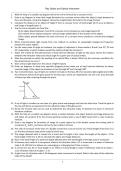
11.Two monochromatic rays of light are incident normally on the face AB of an isosceles right-angled prism ABC,
the refractive indices of the glass prism for the two rays 1 and 2 are respectively 1.35 and 1.45, trace the path
of these rays after entering through the prism.
12.A ray of light is incident on one face of a glass prism and emerges out from the other face. Trace the path of
the ray and derive an expression for the refractive index of the glass prism.
13.Derive the formula that can be used to determine the refractive index of material of a prism in minimum
deviation condition.
14.With the help of a suitable ray diagram derive a relation between the object distance (u) image distance (v)
and radius of curvature R for the convex spherical surface when a ray of light travels from a rarer to denser
medium.
15.Draw a ray diagram for formation of image of a point object by a thin double convex lens having radii of
curvatures 𝑅1 and 𝑅2 and hence derive the lens maker’s formula.
16.The radii of curvature of the faces of a double convex lens as 10 cm and 15 cm, if focal length of the lens is 12
cm find the refractive index of the material of the lens.
17.The image obtained with a convex lens is erect and its length is four times the length of the object . if the
focal length of the lens is 20 cm calculate the object and image distances.
18.How is the focal length of a spherical length affected when the wavelength of the light used is increased?
19.A biconvex lens made of a transparent material of refractive index 1.25 is immersed in a water of refractive
index 1.33. Will the lens behave as a converging or a diverging lens? Give a reason.
20.A convex lens has 20 cm focal length in air. What is its focal length in water? ( Refractive index of air-water =
1.33, refractive index of air-glass = 1.5 ).
21.A glass lens of refractive index 1.45 disappears when immersed in a liquid. What is the value of the refractive
index of the liquid?
1
1. With the help of a suitable ray diagram derive the mirror formula for a concave mirror.
2. Draw a ray diagram to show that image formation by a concave mirror when the object is kept between its
focus and the pole. Using this diagram, derive the magnification formula for the image formed.
3. Calculate the distance of an object of height h from a concave mirror of focal length 10 cm so as to obtain a
real image of magnification 2.
4. Use the mirror equation to show that
(i) An object placed between f and 2f of a concave mirror produces a real image beyond 2f.
(ii) A convex mirror always produces a virtual image independent of the location of the object.
(iii)An object placed between the pole and focus of a concave mirror produces a virtual and enlarged
image.
5. When monochromatic light travels from one medium to another, its wavelength changes but frequency
remains the same, explain.
6. For the same value of angle of incidence, the angles of refraction in three media A, B and C are 150, 250 and
350 respectively. In which medium would the velocity of light be minimum?
7. States the criteria for the phenomenon of total internal reflection of light to take place. Derive the relation
between the refractive index and critical angle for a given pair of optical media.
8. State the principle on which the working of an optical fiber is based. What are the necessary conditions for
this phenomenon to occur?
9. Does critical angle depend on the colour of light? Explain.
10.Draw ray diagrams to show how specially designed prisms make use of total internal reflection to obtain
inverted image of the object by deviation of rays through 900 and through 1800
11.Two monochromatic rays of light are incident normally on the face AB of an isosceles right-angled prism ABC,
the refractive indices of the glass prism for the two rays 1 and 2 are respectively 1.35 and 1.45, trace the path
of these rays after entering through the prism.
12.A ray of light is incident on one face of a glass prism and emerges out from the other face. Trace the path of
the ray and derive an expression for the refractive index of the glass prism.
13.Derive the formula that can be used to determine the refractive index of material of a prism in minimum
deviation condition.
14.With the help of a suitable ray diagram derive a relation between the object distance (u) image distance (v)
and radius of curvature R for the convex spherical surface when a ray of light travels from a rarer to denser
medium.
15.Draw a ray diagram for formation of image of a point object by a thin double convex lens having radii of
curvatures 𝑅1 and 𝑅2 and hence derive the lens maker’s formula.
16.The radii of curvature of the faces of a double convex lens as 10 cm and 15 cm, if focal length of the lens is 12
cm find the refractive index of the material of the lens.
17.The image obtained with a convex lens is erect and its length is four times the length of the object . if the
focal length of the lens is 20 cm calculate the object and image distances.
18.How is the focal length of a spherical length affected when the wavelength of the light used is increased?
19.A biconvex lens made of a transparent material of refractive index 1.25 is immersed in a water of refractive
index 1.33. Will the lens behave as a converging or a diverging lens? Give a reason.
20.A convex lens has 20 cm focal length in air. What is its focal length in water? ( Refractive index of air-water =
1.33, refractive index of air-glass = 1.5 ).
21.A glass lens of refractive index 1.45 disappears when immersed in a liquid. What is the value of the refractive
index of the liquid?
1

