
PURDUE CIVIC LITERACY TEST QUESTIONS &
DETAILED COMPLETE SOLUTIONS PASSED
100%
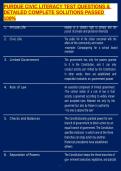
1. Private Life Relates to a citizen's right to privacy and the
pursuit of private and personal interests
2. Civic Life The public life of the citizen concerned with the
affairs of the community and nation
-example: Campaigning for a school board
member
3. Limited Government The government has only the powers granted
to it in the Constitution, and it can only
conduct actions per- mitted by the Constitution.
In other words, there are established and
respected restraints on government power
4. Rule of Law An essential component of limited government.
-The central notion of a rule of law is that
society is governed according to widely known
and accepted rules followed not only by the
governed but also by those in authority
-"no one is above the law"
5. Checks and Balances The Constitutionally granted power for one
branch of government to block action by an
equal branch of government. The Constitution
specifies instances in which one of the three
branches can stop action by another.
Historical precedents have established
others
6. Separation of Powers The Constitution keeps the three branches of
gov- ernment (executive, legislative, and judicial)
1/
16
,PURDUE CIVIC LITERACY TEST QUESTIONS &
DETAILED COMPLETE SOLUTIONS PASSED
100%
separate. The powers and responsibilities of
each is described in a separate Article.
Separation makes each Branch the equal of
the others
2/
16
, PURDUE CIVIC LITERACY TEST QUESTIONS &
DETAILED COMPLETE SOLUTIONS PASSED
100%
7. 14th Amendment (1868) Grants citizenship to "all persons born or
naturalized
in the US"; it forbids any state to deny any person "life,
liberty or property, without due process of law" or
to "deny to any person within its jurisdiction
the equal protection of its laws."
-Most important law ever passed besides original
Constitution and Bill of Rights.
-It has been the vehicle for the expansion of civil
rights, women's rights, gay rights among
other move- ments. It also allowed for the
"incorporation doctrine" which means the
application of the national Bill of Rights to the
states.
8. 15th Amendment (1870) Granted African American men the right to vote
by de-
claring that the "right of citizens of the United States
to vote shall not be denied or abridged by the
United States or by any state on account of
race, color, or previous condition of
servitude."
-Although ratified on February 3, 1870, the promise
of the 15th Amendment would not be fully
realized for almost a century.
-Through the use of poll taxes, literacy tests and oth-
er means, Southern states were able to
ettectively disenfranchise African Americans.
It would take the passage of the Voting Rights
Act of 1965 before the majority of African
3/
16
DETAILED COMPLETE SOLUTIONS PASSED
100%
1. Private Life Relates to a citizen's right to privacy and the
pursuit of private and personal interests
2. Civic Life The public life of the citizen concerned with the
affairs of the community and nation
-example: Campaigning for a school board
member
3. Limited Government The government has only the powers granted
to it in the Constitution, and it can only
conduct actions per- mitted by the Constitution.
In other words, there are established and
respected restraints on government power
4. Rule of Law An essential component of limited government.
-The central notion of a rule of law is that
society is governed according to widely known
and accepted rules followed not only by the
governed but also by those in authority
-"no one is above the law"
5. Checks and Balances The Constitutionally granted power for one
branch of government to block action by an
equal branch of government. The Constitution
specifies instances in which one of the three
branches can stop action by another.
Historical precedents have established
others
6. Separation of Powers The Constitution keeps the three branches of
gov- ernment (executive, legislative, and judicial)
1/
16
,PURDUE CIVIC LITERACY TEST QUESTIONS &
DETAILED COMPLETE SOLUTIONS PASSED
100%
separate. The powers and responsibilities of
each is described in a separate Article.
Separation makes each Branch the equal of
the others
2/
16
, PURDUE CIVIC LITERACY TEST QUESTIONS &
DETAILED COMPLETE SOLUTIONS PASSED
100%
7. 14th Amendment (1868) Grants citizenship to "all persons born or
naturalized
in the US"; it forbids any state to deny any person "life,
liberty or property, without due process of law" or
to "deny to any person within its jurisdiction
the equal protection of its laws."
-Most important law ever passed besides original
Constitution and Bill of Rights.
-It has been the vehicle for the expansion of civil
rights, women's rights, gay rights among
other move- ments. It also allowed for the
"incorporation doctrine" which means the
application of the national Bill of Rights to the
states.
8. 15th Amendment (1870) Granted African American men the right to vote
by de-
claring that the "right of citizens of the United States
to vote shall not be denied or abridged by the
United States or by any state on account of
race, color, or previous condition of
servitude."
-Although ratified on February 3, 1870, the promise
of the 15th Amendment would not be fully
realized for almost a century.
-Through the use of poll taxes, literacy tests and oth-
er means, Southern states were able to
ettectively disenfranchise African Americans.
It would take the passage of the Voting Rights
Act of 1965 before the majority of African
3/
16

