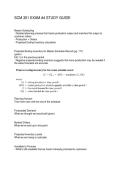
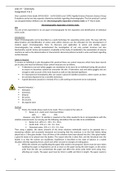
SCM 301 EXAM #4 STUDY GUIDE
Master Scheduling
- Detailed planning process that tracks production output and matches this output to
customer orders
- Production = Orders
- Projected Ending Inventory calculation
Projected Ending Inventory for Master Schedule Record (pg. 171)
(given)
EI(t-1) is the previous period
- Negative projected ending inventory suggests that more production may be needed if
the sales forecasts are accurate
Planning Horizon
Time from now until the end of the schedule
Forecasted Demand
What we thought we would sell (given)
Booked Orders
What we've sold up to this point
Projected Inventory Levels
What we are trying to calculate
Available to Promise
- What's still available that we haven't already promised to customers
,- Negative ATP: the available inventory is oversold and additional units should be
manufactured/purchased
- Part of the Master Schedule Record
Available to Promise (ATP) - pg. 171
(given)
EI(t-1) is the previous period
z-1 is the last week going forward until we produce again
- Only calculate if MPS > 0!!
^^be able to calculate
Bill of Material (BOM)
- A listing of all the things/components that go into making the product
- Provides Product Structure Tree
- Shows low-level coding
^^know this
, Product Structure Tree
Shows how the components in the BOM are put together
^^know this
"Exploding" the BOM
The process of working backward from the master production schedule for a level 0
item (chair) to determine the quantity and timing of orders for the various subassemblies
and components
Planning Lead Time
The time from when a component or material is ordered until it arrives and is ready to
use
Lead Times (pg. 165)
For purchased items and for production???
MRP Record
- Gross Requirements: how many needed? (demand)
- Scheduled Receipts: already on order (given)
- Projected Ending Inventory
- Net Requirements: how many more needed
- Planned Receipts: new orders needed
- Planned Orders: when to order them
**planned receipts ≠ net requirements if there's a minimum order quantity greater than
what's needed
^^on exam, 1 problem where you have to calculate net requirements & planned receipts
Master Scheduling
- Detailed planning process that tracks production output and matches this output to
customer orders
- Production = Orders
- Projected Ending Inventory calculation
Projected Ending Inventory for Master Schedule Record (pg. 171)
(given)
EI(t-1) is the previous period
- Negative projected ending inventory suggests that more production may be needed if
the sales forecasts are accurate
Planning Horizon
Time from now until the end of the schedule
Forecasted Demand
What we thought we would sell (given)
Booked Orders
What we've sold up to this point
Projected Inventory Levels
What we are trying to calculate
Available to Promise
- What's still available that we haven't already promised to customers
,- Negative ATP: the available inventory is oversold and additional units should be
manufactured/purchased
- Part of the Master Schedule Record
Available to Promise (ATP) - pg. 171
(given)
EI(t-1) is the previous period
z-1 is the last week going forward until we produce again
- Only calculate if MPS > 0!!
^^be able to calculate
Bill of Material (BOM)
- A listing of all the things/components that go into making the product
- Provides Product Structure Tree
- Shows low-level coding
^^know this
, Product Structure Tree
Shows how the components in the BOM are put together
^^know this
"Exploding" the BOM
The process of working backward from the master production schedule for a level 0
item (chair) to determine the quantity and timing of orders for the various subassemblies
and components
Planning Lead Time
The time from when a component or material is ordered until it arrives and is ready to
use
Lead Times (pg. 165)
For purchased items and for production???
MRP Record
- Gross Requirements: how many needed? (demand)
- Scheduled Receipts: already on order (given)
- Projected Ending Inventory
- Net Requirements: how many more needed
- Planned Receipts: new orders needed
- Planned Orders: when to order them
**planned receipts ≠ net requirements if there's a minimum order quantity greater than
what's needed
^^on exam, 1 problem where you have to calculate net requirements & planned receipts