
Aantekeningen
Lecture 1 – Introduction
Types of validity
-> internal validity: did the intervention rather than a confounded variable cause the results?
-> external validity: how far can the results be generalized?
-> construct validity: which aspect of the intervention caused the results?
-> statistical validity: are the statistical conslusions correct?
The relation is not symmetric:
-> if causality, then correlation (good)
-> if correlation, then causality (wrong)
And temporal order does not prove causality, either:
-> if A is the cause of B, A must happen before B (good)
-> if A happens before B, A is the cause of B (wrong)
Even if two variables are both correlated and temporally ordered, the earlier one does not have to be the cause of
the later one.
Correlation is a necessary, but not a sufficient (voldoende) precondition for causation.
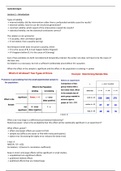
When the effect in the sample is significant and the effect in the population is existing => power
t-test: d
Effect size: how large is a difference/correlation/relationship?
Statistical power: what is the probability that this effect will be statistically significant in an experiment?
What effects power?
-> effect size (larger effects are easier to find)
-> sample size (effects are easier to find with many participants)
-> alpha error (increasing the alpha error reduces the beta error)
t-test: d
ANOVA: f (f = d/2)
Correlation: r (Pearson’s correlation coefficient)
Keep in mind: only large effects will be significant in small studies.
-> unpublished non-significant effects
-> published infalted effects
-> published effects that are indeed large
, Lecture 2 – Quantitative research designs
Experimental or observational
-> experimental: researcher manipulates the exposure of participants
-> observational: researcher observes participants (no manipulation)
Experimental designs
-> can be divided into studies in which participants are randomly or non-
randomly allocated
-> randomized controlled trials (golden standard/most rigorous)
-> non-randomized controlled trials (quasi-experiments)
Randomization
-> randomly allocating participants to conditions is important
-> because it reduces selection and allocation biases
-> so potential confounders are equally distributed across conditions
-> blinding is important for reducing performance bias
Treatment efficacy
-> refers to results obtained under intended treatment conditions
-> but not all people use treatment as allocated (toegewezen)
-> exclusion of those who are treated as planned introduces ascertainment bias
-> intention-to-treat (ITT) analyses used to preserve randomization and reduce biases
-> trying to include participants who didn’t complete the whole experiment in the analyses
-> try to preserve the quality of the randomization and the data in general
CONSORT
=> Consolidation of the Standards of Reporting Trials
-> to improve the standard of written reports of RCTs
-> includes a checklist of 25 items and a flow diagram
-> how participants were randomized
-> where participants were excluded
Observation studies
-> correlational designs
-> uses correlations, lineair regressions and ANOVA’s,
-> non-experimental designs can be divided into
-> analytical studies
-> descriptive studies
-> analytic studies include a comparison group
-> descriptive studies do not
-> analytic studies use inferential statistics
-> generalizes to population
-> descriptive studies use descriptive statistics
-> describes sample
Concurrent and longitudinal designs
-> concurrent designs are studies in which all measures are collected in a single assessment
-> cross-sectional
-> longitudinal designs are studies in which measures are collected in repeated assessements
-> cohort studies
-> assess prospective changes (looking forward in time)
-> you assess the participants at two different times
-> identify a group with an exposure of interest and another group or groups without the exposure
-> follow the exposed and unexposed groups forward in time to determine outcomes
Lecture 1 – Introduction
Types of validity
-> internal validity: did the intervention rather than a confounded variable cause the results?
-> external validity: how far can the results be generalized?
-> construct validity: which aspect of the intervention caused the results?
-> statistical validity: are the statistical conslusions correct?
The relation is not symmetric:
-> if causality, then correlation (good)
-> if correlation, then causality (wrong)
And temporal order does not prove causality, either:
-> if A is the cause of B, A must happen before B (good)
-> if A happens before B, A is the cause of B (wrong)
Even if two variables are both correlated and temporally ordered, the earlier one does not have to be the cause of
the later one.
Correlation is a necessary, but not a sufficient (voldoende) precondition for causation.
When the effect in the sample is significant and the effect in the population is existing => power
t-test: d
Effect size: how large is a difference/correlation/relationship?
Statistical power: what is the probability that this effect will be statistically significant in an experiment?
What effects power?
-> effect size (larger effects are easier to find)
-> sample size (effects are easier to find with many participants)
-> alpha error (increasing the alpha error reduces the beta error)
t-test: d
ANOVA: f (f = d/2)
Correlation: r (Pearson’s correlation coefficient)
Keep in mind: only large effects will be significant in small studies.
-> unpublished non-significant effects
-> published infalted effects
-> published effects that are indeed large
, Lecture 2 – Quantitative research designs
Experimental or observational
-> experimental: researcher manipulates the exposure of participants
-> observational: researcher observes participants (no manipulation)
Experimental designs
-> can be divided into studies in which participants are randomly or non-
randomly allocated
-> randomized controlled trials (golden standard/most rigorous)
-> non-randomized controlled trials (quasi-experiments)
Randomization
-> randomly allocating participants to conditions is important
-> because it reduces selection and allocation biases
-> so potential confounders are equally distributed across conditions
-> blinding is important for reducing performance bias
Treatment efficacy
-> refers to results obtained under intended treatment conditions
-> but not all people use treatment as allocated (toegewezen)
-> exclusion of those who are treated as planned introduces ascertainment bias
-> intention-to-treat (ITT) analyses used to preserve randomization and reduce biases
-> trying to include participants who didn’t complete the whole experiment in the analyses
-> try to preserve the quality of the randomization and the data in general
CONSORT
=> Consolidation of the Standards of Reporting Trials
-> to improve the standard of written reports of RCTs
-> includes a checklist of 25 items and a flow diagram
-> how participants were randomized
-> where participants were excluded
Observation studies
-> correlational designs
-> uses correlations, lineair regressions and ANOVA’s,
-> non-experimental designs can be divided into
-> analytical studies
-> descriptive studies
-> analytic studies include a comparison group
-> descriptive studies do not
-> analytic studies use inferential statistics
-> generalizes to population
-> descriptive studies use descriptive statistics
-> describes sample
Concurrent and longitudinal designs
-> concurrent designs are studies in which all measures are collected in a single assessment
-> cross-sectional
-> longitudinal designs are studies in which measures are collected in repeated assessements
-> cohort studies
-> assess prospective changes (looking forward in time)
-> you assess the participants at two different times
-> identify a group with an exposure of interest and another group or groups without the exposure
-> follow the exposed and unexposed groups forward in time to determine outcomes

