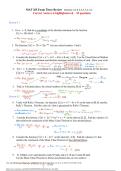
MAT 265 Exam Three Review Sections: 4.1-4.5, 4.7, 5.1, 5.2
Correct Answer is highlighted red - 35 questions
Section 4.1
1. For 𝑥 > 0, find the 𝑥-coordinate of the absolute minimum for the function
𝑓(𝑥 ) = 10𝑥 ln(𝑥) − 11𝑥.
E
meet iii
2. The function 𝑓 (𝑥 ) = (7𝑥 + 5)𝑒 −6𝑥 has one critical number. Find it.
sen.me
3 2
nx zss o Ec EEi
3. Consider the function 𝑓 (𝑥 ) = 𝑥 − 6𝑥 − 63𝑥 + 8 on [−4, 8]. Use the Closed Interval Method
z
to find the absolute maximum and absolute minimum and the location of each. Show your work
een
sina.ee
4. For 𝑥 > 0, find the 𝑥-coordinate to 4 decimal places of the absolute maximum for the function
2+5ln (𝑥)
𝑓 (𝑥 ) = . Justify that your answer is an absolute minimum using calculus.
𝑥
II iii I a I iiit.it i 5𝑥
5. Find, to 4 decimal places, the critical numbers of the function 𝑓 (𝑥 ) = .
9𝑥 2 +7
ex it then
itoperinterval
_say tinkering
is
Section 4.2
s'Ei
ÉTÉ.EE
II f 0.88i
6. Verify with Rolle’s Theorem, the function 𝑓(𝑥 ) = 𝑥 2 − 4𝑥 + 8 on the interval [0, 4] satisfies
Rolle’s Theorem. Find the value of 𝑐 that is guaranteed by Rolle’s Theorem.
7.
ifeng.li c
ini fcosfas
s eggsf zc u zeki
Consider the function 𝑓 (𝑥 ) = 2𝑥 3 + 4𝑥 2 + 𝑥 − 4 on the interval [2, 5]. Find the value(s) of 𝑐
c z atficio
that satisfies the conclusion of the Mean Value Theorem to four decimal places.
f fcal.fi f12 351 30 fix 6 2 8 1
3,1 107
flea
Icesc 1 107 C 35890
8. Consider the function 𝑓 (𝑥 ) = 4 − 6𝑥 2 on the interval [−2,5]. Find the value(s) of 𝑐 that
satisfies the conclusion of the Mean Value Theorem to four decimal places.
f 1 01 18 f
it 1.5000
9. At 2:00pm a car's speedometer reads 50 mph, and at 2:10 pm it reads 80 mph.
Use the Mean Value Theorem to find an acceleration the car must achieve.
10min 11h
This study source was downloaded by 100000900412927 from CourseHero.com on 01-21-2026 02:30:05 GMT -06:00
50 8030
3 180mih
https://www.coursehero.com/file/253224696/MAT265-Exam3-Review-S23-2pdf/
, 1
10. Consider the function 𝑓 (𝑥 ) = on the interval [1,12]. Find the value(s) of 𝑐 that satisfies the
𝑥
conclusion of the Mean Value Theorem to four decimal places.
1
FEE 1
½
-
fici ½
Section 4.3 C2 -12 c 3.4641
11. For the function 𝑓(𝑥 ) = (9 − 2𝑥 )𝑒 3𝑥 , list the 𝑥-values of the inflection point.
¾
I ae se isee aesxisxex sece ox Éx
12. Suppose that 𝑓 (𝑥 ) = 2𝑥 5 − 5𝑥 4. Use interval notation to indicate where 𝑓(𝑥) is increasing and
where it is decreasing.
I
increasing
--
- lox o me
ap
- o
mean c
𝑒𝑥
13. Suppose that 𝑓 (𝑥 ) = . Use interval notation to indicate where 𝑓(𝑥) is concave up and
4 + 𝑒𝑥
concave down. Justify your answer with the second derivative.
et
fix e
cYyq fix YexcutexiyYsk cext
compare
x nu
-16 se
it 1 _team -
Section 4.4 - ii agqe cm
14. Suppose that 𝑓 (𝑥 ) = 5𝑥 − 2 ln(𝑥) ; 𝑥 > 0. Use interval notation to state where the function is
concave up and concave down. Justify your answer with the second derivative.
15. Given the function: 𝑓 (𝑥 ) = 𝑥𝑒 2𝑥
Find the intervals where the function is concave up and those for which it is concave down.
16. Suppose that 𝑓 (𝑥 ) = (2 − 𝑥 )𝑒 𝑥 . Use interval notation to indicate where 𝑓(𝑥) is increasing and
where it is decreasing.
Section 4.5
This study source was downloaded by 100000900412927 from CourseHero.com on 01-21-2026 02:30:05 GMT -06:00
Spring 2019 © School of Mathematical & Statistical Sciences – Arizona State University 2
https://www.coursehero.com/file/253224696/MAT265-Exam3-Review-S23-2pdf/
Correct Answer is highlighted red - 35 questions
Section 4.1
1. For 𝑥 > 0, find the 𝑥-coordinate of the absolute minimum for the function
𝑓(𝑥 ) = 10𝑥 ln(𝑥) − 11𝑥.
E
meet iii
2. The function 𝑓 (𝑥 ) = (7𝑥 + 5)𝑒 −6𝑥 has one critical number. Find it.
sen.me
3 2
nx zss o Ec EEi
3. Consider the function 𝑓 (𝑥 ) = 𝑥 − 6𝑥 − 63𝑥 + 8 on [−4, 8]. Use the Closed Interval Method
z
to find the absolute maximum and absolute minimum and the location of each. Show your work
een
sina.ee
4. For 𝑥 > 0, find the 𝑥-coordinate to 4 decimal places of the absolute maximum for the function
2+5ln (𝑥)
𝑓 (𝑥 ) = . Justify that your answer is an absolute minimum using calculus.
𝑥
II iii I a I iiit.it i 5𝑥
5. Find, to 4 decimal places, the critical numbers of the function 𝑓 (𝑥 ) = .
9𝑥 2 +7
ex it then
itoperinterval
_say tinkering
is
Section 4.2
s'Ei
ÉTÉ.EE
II f 0.88i
6. Verify with Rolle’s Theorem, the function 𝑓(𝑥 ) = 𝑥 2 − 4𝑥 + 8 on the interval [0, 4] satisfies
Rolle’s Theorem. Find the value of 𝑐 that is guaranteed by Rolle’s Theorem.
7.
ifeng.li c
ini fcosfas
s eggsf zc u zeki
Consider the function 𝑓 (𝑥 ) = 2𝑥 3 + 4𝑥 2 + 𝑥 − 4 on the interval [2, 5]. Find the value(s) of 𝑐
c z atficio
that satisfies the conclusion of the Mean Value Theorem to four decimal places.
f fcal.fi f12 351 30 fix 6 2 8 1
3,1 107
flea
Icesc 1 107 C 35890
8. Consider the function 𝑓 (𝑥 ) = 4 − 6𝑥 2 on the interval [−2,5]. Find the value(s) of 𝑐 that
satisfies the conclusion of the Mean Value Theorem to four decimal places.
f 1 01 18 f
it 1.5000
9. At 2:00pm a car's speedometer reads 50 mph, and at 2:10 pm it reads 80 mph.
Use the Mean Value Theorem to find an acceleration the car must achieve.
10min 11h
This study source was downloaded by 100000900412927 from CourseHero.com on 01-21-2026 02:30:05 GMT -06:00
50 8030
3 180mih
https://www.coursehero.com/file/253224696/MAT265-Exam3-Review-S23-2pdf/
, 1
10. Consider the function 𝑓 (𝑥 ) = on the interval [1,12]. Find the value(s) of 𝑐 that satisfies the
𝑥
conclusion of the Mean Value Theorem to four decimal places.
1
FEE 1
½
-
fici ½
Section 4.3 C2 -12 c 3.4641
11. For the function 𝑓(𝑥 ) = (9 − 2𝑥 )𝑒 3𝑥 , list the 𝑥-values of the inflection point.
¾
I ae se isee aesxisxex sece ox Éx
12. Suppose that 𝑓 (𝑥 ) = 2𝑥 5 − 5𝑥 4. Use interval notation to indicate where 𝑓(𝑥) is increasing and
where it is decreasing.
I
increasing
--
- lox o me
ap
- o
mean c
𝑒𝑥
13. Suppose that 𝑓 (𝑥 ) = . Use interval notation to indicate where 𝑓(𝑥) is concave up and
4 + 𝑒𝑥
concave down. Justify your answer with the second derivative.
et
fix e
cYyq fix YexcutexiyYsk cext
compare
x nu
-16 se
it 1 _team -
Section 4.4 - ii agqe cm
14. Suppose that 𝑓 (𝑥 ) = 5𝑥 − 2 ln(𝑥) ; 𝑥 > 0. Use interval notation to state where the function is
concave up and concave down. Justify your answer with the second derivative.
15. Given the function: 𝑓 (𝑥 ) = 𝑥𝑒 2𝑥
Find the intervals where the function is concave up and those for which it is concave down.
16. Suppose that 𝑓 (𝑥 ) = (2 − 𝑥 )𝑒 𝑥 . Use interval notation to indicate where 𝑓(𝑥) is increasing and
where it is decreasing.
Section 4.5
This study source was downloaded by 100000900412927 from CourseHero.com on 01-21-2026 02:30:05 GMT -06:00
Spring 2019 © School of Mathematical & Statistical Sciences – Arizona State University 2
https://www.coursehero.com/file/253224696/MAT265-Exam3-Review-S23-2pdf/