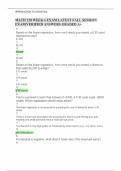
INTRODUCTION TO STATISTICS
MATH 120 WEEK 6 EXAM LATEST FALL SESSION
EXAM|VERIFIED ANSWERS GRADED A+
1.
Based on the linear regression, how much would you expect a 0.55 carat
diamond to cost?
$1,800
9
$2,100
&
$2,500'
2
$2,900
2.
Based on the linear regression, how much would you expect a diamond
that costs $5,500 to weigh?
0.72 carats
-~
0.78 carats
|5
0.81 carats
@
'0.90 carats’
3.
You're surprised to learn that instead of ~$100, a 0.30 carat costs ~$800
carats. Which explanation would make sense?
o
The linear regression is not accurate at predicting the cost of diamonds below 0.40
carats.
a
There is a fixed cost associated with procuring the diamond and offering it for sale,
meaning that small diamonds have a relatively high price.
L8/
The diamond is very high quality as measured by other metrics (e.g., cut, clarity, color).
«
All of the above.’
4
If a residual is negative, what does it mean about the observed value?
o)
, INTRODUCTION TO STATISTICS
The predicted value is greater than the observed value,
o
The predicted value is equal to the observed value.
MATH 120 WEEK 6 EXAM LATEST FALL SESSION
EXAM|VERIFIED ANSWERS GRADED A+
1.
Based on the linear regression, how much would you expect a 0.55 carat
diamond to cost?
$1,800
9
$2,100
&
$2,500'
2
$2,900
2.
Based on the linear regression, how much would you expect a diamond
that costs $5,500 to weigh?
0.72 carats
-~
0.78 carats
|5
0.81 carats
@
'0.90 carats’
3.
You're surprised to learn that instead of ~$100, a 0.30 carat costs ~$800
carats. Which explanation would make sense?
o
The linear regression is not accurate at predicting the cost of diamonds below 0.40
carats.
a
There is a fixed cost associated with procuring the diamond and offering it for sale,
meaning that small diamonds have a relatively high price.
L8/
The diamond is very high quality as measured by other metrics (e.g., cut, clarity, color).
«
All of the above.’
4
If a residual is negative, what does it mean about the observed value?
o)
, INTRODUCTION TO STATISTICS
The predicted value is greater than the observed value,
o
The predicted value is equal to the observed value.