

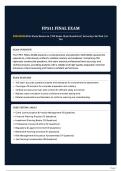
FP511 FINAL EXAM
2025/2026 Elite Study Resource | 100 Exam-Style Questions | Accuracy-Verified | A+
Tier
EXAM OVERVIEW
The FP511 FINAL EXAM presents a comprehensive and authentic 2025/2026 assessment
experience, meticulously crafted to validate mastery and readiness. Comprising 100
rigorously constructed questions, this exam ensures professional-level accuracy and
verified answers, providing students with a reliable and high-quality preparation tool that
enhances critical reasoning and fosters confident performance.
EXAM FEATURES
• 100 exam-accurate questions aligned with standards for comprehensive assessment
• Coverage of 8 domains for complete preparation and mastery
• Verified accuracy and high-yield content for efficient study and review
• Realistic exam simulation to build confidence and test-taking skills
• Detailed explanations and feedback to reinforce learning and understanding
CORE TESTING AREAS
→ Client Communication & Practice Management (9 Questions)
→ Financial Planning Process (15 Questions)
→ Investment Planning Basics (13 Questions)
→ Professional Conduct & Ethics (10 Questions)
→ Regulatory & Legal Environment (9 Questions)
→ Retirement Planning Overview (11 Questions)
→ Risk Management & Insurance Fundamentals (17 Questions)
→ Tax Planning Fundamentals (16 Questions)
Page 1
,Financial Planning Process (15 Questions)
Question 1
Which of the following activities is performed during the "Analysis and Evaluation" phase of the
financial planning process?
A. Developing specific investment recommendations for the client
B. Collecting the client's current financial statements and tax returns
C. Calculating cash‑flow gaps, risk exposure, and retirement adequacy
D. Monitoring the implementation of the approved financial plan
Correct Answer
Calculating cash‑flow gaps, risk exposure, and retirement adequacy
Rationale:
The analysis and evaluation phase focuses on interpreting gathered data, which includes cash‑flow analysis, risk
assessment, and retirement adequacy calculations. Recommendation development, data collection, and monitoring
occur in other phases.
Question 2
In establishing the client‑planner relationship, which statement best reflects a CFP®
professional's ethical duty under the CFP Board Code of Ethics?
A. Disclose all potential conflicts of interest before any recommendation is made
B. Provide the client with a detailed investment prospectus for every security considered
C. Guarantee that the client's portfolio will outperform the market
D. Accept compensation only from the client and never from third parties
Correct Answer
Disclose all potential conflicts of interest before any recommendation is made
Rationale:
The CFP Board Code of Ethics requires professionals to disclose and manage conflicts of interest. The other
options are either impractical or beyond the scope of ethical obligations.
Page 2
,Question 3
During the "Developing and Presenting Recommendations" phase, a planner uses Monte‑Carlo
simulation to assess the probability that a client will meet a $1,200,000 retirement goal. This
technique exemplifies which financial planning method?
A. Deterministic cash‑flow analysis
B. Scenario‑based risk modeling
C. Time‑value of money calculation
D. Asset‑liability matching
Correct Answer
Scenario‑based risk modeling
Rationale:
Monte‑Carlo simulation generates a range of possible outcomes based on stochastic inputs, making it a
scenario‑based risk modeling method used in recommendation development.
Question 4
Which of the following best describes the purpose of the "Implementation" phase in the
financial planning process?
A. To verify that the client's stated objectives are realistic and measurable
B. To execute the agreed‑upon strategies, such as opening accounts and purchasing assets
C. To perform a comprehensive risk tolerance questionnaire
D. To conduct a post‑implementation performance audit
Correct Answer
To execute the agreed‑upon strategies, such as opening accounts and purchasing assets
Rationale:
Implementation translates recommendations into actionable steps-opening accounts, executing trades, and
establishing insurance policies. The other options pertain to earlier or later phases.
Page 3
, Question 5
A planner discovers that a client's existing life‑insurance policy contains a costly surrender
charge that would impede cash‑flow goals. Addressing this issue falls under which planning
principle?
A. Principle of diversification
B. Principle of suitability
C. Principle of cost efficiency
D. Principle of tax minimization
Correct Answer
Principle of cost efficiency
Rationale:
Evaluating and minimizing unnecessary costs, such as surrender charges, aligns with the cost‑efficiency principle,
ensuring the plan maximizes value for the client.
Question 6
When conducting a comprehensive financial plan, a planner applies the "net worth" metric.
Which of the following formulas correctly calculates net worth?
A. Total assets ÷ Total liabilities
B. Total assets - Total liabilities
C. Total liabilities - Total assets
D. Total assets + Total liabilities
Correct Answer
Total assets - Total liabilities
Rationale:
Net worth is defined as the difference between total assets and total liabilities. The other formulas do not represent
net worth.
Page 4
2025/2026 Elite Study Resource | 100 Exam-Style Questions | Accuracy-Verified | A+
Tier
EXAM OVERVIEW
The FP511 FINAL EXAM presents a comprehensive and authentic 2025/2026 assessment
experience, meticulously crafted to validate mastery and readiness. Comprising 100
rigorously constructed questions, this exam ensures professional-level accuracy and
verified answers, providing students with a reliable and high-quality preparation tool that
enhances critical reasoning and fosters confident performance.
EXAM FEATURES
• 100 exam-accurate questions aligned with standards for comprehensive assessment
• Coverage of 8 domains for complete preparation and mastery
• Verified accuracy and high-yield content for efficient study and review
• Realistic exam simulation to build confidence and test-taking skills
• Detailed explanations and feedback to reinforce learning and understanding
CORE TESTING AREAS
→ Client Communication & Practice Management (9 Questions)
→ Financial Planning Process (15 Questions)
→ Investment Planning Basics (13 Questions)
→ Professional Conduct & Ethics (10 Questions)
→ Regulatory & Legal Environment (9 Questions)
→ Retirement Planning Overview (11 Questions)
→ Risk Management & Insurance Fundamentals (17 Questions)
→ Tax Planning Fundamentals (16 Questions)
Page 1
,Financial Planning Process (15 Questions)
Question 1
Which of the following activities is performed during the "Analysis and Evaluation" phase of the
financial planning process?
A. Developing specific investment recommendations for the client
B. Collecting the client's current financial statements and tax returns
C. Calculating cash‑flow gaps, risk exposure, and retirement adequacy
D. Monitoring the implementation of the approved financial plan
Correct Answer
Calculating cash‑flow gaps, risk exposure, and retirement adequacy
Rationale:
The analysis and evaluation phase focuses on interpreting gathered data, which includes cash‑flow analysis, risk
assessment, and retirement adequacy calculations. Recommendation development, data collection, and monitoring
occur in other phases.
Question 2
In establishing the client‑planner relationship, which statement best reflects a CFP®
professional's ethical duty under the CFP Board Code of Ethics?
A. Disclose all potential conflicts of interest before any recommendation is made
B. Provide the client with a detailed investment prospectus for every security considered
C. Guarantee that the client's portfolio will outperform the market
D. Accept compensation only from the client and never from third parties
Correct Answer
Disclose all potential conflicts of interest before any recommendation is made
Rationale:
The CFP Board Code of Ethics requires professionals to disclose and manage conflicts of interest. The other
options are either impractical or beyond the scope of ethical obligations.
Page 2
,Question 3
During the "Developing and Presenting Recommendations" phase, a planner uses Monte‑Carlo
simulation to assess the probability that a client will meet a $1,200,000 retirement goal. This
technique exemplifies which financial planning method?
A. Deterministic cash‑flow analysis
B. Scenario‑based risk modeling
C. Time‑value of money calculation
D. Asset‑liability matching
Correct Answer
Scenario‑based risk modeling
Rationale:
Monte‑Carlo simulation generates a range of possible outcomes based on stochastic inputs, making it a
scenario‑based risk modeling method used in recommendation development.
Question 4
Which of the following best describes the purpose of the "Implementation" phase in the
financial planning process?
A. To verify that the client's stated objectives are realistic and measurable
B. To execute the agreed‑upon strategies, such as opening accounts and purchasing assets
C. To perform a comprehensive risk tolerance questionnaire
D. To conduct a post‑implementation performance audit
Correct Answer
To execute the agreed‑upon strategies, such as opening accounts and purchasing assets
Rationale:
Implementation translates recommendations into actionable steps-opening accounts, executing trades, and
establishing insurance policies. The other options pertain to earlier or later phases.
Page 3
, Question 5
A planner discovers that a client's existing life‑insurance policy contains a costly surrender
charge that would impede cash‑flow goals. Addressing this issue falls under which planning
principle?
A. Principle of diversification
B. Principle of suitability
C. Principle of cost efficiency
D. Principle of tax minimization
Correct Answer
Principle of cost efficiency
Rationale:
Evaluating and minimizing unnecessary costs, such as surrender charges, aligns with the cost‑efficiency principle,
ensuring the plan maximizes value for the client.
Question 6
When conducting a comprehensive financial plan, a planner applies the "net worth" metric.
Which of the following formulas correctly calculates net worth?
A. Total assets ÷ Total liabilities
B. Total assets - Total liabilities
C. Total liabilities - Total assets
D. Total assets + Total liabilities
Correct Answer
Total assets - Total liabilities
Rationale:
Net worth is defined as the difference between total assets and total liabilities. The other formulas do not represent
net worth.
Page 4

