

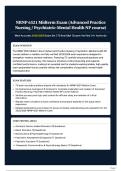
NRNP 6521 Midterm Exam (Advanced Practice
Nursing / Psychiatric-Mental Health NP course)
Most Accurate 2025/2026 Exam Set | 73 Real Q&A | Expert-Verified | A+ Authority
EXAM OVERVIEW
The NRNP 6521 Midterm Exam (Advanced Practice Nursing / Psychiatric-Mental Health NP
course) delivers a realistic and fully verified 2025/2026 exam experience designed to
strengthen mastery and test readiness. Featuring 73 carefully structured questions and
professional-level accuracy, this resource enhances critical reasoning and supports
confident performance, making it an essential tool for students seeking reliable, high-quality
exam preparation that accurately reflects the complexities of psychiatric-mental health
nursing practice.
EXAM FEATURES
• 73 exam-accurate questions aligned with standards for NRNP 6521 Midterm Exam.
• Comprehensive coverage of 6 domains for complete preparation and mastery of Advanced
Practice Nursing / Psychiatric-Mental Health NP course material.
• Verified accuracy and high-yield content for efficient study and retention of critical
information.
• Realistic exam simulation to build confidence and prepare students for the actual exam
experience.
• Detailed explanations and answers to ensure complete understanding and preparation for the
2025/2026 NRNP 6521 Midterm Exam.
CORE TESTING AREAS
→ Anxiety & Trauma-related Disorders (10 Questions)
→ Mood Disorders (13 Questions)
→ Neuroscience & Psychopathology (11 Questions)
→ Psychiatric Assessment & Diagnosis (17 Questions)
→ Psychotic Disorders (11 Questions)
→ Therapeutic Communication & Psychotherapy Basics (11 Questions)
Page 1
,Psychiatric Assessment & Diagnosis (17 Questions)
Question 1
When comparing DSM‑5 and ICD‑10 criteria for a Major Depressive Episode, which of the
following statements is most accurate?
A. DSM‑5 requires a minimum of five symptoms including either depressed mood or anhedonia,
whereas ICD‑10 requires at least four symptoms with depressed mood being mandatory
B. DSM‑5 mandates a minimum duration of two weeks, while ICD‑10 specifies a minimum
duration of one month
C. ICD‑10 includes somatic symptoms as core criteria, whereas DSM‑5 excludes them from the
diagnostic threshold
D. Both systems require the presence of psychomotor agitation or retardation as a required
symptom
Correct Answer
DSM‑5 requires a minimum of five symptoms including either depressed mood or anhedonia,
whereas ICD‑10 requires at least four symptoms with depressed mood being mandatory
Rationale:
DSM‑5 specifies five or more symptoms (including depressed mood or anhedonia) for at least two weeks; ICD‑10
requires at least four symptoms, with depressed mood being essential, and a duration of at least two weeks.
Page 2
,Question 2
In a research setting, which psychometric property of the Structured Clinical Interview for
DSM‑5 (SCID‑5) is most critical for ensuring diagnostic reliability across multiple interviewers?
A. Construct validity
B. Inter‑rater reliability
C. Test‑retest reliability
D. Face validity
Correct Answer
Inter‑rater reliability
Rationale:
Inter‑rater reliability measures the degree to which different clinicians obtain the same diagnosis using the SCID‑5,
which is essential for consistency in research and clinical practice.
Question 3
A 28‑year‑old veteran presents with a sudden onset of delusions and auditory hallucinations
lasting three weeks after a traumatic combat event. Which diagnosis best distinguishes this
presentation from PTSD with psychotic features?
A. Brief Psychotic Disorder
B. Acute Stress Disorder
C. Schizoaffective Disorder
D. Post‑Traumatic Stress Disorder, psychotic subtype
Correct Answer
Brief Psychotic Disorder
Rationale:
Brief Psychotic Disorder is characterized by psychotic symptoms lasting less than one month without a prior
trauma‑related symptom cluster, whereas PTSD with psychotic features would retain core PTSD symptoms and
psychosis would be secondary.
Page 3
, Question 4
On the Brief Psychiatric Rating Scale (BPRS), a total score of 45 most likely indicates which
level of symptom severity?
A. Mild psychiatric disturbance
B. Moderate psychiatric disturbance
C. Marked psychiatric disturbance
D. Severe psychiatric disturbance
Correct Answer
Marked psychiatric disturbance
Rationale:
BPRS scores: 18‑31 = mild, 32‑46 = marked, 47‑61 = severe. A score of 45 falls within the marked range, indicating
significant symptom burden.
Question 5
When assessing decision‑making capacity for a patient with schizophrenia, which source of
information is considered most essential for a comprehensive evaluation?
A. Patient's self‑report of insight
B. Collateral interview with a family member
C. Results of a neuroimaging study
D. Standardized capacity assessment tool alone
Correct Answer
Collateral interview with a family member
Rationale:
Collateral information provides objective data about functional abilities and insight that may be compromised in
schizophrenia, complementing the patient's self‑report and formal tools.
Page 4
Nursing / Psychiatric-Mental Health NP course)
Most Accurate 2025/2026 Exam Set | 73 Real Q&A | Expert-Verified | A+ Authority
EXAM OVERVIEW
The NRNP 6521 Midterm Exam (Advanced Practice Nursing / Psychiatric-Mental Health NP
course) delivers a realistic and fully verified 2025/2026 exam experience designed to
strengthen mastery and test readiness. Featuring 73 carefully structured questions and
professional-level accuracy, this resource enhances critical reasoning and supports
confident performance, making it an essential tool for students seeking reliable, high-quality
exam preparation that accurately reflects the complexities of psychiatric-mental health
nursing practice.
EXAM FEATURES
• 73 exam-accurate questions aligned with standards for NRNP 6521 Midterm Exam.
• Comprehensive coverage of 6 domains for complete preparation and mastery of Advanced
Practice Nursing / Psychiatric-Mental Health NP course material.
• Verified accuracy and high-yield content for efficient study and retention of critical
information.
• Realistic exam simulation to build confidence and prepare students for the actual exam
experience.
• Detailed explanations and answers to ensure complete understanding and preparation for the
2025/2026 NRNP 6521 Midterm Exam.
CORE TESTING AREAS
→ Anxiety & Trauma-related Disorders (10 Questions)
→ Mood Disorders (13 Questions)
→ Neuroscience & Psychopathology (11 Questions)
→ Psychiatric Assessment & Diagnosis (17 Questions)
→ Psychotic Disorders (11 Questions)
→ Therapeutic Communication & Psychotherapy Basics (11 Questions)
Page 1
,Psychiatric Assessment & Diagnosis (17 Questions)
Question 1
When comparing DSM‑5 and ICD‑10 criteria for a Major Depressive Episode, which of the
following statements is most accurate?
A. DSM‑5 requires a minimum of five symptoms including either depressed mood or anhedonia,
whereas ICD‑10 requires at least four symptoms with depressed mood being mandatory
B. DSM‑5 mandates a minimum duration of two weeks, while ICD‑10 specifies a minimum
duration of one month
C. ICD‑10 includes somatic symptoms as core criteria, whereas DSM‑5 excludes them from the
diagnostic threshold
D. Both systems require the presence of psychomotor agitation or retardation as a required
symptom
Correct Answer
DSM‑5 requires a minimum of five symptoms including either depressed mood or anhedonia,
whereas ICD‑10 requires at least four symptoms with depressed mood being mandatory
Rationale:
DSM‑5 specifies five or more symptoms (including depressed mood or anhedonia) for at least two weeks; ICD‑10
requires at least four symptoms, with depressed mood being essential, and a duration of at least two weeks.
Page 2
,Question 2
In a research setting, which psychometric property of the Structured Clinical Interview for
DSM‑5 (SCID‑5) is most critical for ensuring diagnostic reliability across multiple interviewers?
A. Construct validity
B. Inter‑rater reliability
C. Test‑retest reliability
D. Face validity
Correct Answer
Inter‑rater reliability
Rationale:
Inter‑rater reliability measures the degree to which different clinicians obtain the same diagnosis using the SCID‑5,
which is essential for consistency in research and clinical practice.
Question 3
A 28‑year‑old veteran presents with a sudden onset of delusions and auditory hallucinations
lasting three weeks after a traumatic combat event. Which diagnosis best distinguishes this
presentation from PTSD with psychotic features?
A. Brief Psychotic Disorder
B. Acute Stress Disorder
C. Schizoaffective Disorder
D. Post‑Traumatic Stress Disorder, psychotic subtype
Correct Answer
Brief Psychotic Disorder
Rationale:
Brief Psychotic Disorder is characterized by psychotic symptoms lasting less than one month without a prior
trauma‑related symptom cluster, whereas PTSD with psychotic features would retain core PTSD symptoms and
psychosis would be secondary.
Page 3
, Question 4
On the Brief Psychiatric Rating Scale (BPRS), a total score of 45 most likely indicates which
level of symptom severity?
A. Mild psychiatric disturbance
B. Moderate psychiatric disturbance
C. Marked psychiatric disturbance
D. Severe psychiatric disturbance
Correct Answer
Marked psychiatric disturbance
Rationale:
BPRS scores: 18‑31 = mild, 32‑46 = marked, 47‑61 = severe. A score of 45 falls within the marked range, indicating
significant symptom burden.
Question 5
When assessing decision‑making capacity for a patient with schizophrenia, which source of
information is considered most essential for a comprehensive evaluation?
A. Patient's self‑report of insight
B. Collateral interview with a family member
C. Results of a neuroimaging study
D. Standardized capacity assessment tool alone
Correct Answer
Collateral interview with a family member
Rationale:
Collateral information provides objective data about functional abilities and insight that may be compromised in
schizophrenia, complementing the patient's self‑report and formal tools.
Page 4

