8 Characteristics of Living Things:
● Movement - An action performed by an organism/part of an organism, causing a change
in position or place.
● Respiration - Chemical reactions in cells (mitochondria) that break down nutrient
molecules, releasing energy for metabolism.
● Sensitivity - The ability to detect sense stimuli in both internal and external environments,
and to make appropriate responses.
● Homeostasis - The ability to control internal conditions (e.g. water content, body temp).
● Growth - A permanent increase in dry mass and size, caused by an increase of cell
number, cell size, or both.
● Reproduction - The process that makes more of the same kind of organism.
● Excretion - The removal of waste products from metabolism, toxic materials, and
substances in excess of requirements from an organism.
● Nutrition - The taking in of materials required for energy, growth, and development.
○ Plants need light, carbon dioxide, water and ions.
○ Animals need organic compounds, ions, and most need water.
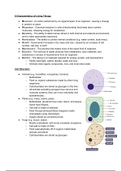
Cell Structure:
● Animals (e.g. houseflies, mosquitoes, humans):
○ Multicellular.
○ Feed on organic substances made by other living
organisms.
○ Carbohydrates are stored as glycogen in the liver.
○ All animals excluding sponges have nervous and
muscular systems; they can move voluntarily and
spontaneously.
● Plants (e.g. maize, beans, peas):
○ Multicellular; all plants have roots, stems, and leaves.
Some have flowers.
○ Cell wall is made of cellulose.
○ Feed through photosynthesis (happens inside
chloroplasts using chlorophyll).
○ Sugars stored as sucrose/sucrose.
● Fungi (e.g. mucor, yeast):
○ Mostly multicellular, with some unicellular exceptions.
○ Cell wall is made of chitin.
○ Feed saprophytically off of organic matter/dead
animals and plants.
○ Carbohydrates are stored as glycogen.
● Movement - An action performed by an organism/part of an organism, causing a change
in position or place.
● Respiration - Chemical reactions in cells (mitochondria) that break down nutrient
molecules, releasing energy for metabolism.
● Sensitivity - The ability to detect sense stimuli in both internal and external environments,
and to make appropriate responses.
● Homeostasis - The ability to control internal conditions (e.g. water content, body temp).
● Growth - A permanent increase in dry mass and size, caused by an increase of cell
number, cell size, or both.
● Reproduction - The process that makes more of the same kind of organism.
● Excretion - The removal of waste products from metabolism, toxic materials, and
substances in excess of requirements from an organism.
● Nutrition - The taking in of materials required for energy, growth, and development.
○ Plants need light, carbon dioxide, water and ions.
○ Animals need organic compounds, ions, and most need water.
Cell Structure:
● Animals (e.g. houseflies, mosquitoes, humans):
○ Multicellular.
○ Feed on organic substances made by other living
organisms.
○ Carbohydrates are stored as glycogen in the liver.
○ All animals excluding sponges have nervous and
muscular systems; they can move voluntarily and
spontaneously.
● Plants (e.g. maize, beans, peas):
○ Multicellular; all plants have roots, stems, and leaves.
Some have flowers.
○ Cell wall is made of cellulose.
○ Feed through photosynthesis (happens inside
chloroplasts using chlorophyll).
○ Sugars stored as sucrose/sucrose.
● Fungi (e.g. mucor, yeast):
○ Mostly multicellular, with some unicellular exceptions.
○ Cell wall is made of chitin.
○ Feed saprophytically off of organic matter/dead
animals and plants.
○ Carbohydrates are stored as glycogen.