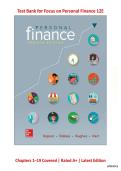
Test Bank for Focus on Personal Finance 12E
elitedocs
Chapters 1–19 Covered | Rated A+ | Latest Edition
elitedocs
, Test Bank for
- 978-1259720680
Chapter 1-19 [Answers are at the End of Each Chapter]
Chapter 01 Testbank - Static
Student: ___________________________________________________________________________
1. Increased demand for a product or service will usually result in lower prices for the item.
True False
qu
2. Inflation reduces the buying power of the dollar.
True False
elitedocs
iz
3. Lenders benefit more than borrowers in times of high inflation.
True False
m
4. Economics is the study of using money to achieve financial goals.
True False
as
5. A decrease in the demand for a product or service may result in unemployment from staff reduction.
True False
te
6. Developing and using a budget is part of the "obtaining" component of financial planning.
True False
rs
7. A financial plan is another name for a budget.
True False
8. Planning to buy a car is an example of an intangible goal.
True False
9. Opportunity costs refer to what a person gives up when making a choice.
True False
elitedocs elitedocs
, 10. Personal opportunity costs refer to time, effort, and health that are given up when a decision is made.
True False
11. Time value of money refers to changes in consumer spending when inflation occurs.
True False
12. Interest on savings is calculated by multiplying the principal amount times the opportunity cost times the annual
interest rate.
True False
13. Present value is also referred to as compounding.
True False
qu
14. Opportunity costs may be viewed only in terms of financial resources.
True False
elitedocs
iz
15. Gross Domestic Product (GDP) measures the total value of goods and services produced within a country's borders,
excluding items produced with foreign resources.
m
True False
as
16. Trade balance is defined as the difference between a country's exports and its imports.
True False
17. The main goal of personal financial planning is managing your money to:
te
A. save and invest for future needs.
B. reduce a person's tax liability.
C. achieve personal economic satisfaction.
D. spend to achieve financial objectives.
rs
E. save, spend, and borrow based on current needs.
18. Higher prices are likely to result from:
A. lower demand by consumers.
B. increased production by business.
C. lower interest rates.
D. increased demand by consumers without increased supply.
E. an increase in the supply of a product.
elitedocs elitedocs
, 19. Who is most likely to benefit from inflation?
A. Retired people
B. Lenders
C. Borrowers
D. Low-income consumers
E. Government
20. Higher consumer prices are likely to be accompanied by:
A. lower union wages.
B. lower interest rates.
C. lower production costs.
D. higher interest rates.
E. higher exports.
qu
21. With an inflation rate of 9 percent, prices would double in about ___________ years.
A. 4
B. 6
C. 8
D. 10
E. 12
elitedocs
iz
22. Increased consumer spending will usually cause:
m
A. lower consumer prices.
B. reduced employment levels.
C. lower tax revenues.
D. lower interest rates.
E. higher employment levels.
as
23. Higher interest rates can be caused by:
A. a lower money supply.
te
B. an increase in the money supply.
C. a decrease in consumer borrowing.
D. lower government spending.
E. increased saving and investing by consumers.
rs
24. The risk premium you receive as a saver is based:
A. on your credit rating.
B. on the amount of money you are borrowing.
C. only on the uncertainty associated with getting your money back.
D. only on the expected rate of inflation.
E. in part on the uncertainty associated with getting your money back and the expected rate of inflation.
elitedocs elitedocs
elitedocs
Chapters 1–19 Covered | Rated A+ | Latest Edition
elitedocs
, Test Bank for
- 978-1259720680
Chapter 1-19 [Answers are at the End of Each Chapter]
Chapter 01 Testbank - Static
Student: ___________________________________________________________________________
1. Increased demand for a product or service will usually result in lower prices for the item.
True False
qu
2. Inflation reduces the buying power of the dollar.
True False
elitedocs
iz
3. Lenders benefit more than borrowers in times of high inflation.
True False
m
4. Economics is the study of using money to achieve financial goals.
True False
as
5. A decrease in the demand for a product or service may result in unemployment from staff reduction.
True False
te
6. Developing and using a budget is part of the "obtaining" component of financial planning.
True False
rs
7. A financial plan is another name for a budget.
True False
8. Planning to buy a car is an example of an intangible goal.
True False
9. Opportunity costs refer to what a person gives up when making a choice.
True False
elitedocs elitedocs
, 10. Personal opportunity costs refer to time, effort, and health that are given up when a decision is made.
True False
11. Time value of money refers to changes in consumer spending when inflation occurs.
True False
12. Interest on savings is calculated by multiplying the principal amount times the opportunity cost times the annual
interest rate.
True False
13. Present value is also referred to as compounding.
True False
qu
14. Opportunity costs may be viewed only in terms of financial resources.
True False
elitedocs
iz
15. Gross Domestic Product (GDP) measures the total value of goods and services produced within a country's borders,
excluding items produced with foreign resources.
m
True False
as
16. Trade balance is defined as the difference between a country's exports and its imports.
True False
17. The main goal of personal financial planning is managing your money to:
te
A. save and invest for future needs.
B. reduce a person's tax liability.
C. achieve personal economic satisfaction.
D. spend to achieve financial objectives.
rs
E. save, spend, and borrow based on current needs.
18. Higher prices are likely to result from:
A. lower demand by consumers.
B. increased production by business.
C. lower interest rates.
D. increased demand by consumers without increased supply.
E. an increase in the supply of a product.
elitedocs elitedocs
, 19. Who is most likely to benefit from inflation?
A. Retired people
B. Lenders
C. Borrowers
D. Low-income consumers
E. Government
20. Higher consumer prices are likely to be accompanied by:
A. lower union wages.
B. lower interest rates.
C. lower production costs.
D. higher interest rates.
E. higher exports.
qu
21. With an inflation rate of 9 percent, prices would double in about ___________ years.
A. 4
B. 6
C. 8
D. 10
E. 12
elitedocs
iz
22. Increased consumer spending will usually cause:
m
A. lower consumer prices.
B. reduced employment levels.
C. lower tax revenues.
D. lower interest rates.
E. higher employment levels.
as
23. Higher interest rates can be caused by:
A. a lower money supply.
te
B. an increase in the money supply.
C. a decrease in consumer borrowing.
D. lower government spending.
E. increased saving and investing by consumers.
rs
24. The risk premium you receive as a saver is based:
A. on your credit rating.
B. on the amount of money you are borrowing.
C. only on the uncertainty associated with getting your money back.
D. only on the expected rate of inflation.
E. in part on the uncertainty associated with getting your money back and the expected rate of inflation.
elitedocs elitedocs