
WGU D322 EXAM QUESTIONS & VERIFIED
CORRECT ANSWERS PASSED 100%
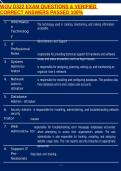
1. Informatio
The technology used in creating, maintaining, and making information
n accessible.
Technolog
y
Administration and Support
2. IT
Professional
Roles responsible for providing technical support for hardware and software
issues end users encounter, such as log-in issues
3. System
Adminis- is responsible for designing, planning, setting up, and maintaining an
trator organiza- tion's network
4. Network is responsible for installing and configuring databases. This position also
Admin- fixes database errors and creates user accounts.
istrator
5. Database
Admin- istrator
6. Security Adminis- is responsible for installing, administering, and troubleshooting network
security
trator issues
7. Web responsible for troubleshooting error messages employees encounter
Administra- tor when attempting to access their organization's website. The web
administrator is also responsible for tracking, compiling, and analyzing
website usage data. This role reports security breaches to appropriate
personnel.
8. Support IT
Pro- Help desk and training.
fessionals
,WGU D322 EXAM QUESTIONS & VERIFIED
CORRECT ANSWERS PASSED 100%
9. Information collection of processed data from a variety of sources
10. DIKW Hierarchy Defines the transition of data to information from knowledge to wisdom.
(Data
Information Knowledge Wisdom)
,WGU D322 EXAM QUESTIONS & VERIFIED
CORRECT ANSWERS PASSED 100%
11. Data in DIKW The input directly received by the user (or computer). It is generally not
usable
until it has been converted into a relevant form.
12. Information Having been inferred from data; one or more processes have been
in DIKW applied to the data to transform it into a more useful form.
13. Knowledge Information that has been put to use; information placed into a context.
in DIKW Refined information such that the user of the knowledge is able to call
forth only relevant portions of information when needed. KNOWING
THR RIGHT THING TO DO
14. Wisdom in DIKW Provides a social setting to knowledge; an understanding of the
"why". Can only come by having both knowledge and experience.
15. Information A collection of data and information used to support the management
Sys- tems of an organization. Also refers to the technical components and human
resources that enable the assembly, storage, and processing of data
and the delivery of infor- mation. This has existed for a lot longer than
computers.
16. Characteristics of Relevance - the data being used must apply directly to the decision being
made
Quality Data
Timely - data must be eflcient and must be provided in a timely
manner Thorough - the data must be complete
Accurate - data should be captured only once, where possible and should
be captured as close to the point of activity as possible.
Reliable - data should reflect stable and consistent data collection
processes across collections points and over time
,WGU D322 EXAM QUESTIONS & VERIFIED
CORRECT ANSWERS PASSED 100%
17. Structured data is coded in a way that makes it easy to convert into a form usable for
analysis.
18. Examples of
structured
data
CORRECT ANSWERS PASSED 100%
1. Informatio
The technology used in creating, maintaining, and making information
n accessible.
Technolog
y
Administration and Support
2. IT
Professional
Roles responsible for providing technical support for hardware and software
issues end users encounter, such as log-in issues
3. System
Adminis- is responsible for designing, planning, setting up, and maintaining an
trator organiza- tion's network
4. Network is responsible for installing and configuring databases. This position also
Admin- fixes database errors and creates user accounts.
istrator
5. Database
Admin- istrator
6. Security Adminis- is responsible for installing, administering, and troubleshooting network
security
trator issues
7. Web responsible for troubleshooting error messages employees encounter
Administra- tor when attempting to access their organization's website. The web
administrator is also responsible for tracking, compiling, and analyzing
website usage data. This role reports security breaches to appropriate
personnel.
8. Support IT
Pro- Help desk and training.
fessionals
,WGU D322 EXAM QUESTIONS & VERIFIED
CORRECT ANSWERS PASSED 100%
9. Information collection of processed data from a variety of sources
10. DIKW Hierarchy Defines the transition of data to information from knowledge to wisdom.
(Data
Information Knowledge Wisdom)
,WGU D322 EXAM QUESTIONS & VERIFIED
CORRECT ANSWERS PASSED 100%
11. Data in DIKW The input directly received by the user (or computer). It is generally not
usable
until it has been converted into a relevant form.
12. Information Having been inferred from data; one or more processes have been
in DIKW applied to the data to transform it into a more useful form.
13. Knowledge Information that has been put to use; information placed into a context.
in DIKW Refined information such that the user of the knowledge is able to call
forth only relevant portions of information when needed. KNOWING
THR RIGHT THING TO DO
14. Wisdom in DIKW Provides a social setting to knowledge; an understanding of the
"why". Can only come by having both knowledge and experience.
15. Information A collection of data and information used to support the management
Sys- tems of an organization. Also refers to the technical components and human
resources that enable the assembly, storage, and processing of data
and the delivery of infor- mation. This has existed for a lot longer than
computers.
16. Characteristics of Relevance - the data being used must apply directly to the decision being
made
Quality Data
Timely - data must be eflcient and must be provided in a timely
manner Thorough - the data must be complete
Accurate - data should be captured only once, where possible and should
be captured as close to the point of activity as possible.
Reliable - data should reflect stable and consistent data collection
processes across collections points and over time
,WGU D322 EXAM QUESTIONS & VERIFIED
CORRECT ANSWERS PASSED 100%
17. Structured data is coded in a way that makes it easy to convert into a form usable for
analysis.
18. Examples of
structured
data

