Week 1
Sociology: the systematic study of society
Society: a system of connections between people; society is structured
Sociologists study:
- Social life
- Social change
- Social causes and consequences of human behaviour
Characterized by its continuous cycling between theory and empiricism (looking at
things that can be directly observed in social life), sociology distinguishes itself from
other disciples.
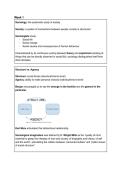
Structure vs. Agency
Structure: social forces (structural/macro-level)
Agency: ability to make personal choices (individual/micro-level)
Berger encouraged us to see the strange in the familiar and the general in the
particular.
Karl Marx articulated this bidirectional relationship.
Sociological imagination was defined by C. Wright Mills as the “quality of mind
essential to grasp the interplay of man and society, of biography and history, of self
and the world”, articulating the relation between “personal troubles” and “public issues
of social structure”.
,Mills jabbed at sociologists for not assuming any personal responsibility for improving
society: sociological imagination isn’t only about thinking, but about action, the
connection between the action and thought being praxis (see later).
Why is sociology important?
It helps us understand the root causes of social issues (such as inequality, terrorism,
racism, etc.), the comprehension of which would translate into meaningful action
(ideally) and upend the status quo.
Fletcher argued it is of “central importance in and for our time”. He also emphasized
empirical methods in his remarks about “reliable knowledge” serving as the basis of
social action.
Land acknowledgments, immigration and rising international student enrolment are
things relevant to UofT/Toronto/Canada that can be seen “sociologically”.
Max Weber came up with life chances: the varying opportunities that people are
given in life based on socioeconomic status, race, ethnicity, and gender.
The higher one's socioeconomic status, the more life chances one gets. A study by
Stephen Sartor shows that from the 1960s until the 2010s, parental education is a
strong predictor of their children’s educational attainment.
The dark side to the sociological imagination
Prof. Brett theorizes that the fundamental sociological realization that agency is much
less powerful and important than structure, may lead to learned helplessness, fatalism
and an external locus of control.
Norms are expectations for how we are supposed to act, think and look.
Norms are reinforced through social consequences
History of sociology
Arguably the first known sociologist, Ibn Khaldun recognized that as groups grew in
size, labour was no longer used for survival but for pursuit of luxury for the wealthy
and powerful (the select few). But sociology only really reached its apex during the
,18th and 19th centuries, largely as the result of European scholars gaining
unprecedented exposure to other societies residing in newly conquered or colonized
territories in virtually every corner of the world.
As colonization fuelled the Industrial Revolution, Europe became increasingly
urbanized and commercialized and new social hierarchies were formed, so there was
greater need for sociologists to study and explain the rapid changes that were
occurring throughout all facets of society in front of their very eyes.
Excerpt from textbook:
Auguste Comte suggested that scientific methods could be used to study social life.
He reintroduced the term “sociology” (sociologie) although Emmanuel-Joseph
Sieyes technically coined it first.
According to Comte, sociology would focus on 2 key dimensions of society:
● social organization (statics)
● social change (dynamics)
Week 2
Theory: a set of propositions intended to explain a fact or phenomenon.
3 types of approaches to theories:
● Positivist: seek objective explanation and prediction (stem from natural
sciences)
● Interpretive: focus on understanding themselves, others and the world around
, them.
● Critical: focus on the role that power plays in social processes and why some
people’s understandings of the world become dominant
Classical sociological theories: developed in early years and foundation of
subsequent theories.
Contemporary sociological theories: developed since the mid-20th century.
Core theoretical perspectives:
FUNCTIONALIST (MACRO-LEVEL + POSITIVIST)
● Manifest functions: intended functions that particular structures are meant to
fulfil, e.g. education is supposed to teach you knowledge and skills.
● Latent functions: unintended functions that nevertheless have a positive
impact, e.g. student social life)
● Latent dysfunctions: are unintended functions that have a negative impact
(e.g. student mental health)
Emile Durhkeim: another founding father of sociology, key figure in functionalism. He
,studied social facts:
● Material social facts (money, government, education, etc.)
● Non-material social facts (morals, norms, values, etc.)
Mechanical solidarity (pre-modern) arose from collective consciousness
Organic solidarity (modern) arose from inter-dependence
Anomie: traditional norms deteriorate, processes of social control decline and
institutions become dysfunctional.
Durkheim theorized that during times of rapid social change, people become
unregulated because of the breakdown of old norms, leading to anomic suicide.
CONFLICT (MACRO-LEVEL + CRITICAL)
Karl Marx was a critic of the capitalist system where the bourgeoisie own the means
of production and the proletariat majority own little to nothing and have no choice but
to work for the bourgeoisie in exchange for wages.
Durkheim saw this as organic solidarity, while Marx saw it as exploitative and marked
by conflict and tensions.
According to Marx,
● The bourgeoisie make profit out of the proletariat’s labor by extracting surplus
value: selling goods at a higher price than they cost to produce.
● Consequently, workers experience alienation from the product of their labor,
and in extreme cases, their own humanity.
● Marx encouraged praxis, i.e. providing subordinated groups in society with the
, knowledge they need to end their powerlessness.
SYMBOLIC INTERACTIONIST (MICRO-LEVEL + INTERPRETIVE)
Society is composed of individuals engaged in various forms of communication, e.g.
words, facial expressions, gestures, clothing, etc.
● Significant others: specific people important to us and play a role in our
socialization, e.g. “What will my parents think?”
● Generalized other: overall abstract sense of people’s expectations of us, e.g.
“What will people think?”
(We develop the latter as we grow up)
Erving Goffman proposed the theory of dramaturgy, conceptualizing social life as a
theatre:
● The front stage is where we perform a certain social role
● The back stage is where we discard this social role
Impression management ensures that our appearances, words and actions
correspond to the role we are playing.
Total institutions: places where people are segregated from the outside world and
may take on a specific social role and identity (e.g. schools, hospitals, military
academy, prisons, etc.)
FEMINIST (MACRO/MICRO-LEVEL + CRITICAL)
Micro-level: how individuals make choices, perform everyday activities, interact with
partners and socialize with children.
Macro-level: how social structures can change, sometimes through social
movements (e.g. women’s suffrage)
Patriarchy is a social structure where legal and social power is concentrated in the
hands of men.
● Feminist perspectives contend that academia has been traditionally
androcentric, meaning male-centered, or taking men’s experiences as the
normative human experience.
● Feminist perspectives assume that society is structured on the basis of gender
, (macro-level) so individual experiences are also gendered (micro-level).
● Feminist perspectives contend that research and theory must be intertwined
with practice.
Harriet Martineau, was an early feminist sociologist who advocated for social reform
for women and the abolition of slavery.
Dorothy Smith theorized that because men and women have occupied different
positions in society, they have developed distinct standpoints (which arise from
social identities in contrast to viewpoints)
POSTMODERN (MACRO-LEVEL + INTERPRETIVE)
Skeptical postmodernism: social changes have created too much chaos that we
now struggle to understand the world sociologically.
Affirmative postmodernism: due to rapid societal changes, we cannot rely on grand
theories of society or broad categorizations of people. Postmodernists seek to
deconstruct what is perceived as “knowledge”.
● Some consider poststructuralism a form of postmodernism (assume this
viewpoint throughout the course).
● Poststructuralists state that there is no objective truth, but the “truth” is
historically produced in relation to knowledge and power.
● Michel Foucault argued that power is expressed through discourse: ways of
talking about a social phenomenon, or the body of knowledge about that
phenomenon, e.g. what is masculinity/femininity?
Applying theory to empirical evidence
Sociology: the systematic study of society
Society: a system of connections between people; society is structured
Sociologists study:
- Social life
- Social change
- Social causes and consequences of human behaviour
Characterized by its continuous cycling between theory and empiricism (looking at
things that can be directly observed in social life), sociology distinguishes itself from
other disciples.
Structure vs. Agency
Structure: social forces (structural/macro-level)
Agency: ability to make personal choices (individual/micro-level)
Berger encouraged us to see the strange in the familiar and the general in the
particular.
Karl Marx articulated this bidirectional relationship.
Sociological imagination was defined by C. Wright Mills as the “quality of mind
essential to grasp the interplay of man and society, of biography and history, of self
and the world”, articulating the relation between “personal troubles” and “public issues
of social structure”.
,Mills jabbed at sociologists for not assuming any personal responsibility for improving
society: sociological imagination isn’t only about thinking, but about action, the
connection between the action and thought being praxis (see later).
Why is sociology important?
It helps us understand the root causes of social issues (such as inequality, terrorism,
racism, etc.), the comprehension of which would translate into meaningful action
(ideally) and upend the status quo.
Fletcher argued it is of “central importance in and for our time”. He also emphasized
empirical methods in his remarks about “reliable knowledge” serving as the basis of
social action.
Land acknowledgments, immigration and rising international student enrolment are
things relevant to UofT/Toronto/Canada that can be seen “sociologically”.
Max Weber came up with life chances: the varying opportunities that people are
given in life based on socioeconomic status, race, ethnicity, and gender.
The higher one's socioeconomic status, the more life chances one gets. A study by
Stephen Sartor shows that from the 1960s until the 2010s, parental education is a
strong predictor of their children’s educational attainment.
The dark side to the sociological imagination
Prof. Brett theorizes that the fundamental sociological realization that agency is much
less powerful and important than structure, may lead to learned helplessness, fatalism
and an external locus of control.
Norms are expectations for how we are supposed to act, think and look.
Norms are reinforced through social consequences
History of sociology
Arguably the first known sociologist, Ibn Khaldun recognized that as groups grew in
size, labour was no longer used for survival but for pursuit of luxury for the wealthy
and powerful (the select few). But sociology only really reached its apex during the
,18th and 19th centuries, largely as the result of European scholars gaining
unprecedented exposure to other societies residing in newly conquered or colonized
territories in virtually every corner of the world.
As colonization fuelled the Industrial Revolution, Europe became increasingly
urbanized and commercialized and new social hierarchies were formed, so there was
greater need for sociologists to study and explain the rapid changes that were
occurring throughout all facets of society in front of their very eyes.
Excerpt from textbook:
Auguste Comte suggested that scientific methods could be used to study social life.
He reintroduced the term “sociology” (sociologie) although Emmanuel-Joseph
Sieyes technically coined it first.
According to Comte, sociology would focus on 2 key dimensions of society:
● social organization (statics)
● social change (dynamics)
Week 2
Theory: a set of propositions intended to explain a fact or phenomenon.
3 types of approaches to theories:
● Positivist: seek objective explanation and prediction (stem from natural
sciences)
● Interpretive: focus on understanding themselves, others and the world around
, them.
● Critical: focus on the role that power plays in social processes and why some
people’s understandings of the world become dominant
Classical sociological theories: developed in early years and foundation of
subsequent theories.
Contemporary sociological theories: developed since the mid-20th century.
Core theoretical perspectives:
FUNCTIONALIST (MACRO-LEVEL + POSITIVIST)
● Manifest functions: intended functions that particular structures are meant to
fulfil, e.g. education is supposed to teach you knowledge and skills.
● Latent functions: unintended functions that nevertheless have a positive
impact, e.g. student social life)
● Latent dysfunctions: are unintended functions that have a negative impact
(e.g. student mental health)
Emile Durhkeim: another founding father of sociology, key figure in functionalism. He
,studied social facts:
● Material social facts (money, government, education, etc.)
● Non-material social facts (morals, norms, values, etc.)
Mechanical solidarity (pre-modern) arose from collective consciousness
Organic solidarity (modern) arose from inter-dependence
Anomie: traditional norms deteriorate, processes of social control decline and
institutions become dysfunctional.
Durkheim theorized that during times of rapid social change, people become
unregulated because of the breakdown of old norms, leading to anomic suicide.
CONFLICT (MACRO-LEVEL + CRITICAL)
Karl Marx was a critic of the capitalist system where the bourgeoisie own the means
of production and the proletariat majority own little to nothing and have no choice but
to work for the bourgeoisie in exchange for wages.
Durkheim saw this as organic solidarity, while Marx saw it as exploitative and marked
by conflict and tensions.
According to Marx,
● The bourgeoisie make profit out of the proletariat’s labor by extracting surplus
value: selling goods at a higher price than they cost to produce.
● Consequently, workers experience alienation from the product of their labor,
and in extreme cases, their own humanity.
● Marx encouraged praxis, i.e. providing subordinated groups in society with the
, knowledge they need to end their powerlessness.
SYMBOLIC INTERACTIONIST (MICRO-LEVEL + INTERPRETIVE)
Society is composed of individuals engaged in various forms of communication, e.g.
words, facial expressions, gestures, clothing, etc.
● Significant others: specific people important to us and play a role in our
socialization, e.g. “What will my parents think?”
● Generalized other: overall abstract sense of people’s expectations of us, e.g.
“What will people think?”
(We develop the latter as we grow up)
Erving Goffman proposed the theory of dramaturgy, conceptualizing social life as a
theatre:
● The front stage is where we perform a certain social role
● The back stage is where we discard this social role
Impression management ensures that our appearances, words and actions
correspond to the role we are playing.
Total institutions: places where people are segregated from the outside world and
may take on a specific social role and identity (e.g. schools, hospitals, military
academy, prisons, etc.)
FEMINIST (MACRO/MICRO-LEVEL + CRITICAL)
Micro-level: how individuals make choices, perform everyday activities, interact with
partners and socialize with children.
Macro-level: how social structures can change, sometimes through social
movements (e.g. women’s suffrage)
Patriarchy is a social structure where legal and social power is concentrated in the
hands of men.
● Feminist perspectives contend that academia has been traditionally
androcentric, meaning male-centered, or taking men’s experiences as the
normative human experience.
● Feminist perspectives assume that society is structured on the basis of gender
, (macro-level) so individual experiences are also gendered (micro-level).
● Feminist perspectives contend that research and theory must be intertwined
with practice.
Harriet Martineau, was an early feminist sociologist who advocated for social reform
for women and the abolition of slavery.
Dorothy Smith theorized that because men and women have occupied different
positions in society, they have developed distinct standpoints (which arise from
social identities in contrast to viewpoints)
POSTMODERN (MACRO-LEVEL + INTERPRETIVE)
Skeptical postmodernism: social changes have created too much chaos that we
now struggle to understand the world sociologically.
Affirmative postmodernism: due to rapid societal changes, we cannot rely on grand
theories of society or broad categorizations of people. Postmodernists seek to
deconstruct what is perceived as “knowledge”.
● Some consider poststructuralism a form of postmodernism (assume this
viewpoint throughout the course).
● Poststructuralists state that there is no objective truth, but the “truth” is
historically produced in relation to knowledge and power.
● Michel Foucault argued that power is expressed through discourse: ways of
talking about a social phenomenon, or the body of knowledge about that
phenomenon, e.g. what is masculinity/femininity?
Applying theory to empirical evidence