

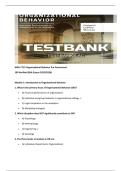
WGU C715 Organizational Behavior Pre-Assessment
100 Verified Q&A (Latest 2025/2026)
Module 1: Introduction to Organizational Behavior
1. What is the primary focus of Organizational Behavior (OB)?
• A) Financial performance of organizations
• B) Individual and group behavior in organizational settings ✓
• C) Legal compliance in the workplace
• D) Marketing strategies
2. Which discipline does NOT significantly contribute to OB?
• A) Psychology
• B) Anthropology
• C) Engineering ✓
• D) Sociology
3. The three levels of analysis in OB are:
• A) Individual, Department, Organizational
, • B) Individual, Group, Organizational ✓
• C) Employee, Manager, Executive
• D) Micro, Meso, Macro
4. Evidence-based management complements systematic study by:
• A) Relying solely on intuition
• B) Using scientific evidence to inform decisions ✓
• C) Eliminating the need for data analysis
• D) Focusing only on qualitative data
Module 2: Diversity and Individual Differences
5. Surface-level diversity refers to:
• A) Personality differences
• B) Differences in values and beliefs
• C) Demographic characteristics like age and race ✓
• D) Cognitive abilities
6. Which is NOT one of the Big Five personality traits?
• A) Openness to experience
• B) Emotional stability
• C) Agreeableness
• D) Optimism ✓
7. Emotional intelligence involves the ability to:
• A) Suppress all emotions at work
• B) Recognize and manage one's own and others' emotions ✓
• C) Use emotions to manipulate others
• D) Eliminate emotional responses
8. People with high self-monitoring:
, • A) Are unaware of how others see them
• B) Adjust their behavior to external situations ✓
• C) Always behave consistently
• D) Avoid social interactions
9. The Myers-Briggs Type Indicator classifies people by all EXCEPT:
• A) Thinking vs. Feeling
• B) Introverted vs. Extraverted
• C) Stable vs. Neurotic ✓
• D) Judging vs. Perceiving
10. Deep-level diversity becomes more important than surface-level diversity:
• A) During initial interactions
• B) As people get to know each other better ✓
• C) In recruitment processes
• D) When making first impressions
Module 3: Attitudes and Job Satisfaction
11. The three components of an attitude are:
• A) Belief, Behavior, Consequence
• B) Cognitive, Affective, Behavioral ✓
• C) Thought, Emotion, Action
• D) Knowledge, Feeling, Intention
12. Cognitive dissonance occurs when:
• A) Attitudes and behaviors are consistent
• B) There's inconsistency between attitudes and behaviors ✓
• C) Emotions override logic
• D) Behavior follows attitudes perfectly
, 13. Job satisfaction is best predicted by:
• A) Salary alone
• B) Personality and fit with work environment ✓
• C) Number of vacation days
• D) Office size
14. The most significant consequence of job satisfaction is:
• A) Increased creativity
• B) Higher life satisfaction
• C) Reduced turnover and absenteeism ✓
• D) Better customer service
15. Organizational commitment includes all EXCEPT:
• A) Affective commitment
• B) Continuance commitment
• C) Regulatory commitment ✓
• D) Normative commitment
Module 4: Motivation Concepts
16. Maslow's hierarchy of needs progresses from:
• A) Self-actualization to physiological needs
• B) Psychological to social needs
• C) Physiological to self-actualization needs ✓
• D) External to internal needs
17. According to Herzberg, which factors lead to satisfaction?
• A) Hygiene factors
• B) Motivators ✓
• C) Extrinsic factors
100 Verified Q&A (Latest 2025/2026)
Module 1: Introduction to Organizational Behavior
1. What is the primary focus of Organizational Behavior (OB)?
• A) Financial performance of organizations
• B) Individual and group behavior in organizational settings ✓
• C) Legal compliance in the workplace
• D) Marketing strategies
2. Which discipline does NOT significantly contribute to OB?
• A) Psychology
• B) Anthropology
• C) Engineering ✓
• D) Sociology
3. The three levels of analysis in OB are:
• A) Individual, Department, Organizational
, • B) Individual, Group, Organizational ✓
• C) Employee, Manager, Executive
• D) Micro, Meso, Macro
4. Evidence-based management complements systematic study by:
• A) Relying solely on intuition
• B) Using scientific evidence to inform decisions ✓
• C) Eliminating the need for data analysis
• D) Focusing only on qualitative data
Module 2: Diversity and Individual Differences
5. Surface-level diversity refers to:
• A) Personality differences
• B) Differences in values and beliefs
• C) Demographic characteristics like age and race ✓
• D) Cognitive abilities
6. Which is NOT one of the Big Five personality traits?
• A) Openness to experience
• B) Emotional stability
• C) Agreeableness
• D) Optimism ✓
7. Emotional intelligence involves the ability to:
• A) Suppress all emotions at work
• B) Recognize and manage one's own and others' emotions ✓
• C) Use emotions to manipulate others
• D) Eliminate emotional responses
8. People with high self-monitoring:
, • A) Are unaware of how others see them
• B) Adjust their behavior to external situations ✓
• C) Always behave consistently
• D) Avoid social interactions
9. The Myers-Briggs Type Indicator classifies people by all EXCEPT:
• A) Thinking vs. Feeling
• B) Introverted vs. Extraverted
• C) Stable vs. Neurotic ✓
• D) Judging vs. Perceiving
10. Deep-level diversity becomes more important than surface-level diversity:
• A) During initial interactions
• B) As people get to know each other better ✓
• C) In recruitment processes
• D) When making first impressions
Module 3: Attitudes and Job Satisfaction
11. The three components of an attitude are:
• A) Belief, Behavior, Consequence
• B) Cognitive, Affective, Behavioral ✓
• C) Thought, Emotion, Action
• D) Knowledge, Feeling, Intention
12. Cognitive dissonance occurs when:
• A) Attitudes and behaviors are consistent
• B) There's inconsistency between attitudes and behaviors ✓
• C) Emotions override logic
• D) Behavior follows attitudes perfectly
, 13. Job satisfaction is best predicted by:
• A) Salary alone
• B) Personality and fit with work environment ✓
• C) Number of vacation days
• D) Office size
14. The most significant consequence of job satisfaction is:
• A) Increased creativity
• B) Higher life satisfaction
• C) Reduced turnover and absenteeism ✓
• D) Better customer service
15. Organizational commitment includes all EXCEPT:
• A) Affective commitment
• B) Continuance commitment
• C) Regulatory commitment ✓
• D) Normative commitment
Module 4: Motivation Concepts
16. Maslow's hierarchy of needs progresses from:
• A) Self-actualization to physiological needs
• B) Psychological to social needs
• C) Physiological to self-actualization needs ✓
• D) External to internal needs
17. According to Herzberg, which factors lead to satisfaction?
• A) Hygiene factors
• B) Motivators ✓
• C) Extrinsic factors

