

Public relations and reputation management
Lecture 1- Introduction and stakeholder communication
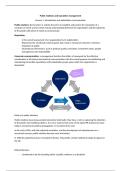
Public relations: the function or activity that aims to establish and protect the reputation of a
company or brand, and to create mutual understanding between the organization and the segments
of the public with whom it needs to communicate
Reputation:
- Is the overall assessment of an organization by its stakeholders
- Represents the emotional reaction (good, bad, weak or strong) of costumers, investors,
employees & public
- Encompasses dimensions, such as product quality, innovation, investment value, people
management and responsibility
Corporate communication: a management function that offers a framework for the effective
coordination of all internal and external communication with the overall purpose of establishing and
maintaining favourable reputations with stakeholder groups upon which the organization is
dependent
History of public relations:
Public relations have always existed somewhat informally: they have a role in capturing the attention
of the public and mobilizing citizens. It is not a surprise that some of the oldest PR material we have
today is connected to political propaganda, or recruitment for wars
In the early 1900s, with the industrial revolution, and the development of advertisement as a
structured concept, public relations became more formalized
In 1900 the publicity bureau is founded in Boston. Meanwhile, similar institutions begin to appear in
the UK
Edward Bernays:
- Considered to be the founding father of public relations as a discipline
, - Was the nephew of Freud and deeply influenced by his theories about the subconscious
- Introduced the concept of the focus group and worked with tobacco brands and other
controversial products
- Made bacon & eggs a famous American breakfast through PR
Public relations in the 1980s:
- Restructuring trend: all activities within an organization evaluated on the basis of what they
contribute to the organization
- Communication professional are consolidated in PR departments and procedures are
established for the whole organization
Public relations in the 1990s:
- Strategic positioning: organizations use PR as a way to achieve a competitive corporate
identity
- Communication professionals have the role to shape an organization’s brand, which can be
conveniently ‘’positioned’’ within the minds of stakeholders
Public relations in the 2000s:
- Stakeholder engagement: thanks to new media, stakeholders become real participants in an
organization’s public relations
- Old principles of strategic communication still apply, but the relationship with stakeholders
becomes a dialogue rather than a one-directional communication
Nowadays public relations is:
- More complex, technical and precise
- Divided into different areas, require different talents and
specializations
- Driven by technological changes (new media)
,In modern language, a stake is a symbol for having an interest (monetary or otherwise) in something
Stakeholder: any group or individual who can affect or is affected by the achievements of the
organization’s purpose and objectives
Strategic management: two views
Theory: Neo-classical Economic Theory: Socio-Economic
Main objective: maximise profits Main objective: mediate between interests
Input-output model:
- The input-output model assumes that the value of the organization is a pie, and that only the
interests of those who own a slice should matter
- That is why the input-output model is also called the share-holder model
Four elements behind input-output model:
, H&M under the input-output model:
Four elements behind stakeholder model:
H&M under the stakeholder model
Lecture 1- Introduction and stakeholder communication
Public relations: the function or activity that aims to establish and protect the reputation of a
company or brand, and to create mutual understanding between the organization and the segments
of the public with whom it needs to communicate
Reputation:
- Is the overall assessment of an organization by its stakeholders
- Represents the emotional reaction (good, bad, weak or strong) of costumers, investors,
employees & public
- Encompasses dimensions, such as product quality, innovation, investment value, people
management and responsibility
Corporate communication: a management function that offers a framework for the effective
coordination of all internal and external communication with the overall purpose of establishing and
maintaining favourable reputations with stakeholder groups upon which the organization is
dependent
History of public relations:
Public relations have always existed somewhat informally: they have a role in capturing the attention
of the public and mobilizing citizens. It is not a surprise that some of the oldest PR material we have
today is connected to political propaganda, or recruitment for wars
In the early 1900s, with the industrial revolution, and the development of advertisement as a
structured concept, public relations became more formalized
In 1900 the publicity bureau is founded in Boston. Meanwhile, similar institutions begin to appear in
the UK
Edward Bernays:
- Considered to be the founding father of public relations as a discipline
, - Was the nephew of Freud and deeply influenced by his theories about the subconscious
- Introduced the concept of the focus group and worked with tobacco brands and other
controversial products
- Made bacon & eggs a famous American breakfast through PR
Public relations in the 1980s:
- Restructuring trend: all activities within an organization evaluated on the basis of what they
contribute to the organization
- Communication professional are consolidated in PR departments and procedures are
established for the whole organization
Public relations in the 1990s:
- Strategic positioning: organizations use PR as a way to achieve a competitive corporate
identity
- Communication professionals have the role to shape an organization’s brand, which can be
conveniently ‘’positioned’’ within the minds of stakeholders
Public relations in the 2000s:
- Stakeholder engagement: thanks to new media, stakeholders become real participants in an
organization’s public relations
- Old principles of strategic communication still apply, but the relationship with stakeholders
becomes a dialogue rather than a one-directional communication
Nowadays public relations is:
- More complex, technical and precise
- Divided into different areas, require different talents and
specializations
- Driven by technological changes (new media)
,In modern language, a stake is a symbol for having an interest (monetary or otherwise) in something
Stakeholder: any group or individual who can affect or is affected by the achievements of the
organization’s purpose and objectives
Strategic management: two views
Theory: Neo-classical Economic Theory: Socio-Economic
Main objective: maximise profits Main objective: mediate between interests
Input-output model:
- The input-output model assumes that the value of the organization is a pie, and that only the
interests of those who own a slice should matter
- That is why the input-output model is also called the share-holder model
Four elements behind input-output model:
, H&M under the input-output model:
Four elements behind stakeholder model:
H&M under the stakeholder model

