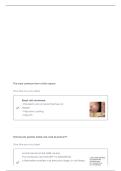
The most common form of skin cancer
Give this one a try later!
Basal cell carcinoma
• Persistent sore or lesion that has not
healed
• May have crusting
• May itch
Normocytic anemia. Sickle cell, look at picture??
Give this one a try later!
normal size & normal HGB volume
The red blood cell MATURITY is ABNORMAL
o Maturation problem is at precursor stage, or cell keeps
, maturing to large size. R/t folic acid, vitamin B12 deficiency,
hereditary disorders iron deficiency, sideroblastic anemia
Normocytic-normochromic
White blood cells are divided into?
Give this one a try later!
granulocytes and non-granulocytes. Granulocytes include neutrophils,
basophils, and eosinophils.
Rubella (German Measles)
Give this one a try later!
· "3-day measles" Very mild. Maculopapular rash progresses
from face down. Some lesions on soft palate. Gone by 4th
day. Teratogenic to fetus- blindness, heart problems, IUGR,
deafness.
Drug eruption rash
Give this one a try later!
, Immunologically mediated cutaneous
reactions to medications include immunoglobulin E (IgE)-
dependent, cytotoxic, immune complex, and cell-mediated
hypersensitivity reactions.
Laboratory
Hgb<12g/dL ↓
Hct<35% ↓
Serum Iron ↑
Ferritin<12ug/L ↑
MCV ↑
MCHC ↔
Retic Count ↓
TIBC250-450ug/dL ↔
RDW ↑
Bilirubin ↔/↑
Serum Folate ↓
Give this one a try later!
Folate Deficiency(MCV > 100fL Macrocytic
(Pernicious Anemia))
No Dosepack!- 21 days tx needed
Give this one a try later!
poison ivy
, candididasis yeast, candida albicans
Give this one a try later!
typically the diaper area. Rash is confluent with satellite
papules. Yeast is treated with Nystatin.
actinic keratosis-Occurs secondary to chronic sun damage
Give this one a try later!
Slightly raised erythematous lesion that is
usually less than 1 cm in diameter with an
irregular, rough surface
Onycholysis
Give this one a try later!
Lifting of the nail plate from the nail bed without shedding,
usually beginning at the free edge and continuing toward
the lunula area.
often coexists with a yeast infection.
Contact irritants, trauma, & moisture are the most common
causes; some association with psoriasis
Give this one a try later!
Basal cell carcinoma
• Persistent sore or lesion that has not
healed
• May have crusting
• May itch
Normocytic anemia. Sickle cell, look at picture??
Give this one a try later!
normal size & normal HGB volume
The red blood cell MATURITY is ABNORMAL
o Maturation problem is at precursor stage, or cell keeps
, maturing to large size. R/t folic acid, vitamin B12 deficiency,
hereditary disorders iron deficiency, sideroblastic anemia
Normocytic-normochromic
White blood cells are divided into?
Give this one a try later!
granulocytes and non-granulocytes. Granulocytes include neutrophils,
basophils, and eosinophils.
Rubella (German Measles)
Give this one a try later!
· "3-day measles" Very mild. Maculopapular rash progresses
from face down. Some lesions on soft palate. Gone by 4th
day. Teratogenic to fetus- blindness, heart problems, IUGR,
deafness.
Drug eruption rash
Give this one a try later!
, Immunologically mediated cutaneous
reactions to medications include immunoglobulin E (IgE)-
dependent, cytotoxic, immune complex, and cell-mediated
hypersensitivity reactions.
Laboratory
Hgb<12g/dL ↓
Hct<35% ↓
Serum Iron ↑
Ferritin<12ug/L ↑
MCV ↑
MCHC ↔
Retic Count ↓
TIBC250-450ug/dL ↔
RDW ↑
Bilirubin ↔/↑
Serum Folate ↓
Give this one a try later!
Folate Deficiency(MCV > 100fL Macrocytic
(Pernicious Anemia))
No Dosepack!- 21 days tx needed
Give this one a try later!
poison ivy
, candididasis yeast, candida albicans
Give this one a try later!
typically the diaper area. Rash is confluent with satellite
papules. Yeast is treated with Nystatin.
actinic keratosis-Occurs secondary to chronic sun damage
Give this one a try later!
Slightly raised erythematous lesion that is
usually less than 1 cm in diameter with an
irregular, rough surface
Onycholysis
Give this one a try later!
Lifting of the nail plate from the nail bed without shedding,
usually beginning at the free edge and continuing toward
the lunula area.
often coexists with a yeast infection.
Contact irritants, trauma, & moisture are the most common
causes; some association with psoriasis