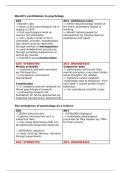
Wundt’s contribution to psychology
AO1 AO1- additional notes
- (Wundt’s lab) -> before Wundt biology looked at
-> gave us first psychological lab in the brain, philosophy looked at
Leipzig in 1879 thinking
-> first psychological work as -> Wundt trained people for
science not philosophy introspection by training them to
-> aim= study human mind in experience and report
controlled, scientific, standardised
way which could be replicated
through method of introspection
-> used standardised procedures
through recording experiences of
stimuli eg. Sounds
-> therefore used structuralism
AO3- STRENGTHS AO3- WEAKNESSES
Mostly scientific Subjective data
-> systematic and well-controlled -> participants self-record their
eg. Introspection mental processes, may have hidden
-> procedures/ instructions some thoughts, not reliable
standardised -> therefore cannot establish
‘meaningful laws of behaviour’ from
Contribution such data + cannot predict future
-> 1st academic journal/ textbook for behaviour
future psychological research -> not considered scientific today
-> pioneering research set
foundation for future approaches eg.
Cognitive neuroscience, behaviourist
The emergence of psychology as a science
AO1 AO1
- (1920s) behaviourists - (1970s/90s) biological
-> ignores introspection as it is -> investigate physiological
subjective data processes as they happen eg. FMRI
-> only study phenomena that can for brain activity
be objectively measured/ observed
- (1950s/60s) cognitive
-> study mind eg. Memory, attention
through experiments
AO3- STRENGTHS AO3- WEAKNESSES
, Modern psychology considered Subjective data
scientific -> not all approaches use objective
-> aims to describe/ methods
understand/predict/ manipulate -> humanists reject scientific
behaviour approach completely to focus on
-> scientific methods to investigate individual subjective experiences
theories in controlled/ objective way -> psychodynamic all in the
eg. Biological brain scans unconscious, cannot falsify
Not a paradigm
-> (Kuhn) science should have a set
of principles/ theories that ALL who
work within that subject agree on
Learning approaches- the behaviourist approach
AO1- key beliefs AO1- key studies
-> all behaviour is due to learning - (Pavlov)
through CC/ OC and experience -> studied CC
(‘tabula rasa’ born with mind as -> experimented with dogs who
blank slate, written on with learned to salivate at the sound of a
experience- John Locke) bell
-> values over, observable UCS (food)= UCR (salivation/
behaviour and ignores all internal hunger)
mental processes UCS + NS (bell)= UCR (repeated)
-> focus on stimulus-response CS (bell)= CR (salivation/ hunger)
- (Skinner)
-> studied OC with rats/ pigeons
and a ‘Skinner’s box’'
-> research in positive
reinforcement, negative
reinforcement
AO3- STRENGTHS AO3- WEAKNESSES
Scientific Reductionistic
-> high- control as lab setting -> oversimplifies behaviour
-> measure observable behaviour -> ignores internal processes eg.
only Mood
-> stimulus- response focus -> more complex than observable
eliminates extraneous variables behaviour alone
-> can establish cause and effect
Environmental determinism
Real-world application -> all current behaviour is a result of
-> applied to real- world behaviours/ past reinforcement