SUMMARY PHYSICAL EDUCATION IGCSE CAMBRIDGE
This summary does not include any pictures for copyright reasons.
Unit 1
Bone: a hard tissue that forms the skeleton, they are lightweight
however strong and perform many functions.
Skeleton: the internal organization of the bones (206 in total)
that shape the body.
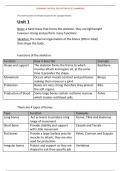
Functions of the skeleton:
Function How it does this Example
Shape and support The skeleton forms the frame to which Backbone
muscles attach and organs sit, at the same
time it provides the shape.
Movement Occurs when mucles contract and pull bones Biceps
making them move on a joint.
Protection Bones are very strong therefore they protect Ribs
the soft organs.
Production of blood Some large bones contain red bone marrow Pelvis
which creates red blood cells.
There are 4 types of bones:
Type Function Examples
Long bones Act as levers to produce a big Femur, Tibia and Humerus
range of movement
Short bone Provide stability and support Carpals and Tarsals
with Little movement
Flat bones Provide a large Surface area for Pelvis, Cranium and Scapula
muscles to attach, they are also
used for protection
Irregular bones Protect and support as they are Vertebrae
shaped to suit their specific job
, SUMMARY PHYSICAL EDUCATION IGCSE CAMBRIDGE
While practicing sports the skeleton is put under pressure so all
of its various functions can operate.
Joint: a point in the body where 2 or more bones join allowing
movement
There are 3 types of joints:
Type Description Example
Fixed/Immovable These cannot move, thay are In the skull
also known as fibrous joints
Slightly moveable Can move a little bit as they are Vertreba
linked by ligaments and
cartilages
Freely moveable Also known as Synovial joints Knee
and they are more complex tan
the other types
Cartilage: a flexible and firm connective tissue which absorbs the
movement and acts as a cushion to stop bones from touching.
The freely moveable joint has several parts:
Role Part
A strong band of tissue which connects muscles to Tendon
bones and withstands tension
It is flexible and strong located at the end of the Cartilage
bone and acts as a cushionto prevent bones from
touching
Strong elastic fibres which hold bones together. Ligament
Surrounds and protects the joint holding the bones Joint capsule
together made of a fibrous membrane and a sinovial
membrane
Acts as a lubricant to reduce friction therefore Synovial fluid
prevents wear and tear
Surrounds the joint capsule containing sinovial fluid Synovial membrane
, SUMMARY PHYSICAL EDUCATION IGCSE CAMBRIDGE
There are 2 main types of sinovial joints, ball and socket joint
and hinge joint:
Ball and socket joint:
Shoulder and hip
Large range of motion in every direction
Bone has a bulge/ball that fits in the socket of the other
bone
Less stable
Hinge joint:
Elbow and knee
Allow movement in one direction
Movement is bend or straighten
More stable
There more motion a joint has the less stable it is therefore the
more prone of injury it is. The less stable joint relies more on the
surrounding structures (muscles, ligaments…) that stabilises
them. During exercise joints receive lots of stress and pressure so
they can be quite easily injured such as a sprain (this is when 1 or
more ligaments are twisted, stretched or torn).
Joints in the upper body help humans move while the joints in
the lower body the joints are used to stabilise and balance.
There are 8 types of different movements which can be grouped
in 4 pairs which are opposite.
, SUMMARY PHYSICAL EDUCATION IGCSE CAMBRIDGE
Movement. Explanation.
Pair 1 Flexion Bending a part of the body
away from the body
Extension Straightening a part of the
body
Pair 2 Abduction Sideways movement away
form the body
Adduction Sideways movement towards
the body
Pair 3 Rotation Rotating on itself on an
imaginary axis
Circumduction Moving a limb in circles
Pair 4 Plantar flexion Moving toes away from the
tibia
Dorsiflexion Moving toes towards the tibia
Muscle: a band of fibrous tissue which contracts to produce
movement, there are between 650 and 840 muscles in the body,
here are the main voluntary muscles.
Sport. Muscle. Action.
Swimming Trapezius Rotates and holds the shoulder and moves
your head
Badminton Deltoids Rises the arms forwards, backwards and
sideways
Tennis Pectorals Moves the arms through adduction
Archery Biceps Bends the arm at the elbow
Javelin Tricep Straightens the arm
Pull ups Latissimus dorsi Pulls the arms down or towards you
(lats)
Rowing Abdominals (abs) Flexes your spine
This summary does not include any pictures for copyright reasons.
Unit 1
Bone: a hard tissue that forms the skeleton, they are lightweight
however strong and perform many functions.
Skeleton: the internal organization of the bones (206 in total)
that shape the body.
Functions of the skeleton:
Function How it does this Example
Shape and support The skeleton forms the frame to which Backbone
muscles attach and organs sit, at the same
time it provides the shape.
Movement Occurs when mucles contract and pull bones Biceps
making them move on a joint.
Protection Bones are very strong therefore they protect Ribs
the soft organs.
Production of blood Some large bones contain red bone marrow Pelvis
which creates red blood cells.
There are 4 types of bones:
Type Function Examples
Long bones Act as levers to produce a big Femur, Tibia and Humerus
range of movement
Short bone Provide stability and support Carpals and Tarsals
with Little movement
Flat bones Provide a large Surface area for Pelvis, Cranium and Scapula
muscles to attach, they are also
used for protection
Irregular bones Protect and support as they are Vertebrae
shaped to suit their specific job
, SUMMARY PHYSICAL EDUCATION IGCSE CAMBRIDGE
While practicing sports the skeleton is put under pressure so all
of its various functions can operate.
Joint: a point in the body where 2 or more bones join allowing
movement
There are 3 types of joints:
Type Description Example
Fixed/Immovable These cannot move, thay are In the skull
also known as fibrous joints
Slightly moveable Can move a little bit as they are Vertreba
linked by ligaments and
cartilages
Freely moveable Also known as Synovial joints Knee
and they are more complex tan
the other types
Cartilage: a flexible and firm connective tissue which absorbs the
movement and acts as a cushion to stop bones from touching.
The freely moveable joint has several parts:
Role Part
A strong band of tissue which connects muscles to Tendon
bones and withstands tension
It is flexible and strong located at the end of the Cartilage
bone and acts as a cushionto prevent bones from
touching
Strong elastic fibres which hold bones together. Ligament
Surrounds and protects the joint holding the bones Joint capsule
together made of a fibrous membrane and a sinovial
membrane
Acts as a lubricant to reduce friction therefore Synovial fluid
prevents wear and tear
Surrounds the joint capsule containing sinovial fluid Synovial membrane
, SUMMARY PHYSICAL EDUCATION IGCSE CAMBRIDGE
There are 2 main types of sinovial joints, ball and socket joint
and hinge joint:
Ball and socket joint:
Shoulder and hip
Large range of motion in every direction
Bone has a bulge/ball that fits in the socket of the other
bone
Less stable
Hinge joint:
Elbow and knee
Allow movement in one direction
Movement is bend or straighten
More stable
There more motion a joint has the less stable it is therefore the
more prone of injury it is. The less stable joint relies more on the
surrounding structures (muscles, ligaments…) that stabilises
them. During exercise joints receive lots of stress and pressure so
they can be quite easily injured such as a sprain (this is when 1 or
more ligaments are twisted, stretched or torn).
Joints in the upper body help humans move while the joints in
the lower body the joints are used to stabilise and balance.
There are 8 types of different movements which can be grouped
in 4 pairs which are opposite.
, SUMMARY PHYSICAL EDUCATION IGCSE CAMBRIDGE
Movement. Explanation.
Pair 1 Flexion Bending a part of the body
away from the body
Extension Straightening a part of the
body
Pair 2 Abduction Sideways movement away
form the body
Adduction Sideways movement towards
the body
Pair 3 Rotation Rotating on itself on an
imaginary axis
Circumduction Moving a limb in circles
Pair 4 Plantar flexion Moving toes away from the
tibia
Dorsiflexion Moving toes towards the tibia
Muscle: a band of fibrous tissue which contracts to produce
movement, there are between 650 and 840 muscles in the body,
here are the main voluntary muscles.
Sport. Muscle. Action.
Swimming Trapezius Rotates and holds the shoulder and moves
your head
Badminton Deltoids Rises the arms forwards, backwards and
sideways
Tennis Pectorals Moves the arms through adduction
Archery Biceps Bends the arm at the elbow
Javelin Tricep Straightens the arm
Pull ups Latissimus dorsi Pulls the arms down or towards you
(lats)
Rowing Abdominals (abs) Flexes your spine