
Human Eye
Sense organ that helps us to see.
- Located in eye sockets in skull.
- Diameter of Eye is 2.3 cm (Size of eye remains same throughout
our whole life)
VITREOUS HUMOUR
,Parts of Human Eye
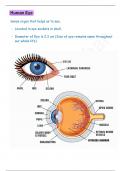
1) Cornea –
It is the outermost, transparent part. It provides most of the
refraction of light.
2) Lens –
It is composed of a fibrous, jelly like material. Provides the
focused real and inverted image of the object on the Retina.
This is convex lens that converges light at Retina.
3) Iris –
It is a dark muscular diaphragm that controls the size of the
pupil.
4) Pupil –
It is the window of the eye. It is the central aperture in Iris.
It regulates and controls the amount of light entering the
eye.
5) Ciliary Muscles –
They hold the lens in position and help in modifying the
curvature of lens.
6) Retina –
It is a delicate membrane having enormous number of light
sensitive cells.
, 7) Optic Nerve –
It transmits visual information from retina to Brain.
8) Blind Spot –
The point at which the optic nerve leaves the eye.
9) Aqueous Humour –
Between the cornea and eye lens, there is a space filled with
transparent liquid is called the aqueous humour which helps
the refracted light to be focused on retina. It also provides
nutrition to eye.
10) Vitreous Humour –
Space between eye lens and retina is filled with a liquid called
Vitreous Humour.
Far Point of Eye –
Maximum distance to which eye can see clearly, is called far point
of eye.
- For a normal eye, it’s value is Infinity
Near Point of Eye –
Minimum distance at which an object can be seen most distinctly
without any strain is called the least distance of distinct vision.
- For a normal eye, it’s value is 25cm.
Sense organ that helps us to see.
- Located in eye sockets in skull.
- Diameter of Eye is 2.3 cm (Size of eye remains same throughout
our whole life)
VITREOUS HUMOUR
,Parts of Human Eye
1) Cornea –
It is the outermost, transparent part. It provides most of the
refraction of light.
2) Lens –
It is composed of a fibrous, jelly like material. Provides the
focused real and inverted image of the object on the Retina.
This is convex lens that converges light at Retina.
3) Iris –
It is a dark muscular diaphragm that controls the size of the
pupil.
4) Pupil –
It is the window of the eye. It is the central aperture in Iris.
It regulates and controls the amount of light entering the
eye.
5) Ciliary Muscles –
They hold the lens in position and help in modifying the
curvature of lens.
6) Retina –
It is a delicate membrane having enormous number of light
sensitive cells.
, 7) Optic Nerve –
It transmits visual information from retina to Brain.
8) Blind Spot –
The point at which the optic nerve leaves the eye.
9) Aqueous Humour –
Between the cornea and eye lens, there is a space filled with
transparent liquid is called the aqueous humour which helps
the refracted light to be focused on retina. It also provides
nutrition to eye.
10) Vitreous Humour –
Space between eye lens and retina is filled with a liquid called
Vitreous Humour.
Far Point of Eye –
Maximum distance to which eye can see clearly, is called far point
of eye.
- For a normal eye, it’s value is Infinity
Near Point of Eye –
Minimum distance at which an object can be seen most distinctly
without any strain is called the least distance of distinct vision.
- For a normal eye, it’s value is 25cm.


