
Introduction to the Fukushima case.
Lecture 1 Wit:
11 March, 2011, the day of the triple disaster.
Great Tohoku Earthquake. 9.0-9.1 magnitude. Most powerful in Japan.
Damage to infrastructure
- Roads inaccessible
- Power outage due to severed power lines
Tsunami
- Over 30 m in certain places
- 500 km of Japanese east coast devastated
- Water covered area 90% of Tokyo
- Highest tsunami in history
HQ in Prime Minister office.
- Crisis management center
- Disaster countermeasures
- decapitation of local governments
Mobilization of Japanese self-defense forces.
- Support from the US. Operation Tomodachi.
- Countries and international organizations
- Civil society, large amount of volunteers
- NGO’s (institutions coordinating disaster relief across Japan)
Disaster:
,
,Actors:
On site: workers
Off site: Supervisor Yoshida
Leader: PM Naoto Kan
Humanitarian crisis:
470.000 people displaced at peak crisis
170.000 due to natural disasters
Still lots of people are displaced.
Consequences and aftermath:
Support for evacuees and reconstruction of the region
reviving industries and livelihoods.
decommisioning Daichi and nuclear safety.
, Reading Kushia 2016: Learning from a disaster
Fukushima Daiichi plant had 6 reactors, 1, 2 & 3 were operational. (the rest, routine maintenance)
After earthquake, reactors scrammed (SCRAM), emergency shutdown.
All external power was cut off, but internal power (EDG’s and batteries0 began to operate pumps
and cool system.
Tsunami obliterated the seawall, destroyed all on-site back-up power sources and pumps (necessary
to cool down reactor). Without capability to cool core meltdown and hydrogen explosion.
No direct deaths because of radiation. Disaster 7 on a scale of INES. Maximum, just like Chernobyl (6
times more radiation due to explosion core reactor)
Too cool down reactor: seawater into fuel pools and reactor contaminated water. Partly released
into the Pacific.
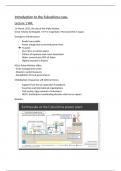
EARTHQUAKE
Operations center buildings catastrophically damaged, almost unusable.
Completely dependent on its on-site backup power sources.
Staff evacuated to a newly constructed emergency operations center, built on slightly higher
ground and designed to withstand strong earthquakes.
Had this structure not existed, the lack of a viable on-site staging ground for the rescue
operation would have likely led to a significantly worse outcome. This seismically reinforced
operations center had been completed just eight months prior to the earthquake
TSUNAMI
10 m. seawall designed to stop a tsunami only up to 5.7 meters. Waves of 12 meter
Destroyed much of cooling system. Pumps seawater reactor building. Cool fuel rods.
Almost all of the on-site backup power sources and infrastructure—the diesel generators,
batteries, and circuit boards for the plant.
Lost capability to cool.
The Fukushima Daiichi Reactors 1, 2, and 3, which were operating at the time of the disaster, were
boiling water reactors (BWR). In a BWR, heat from the nuclear reactions of fuel rods within a sealed
chamber boils water under high pressure, creating steam that rotates turbines to generate
electricity. The total seawater requirement was almost 1.9 million tons daily for this one plant.
Initial scrams - emergency shutdowns of the fuel core reactions—were successful.
But even after shutting down, the fuel rods retained considerable heat, requiring large amounts of
water for cooling.
Restoring cooling capabilities was of paramount importance.
Not been able to cool the reactors and could not monitor the water levels of Reactors 1 and 2,
Fukushima Daiichi plant manager Masao Yoshida officially declared a “nuclear emergency in
progress,” in accordance with the Nuclear Emergency Preparedness Act. As soon as the hot core
evaporated the water and exposed the fuel rods, the rods would overheat and become damaged,
resulting in the phenomenon commonly labeled “meltdown.”
As events rapidly unfolded, severe information and communications problems at all levels of
decision-making plagued the recovery effort.
The earthquake paralyzed telecommunications networks around the country, and in the Tokyo
Lecture 1 Wit:
11 March, 2011, the day of the triple disaster.
Great Tohoku Earthquake. 9.0-9.1 magnitude. Most powerful in Japan.
Damage to infrastructure
- Roads inaccessible
- Power outage due to severed power lines
Tsunami
- Over 30 m in certain places
- 500 km of Japanese east coast devastated
- Water covered area 90% of Tokyo
- Highest tsunami in history
HQ in Prime Minister office.
- Crisis management center
- Disaster countermeasures
- decapitation of local governments
Mobilization of Japanese self-defense forces.
- Support from the US. Operation Tomodachi.
- Countries and international organizations
- Civil society, large amount of volunteers
- NGO’s (institutions coordinating disaster relief across Japan)
Disaster:
,
,Actors:
On site: workers
Off site: Supervisor Yoshida
Leader: PM Naoto Kan
Humanitarian crisis:
470.000 people displaced at peak crisis
170.000 due to natural disasters
Still lots of people are displaced.
Consequences and aftermath:
Support for evacuees and reconstruction of the region
reviving industries and livelihoods.
decommisioning Daichi and nuclear safety.
, Reading Kushia 2016: Learning from a disaster
Fukushima Daiichi plant had 6 reactors, 1, 2 & 3 were operational. (the rest, routine maintenance)
After earthquake, reactors scrammed (SCRAM), emergency shutdown.
All external power was cut off, but internal power (EDG’s and batteries0 began to operate pumps
and cool system.
Tsunami obliterated the seawall, destroyed all on-site back-up power sources and pumps (necessary
to cool down reactor). Without capability to cool core meltdown and hydrogen explosion.
No direct deaths because of radiation. Disaster 7 on a scale of INES. Maximum, just like Chernobyl (6
times more radiation due to explosion core reactor)
Too cool down reactor: seawater into fuel pools and reactor contaminated water. Partly released
into the Pacific.
EARTHQUAKE
Operations center buildings catastrophically damaged, almost unusable.
Completely dependent on its on-site backup power sources.
Staff evacuated to a newly constructed emergency operations center, built on slightly higher
ground and designed to withstand strong earthquakes.
Had this structure not existed, the lack of a viable on-site staging ground for the rescue
operation would have likely led to a significantly worse outcome. This seismically reinforced
operations center had been completed just eight months prior to the earthquake
TSUNAMI
10 m. seawall designed to stop a tsunami only up to 5.7 meters. Waves of 12 meter
Destroyed much of cooling system. Pumps seawater reactor building. Cool fuel rods.
Almost all of the on-site backup power sources and infrastructure—the diesel generators,
batteries, and circuit boards for the plant.
Lost capability to cool.
The Fukushima Daiichi Reactors 1, 2, and 3, which were operating at the time of the disaster, were
boiling water reactors (BWR). In a BWR, heat from the nuclear reactions of fuel rods within a sealed
chamber boils water under high pressure, creating steam that rotates turbines to generate
electricity. The total seawater requirement was almost 1.9 million tons daily for this one plant.
Initial scrams - emergency shutdowns of the fuel core reactions—were successful.
But even after shutting down, the fuel rods retained considerable heat, requiring large amounts of
water for cooling.
Restoring cooling capabilities was of paramount importance.
Not been able to cool the reactors and could not monitor the water levels of Reactors 1 and 2,
Fukushima Daiichi plant manager Masao Yoshida officially declared a “nuclear emergency in
progress,” in accordance with the Nuclear Emergency Preparedness Act. As soon as the hot core
evaporated the water and exposed the fuel rods, the rods would overheat and become damaged,
resulting in the phenomenon commonly labeled “meltdown.”
As events rapidly unfolded, severe information and communications problems at all levels of
decision-making plagued the recovery effort.
The earthquake paralyzed telecommunications networks around the country, and in the Tokyo


