

Biology summary
Characteristics of living organisms:
● Movement - Reproduction - Sensitivity
● Growth - Respiration - Excretion
● Nutrition
Cell structure
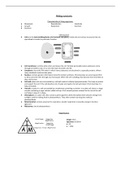
● Cells are the basic building blocks of all animals and plants. Inside cells are various structures that are
specialised to conduct a particular function.
● Cell membrane: controls what enters and leaves the cell. Partially permeable (some substances come
through and others not). It is a very thin layer of protein and fat
● Cytoplasm: clear jelly 70% water in which many substances are dissolved in, especially proteins. Where
many metabolic reactions take place.
● Nucleus: contains genetic information stored for protein synthesis. Chromosomes are very long and thin
so they cannot be seen through any microscope. When the cell is dividing, they become short and thick so
they can be seen.
● Cell wall: plant cells are surrounded by a cell wall made of cellulose (polysaccharide). This helps to protect
and support the cell. If the cell absorbs a lot of water and swells, the cell wall stops it from bursting. It is
fully permeable.
● Vacuole: a space in a cell surrounded by a membrane containing a solution. In a plant cell, there is a large
vacuole containing a sugar solution called cell sap. A full vacuole presses outward to the rest of the cell
and helps to keep it in shape.
● Chloroplasts: in a plant cell, they contain a green pigment called chlorophyll which absorbs energy from
sunlight, used for making food in photosynthesis. They often contain starch grains made by
photosynthesis.
● Mitochondrial: contains enzymes for respiration. Aerobic respiration to provide energy to function
(glucose)
● Ribosomes: site of photosynthesis
Magnification
Image: 5mm
Specimen: 0.05mm
● I/A
● = 100x
, Diffusion
● Diffusion explains how particles move through gas or liquid from a high concentration to a low
concentration.
● When the temperature rises, diffusion is quicker because the particles move faster and have more
energy. When the diffusion distance is greater, diffusion takes longer because the particles have to
move a larger distance. When the surface area is larger, more diffusion can happen.
Diffusion and living organisms
● Living organisms obtain many requirements by diffusion. They also get rid of many of their waste
products.
● For example, plants need carbon dioxide for photosynthesis. This diffuses from the air into the leaves,
through the stomata.
Experiment of diffusion of substances through a membrane
Measuring rate of osmosis
Osmosis
● Osmosis is the diffusion of water when particles spread from a high to low concentration. The water tries
to dilute substances such as salt and sugar (water potential= water concentration)
, Water molecules are very small. Sugar molecules are much larger. In visking
tubing, the holes are big enough to let the water molecules through. However,
sugar molecules don’t pass through because it is partially permeable. As the
sugar molecules cannot diffuse through the membrane to even out the amount
of water and sugar, some water molecules will diffuse to the outside part of the
cell
As water enters the cell, the cell membrane has to stretch as the cell becomes
larger. The cell membrane will continue to stretch and the cell will eventually burst
Hypertonic:
plasmolysed
Isotonic: flaccid
Hypotonic:
turgid
Plant cells do not burst in pure water. This is because they have a fully permeable
cell wall. It has a partially permeable cell membrane. The cell will take in water by
osmosis. As water goes in, the cytoplasm and vacuole will swell. However, the
plant cell has a very strong cell wall. The cytoplasm presses against the cell wall,
but the cell wall resists. This pressure is called turgor pressure. The cell now
becomes turgid.
This plant cell is plasmolysed. This is because the solution outside of the cell is
more concentrated than the one inside. The water diffuses outside the cell by
osmosis. The cell shrinks slightly and becomes flaccid. The cell membrane then
tears away from the cell wall, so the cell is plasmolysed.
Characteristics of living organisms:
● Movement - Reproduction - Sensitivity
● Growth - Respiration - Excretion
● Nutrition
Cell structure
● Cells are the basic building blocks of all animals and plants. Inside cells are various structures that are
specialised to conduct a particular function.
● Cell membrane: controls what enters and leaves the cell. Partially permeable (some substances come
through and others not). It is a very thin layer of protein and fat
● Cytoplasm: clear jelly 70% water in which many substances are dissolved in, especially proteins. Where
many metabolic reactions take place.
● Nucleus: contains genetic information stored for protein synthesis. Chromosomes are very long and thin
so they cannot be seen through any microscope. When the cell is dividing, they become short and thick so
they can be seen.
● Cell wall: plant cells are surrounded by a cell wall made of cellulose (polysaccharide). This helps to protect
and support the cell. If the cell absorbs a lot of water and swells, the cell wall stops it from bursting. It is
fully permeable.
● Vacuole: a space in a cell surrounded by a membrane containing a solution. In a plant cell, there is a large
vacuole containing a sugar solution called cell sap. A full vacuole presses outward to the rest of the cell
and helps to keep it in shape.
● Chloroplasts: in a plant cell, they contain a green pigment called chlorophyll which absorbs energy from
sunlight, used for making food in photosynthesis. They often contain starch grains made by
photosynthesis.
● Mitochondrial: contains enzymes for respiration. Aerobic respiration to provide energy to function
(glucose)
● Ribosomes: site of photosynthesis
Magnification
Image: 5mm
Specimen: 0.05mm
● I/A
● = 100x
, Diffusion
● Diffusion explains how particles move through gas or liquid from a high concentration to a low
concentration.
● When the temperature rises, diffusion is quicker because the particles move faster and have more
energy. When the diffusion distance is greater, diffusion takes longer because the particles have to
move a larger distance. When the surface area is larger, more diffusion can happen.
Diffusion and living organisms
● Living organisms obtain many requirements by diffusion. They also get rid of many of their waste
products.
● For example, plants need carbon dioxide for photosynthesis. This diffuses from the air into the leaves,
through the stomata.
Experiment of diffusion of substances through a membrane
Measuring rate of osmosis
Osmosis
● Osmosis is the diffusion of water when particles spread from a high to low concentration. The water tries
to dilute substances such as salt and sugar (water potential= water concentration)
, Water molecules are very small. Sugar molecules are much larger. In visking
tubing, the holes are big enough to let the water molecules through. However,
sugar molecules don’t pass through because it is partially permeable. As the
sugar molecules cannot diffuse through the membrane to even out the amount
of water and sugar, some water molecules will diffuse to the outside part of the
cell
As water enters the cell, the cell membrane has to stretch as the cell becomes
larger. The cell membrane will continue to stretch and the cell will eventually burst
Hypertonic:
plasmolysed
Isotonic: flaccid
Hypotonic:
turgid
Plant cells do not burst in pure water. This is because they have a fully permeable
cell wall. It has a partially permeable cell membrane. The cell will take in water by
osmosis. As water goes in, the cytoplasm and vacuole will swell. However, the
plant cell has a very strong cell wall. The cytoplasm presses against the cell wall,
but the cell wall resists. This pressure is called turgor pressure. The cell now
becomes turgid.
This plant cell is plasmolysed. This is because the solution outside of the cell is
more concentrated than the one inside. The water diffuses outside the cell by
osmosis. The cell shrinks slightly and becomes flaccid. The cell membrane then
tears away from the cell wall, so the cell is plasmolysed.


