3.3: Nutrition and energy systems
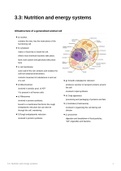
Ultrastructure of a generalized animal cell
a) nucleus
contains the dna, has the instructions of the
fucntioning cell
b) cytoplasm
matrix or fluid that is inside the cell.
where most chemical reactions take place.
lactic acid system and glycolysis take place
here
c) cell membrane
outer wall of the cell. protects and isolates the
cell from external environment.
controls movement of substances in and out
of a cell g) Smooth endoplasmic reticulum
d) Mitochondrion produces vesicles to transport proteins around
the cell
involved in aerobic prod. of ATP
*it’s present in all human cells involved in lipid synthesis
e) Ribosomes h) Golgi apparatus
involved in protein synthesis. processing and packaging of proteins and fats
bound to a membrane that forms the rough i) Centrioles (Centrosome)
endoplasmic reticulum but can also be involved in organizing the cell during cell
through the cell, wandering division
f) Rough endoplasmtic reticulum j) Lysosomes
involved in protein synthesis digestion and breakdown of food particles,
“old” organelles and bacteria
3.3: Nutrition and energy systems 1
, Ultrastructure of a generalized mitochondrion
a) cristae
b) inner membrane
c) outer membrane
d) intermembrane space
e) ribosome 70S and naked
loops of DNA
f) matrix
Cell respiration
cell respiration: the controlled release of energy
in the form of ATP (adenosine triphosphate) from
the catabolism of organic compounds in the cell
it can be either aerobic or anaerobic (depends
on the intensity and duration of the exercise)
Cell respiration (includes aerobic glycolysis, Krebs cycle
and electron transport chain)
3.3: Nutrition and energy systems 2