
PSYCHOPATHOLOGY 1
DEFINING ABNORMALITY
STATISTICAl INFREQUENCY (SI)
- This is a mathematical method for defining abnormality. This definition works on
the idea that abnormality should be based on infrequency; if it occurs rarely
then it is abnormal.
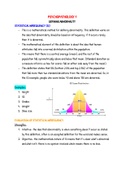
- The mathematical element of this definition is about the idea that human
attributes fall into a normal distribution within the population.
- This means that there is a central average (mean), and the rest of the
population fall symmetrically above and below that mean. (Standard deviation as
a measure informs us how far scores fall on either side away from the mean).
- This definition states that 5% (bottom 2.5% and top 2.5%) of the population
that fall more than two standard deviations from the mean are abnormal. So, in
the IQ example, people who score below 70 and above 130 are abnormal.
Examples;
1. Height
2. IQ
3. Grades
4. Weight
5. Shoe size
EVAlUATION OF STATISTICAl INFREQUENCY
Strengths:
1. Intuitive- the idea that abnormality is when something doesn’t occur as stated
by this definition, often is an accepted definition for the word and makes sense.
2. Objective- the mathematical nature of SI means that it’s clear what’s abnormal
and what isn’t; there is no opinion involved which means there is no bias.
,Weaknesses:
1. Abnormal behaviours can occur frequently- it is not the case that abnormal, as
in unhelpful and painful, behaviours occur rarely. Depression is an example,
where it is argued that 25% of the population will experience a mental health
issue at some point in their lives.
2. Culture- there is no consideration of cultural differences at all as it argues that
the population of the world is contained within the normal distribution. There
are variances between cultures and the mathematical nature of this definition
does not allow for this. This ultimately means that abnormality could be
widespread in one culture because of its comparison with the rest of the world.
DEVIATION FROM SOCIAL NORMS (DSN)
- Most of us notice people whose behaviour is a deviation from social norms-
when a person behaves in a way that is different to how we would expect people
to behave.
- Groups of people choose to define behaviour as abnormal on the basis that it
offends their sense of what is acceptable, or the ‘norm’.
- We make a collective judgement as a society about what is right. Social norms
are not the same as laws. Laws are explicit but social norms are implicit.
- This approach to defining abnormality is to consider deviations from society
norms as an indication of abnormality.
Examples;
1. Antisocial personality disorder (impulsive, aggressive, irresponsable)
2. Laughing at a funeral.
EVAlUATION OF DEVIATION FROM SOCIAL NORMS
Strengths:
1. Flexibility- a strength is that it is flexible depending on the situation and age. A
social norm is to wear full clothing whilst out shopping, but a bikini is
, acceptable on a beach. It is also socially acceptable to drink milk out of a bottle
with a test if you are a baby, but not as an adult.
2. Clarity- in most instances if you have lived within a culture for a long time, you
will be aware of what is, and what is not acceptable.
3. Helps society- adhering to social norms means that society is ordered and
predictable.
Weaknesses:
1. Change over time- although this definition allows for age and situation
dependent behaviour, the changes in legislation mean that norms vary
depending on the time. This is sometimes hard to judge and means that there is
a lack of consensus between generations. For example, homosexuality was
regarded as a mental illness into the 1970s, whereas nowadays that is no longer
the case.
2. Cultural differences- the fact that there is so much variation cross culturally
can be a weakness of the definition as it is not always clear what is abnormal and
what is not in cultures. It is only by being immersed in the culture for a period
of time that the decision can be made.
3. Ethic differences- social norms tend to be dictated by the majority within a
culture and this means that there are sections of society where behaviour is
seen as normal within an ethnic community, but not within the culture as a
whole. This can lead to a lack of understanding from both the ethnic minority
and the majority of people within a culture.
FAILURE TO FUNCTION ADEQUATELY (FFA)
- A person may cross the line between ‘normal’ and ‘abnormal’ at the point when
they can no longer cope with the demands of everyday life and they fail to
function adequately.


