
7/1/25
2.1 - Economic Policies Under Lenin
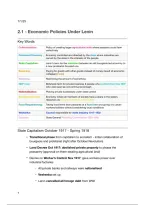
Key Words
Collectivisation Policy of creating larger agricultural units where peasants could farm
collectively
Command Economy Economy controlled and directed by the state where industries are
owned by the state in the interests of the people.
State Capitalism: Lenin’s term for the transition between an old bourgeois-led economy to
a new proletariat-focused one
Bartering: Paying for goods with other goods instead of money (result of economic
collapse) (trade)
Rationing: Restricting the amount of something
NEP men: Bolshevik term for private business & people who pro ted from the NEP
who were seen as not communist enough
Nationalisation: Placing private businesses under state control
Socialist Economy: Economy where all members of society have a share in the state’s
resources as private ownership is prohibited
Food Requisitioning: Taking food items from peasants at a xed rate and giving it to urban
workers/soldiers without considering local conditions
Veshenka: Council responsible for state industry 1917-1932
Gosplan: State General Planning Commission 1921-1991
State Capitalism October 1917 - Spring 1918
• Transitional phase from capitalism to socialism - initial collaboration of
bourgeois and proletariat (right after October Revolution)
• Land Decree Oct 1917: abolished private property to please the
peasantry (approval on them stealing agricultural land)
• Decree on Worker’s Control Nov 1917: gave workers power over
industrial factories
- All private banks and railways were nationalised
- Veshenka set up
- Lenin cancelled all foreign debt from WWI
1
fi fi
, • Nationalisation of Industry Feb 1918: programme for state takeover of
larger industrial concerns (within 2 years all major enterprises were under
central government control)
SUCCESSES FAILURES
Ideological success as power was given to Rise in in ation but not in production
workers and peasants through decrees (Workers’ Council gave themselves huge
pay rises -> demand increased but supply
didn’t)
Increased support for Bolshevik party Tensions between government control and
worker self-management (Veshenka set up
because of a need for greater supervision
- shows workers did not know how to lead
themselves)
Rush into new decrees worsened economy
to near collapse
War Communism 1918-1921
• Measures introduced by Bolshevik government to ensure that Red Army
had enough supplies to win
• Build socialism without foreign aid
• Increased government intervention in the economy - radicalisation of
economic policy and extension of Bolshevik control
- private property and private trade were abolished before expected
(not really a transition)
- Large-scale nationalisation as a result of economic collapse (not
ideological communist but usual e.g FDR in US after 1929 crash)
- Bolsheviks took over factories, mines, workshops, railways... and
implemented harsh military-style discipline for productivity e.g
‘Labour Armies’, ‘Communist Saturdays’...
- Nº of goods produced in factories fell, leading to sailors at
Kronstadt naval base revolting against government
- By 1921, industrial production was 20% of what it was in 1913
- Work made compulsory for able-bodied men between 16-50
years in 1919
- Working days extended to 11 hours in 1918
2
fl


