
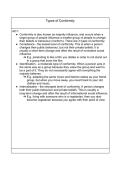
Types of Conformity
AO1:
● Conformity is also known as majority influence, and occurs when a
larger group of people influence a smaller group of people to change
their beliefs or behaviour (conform). There are 3 types of conformity.
● Compliance - the lowest level of conformity. This is when a person
changes their public behaviour, but not their private beliefs. It is
usually a short-term change and often the result of normative social
influence.
➔E.g. pretending to like a film you dislike in order to not stand out
in a group that loves the film.
● Identification - a moderate type of conformity. When a person acts in
the same way as a group because they value the group and want to
be a part of it. They do not necessarily agree with everything the
majority believes.
➔E.g. adopting the same music and fashion tastes as your friend
group, but when you move away, you revert back to your old
clothes and music.
● Internalisation - the strongest level of conformity. A person changes
both their public behaviour and private beliefs. This is usually a
long-term change and often the result of informational social influence.
➔E.g. living with someone who is a vegetarian, then you also
become vegetarian because you agree with their point of view.
, Explanations for Conformity:
Informational & Normative Social Influence
AO1:
● Normative social influence - following the crowd, this occurs when an individual
conforms because they want to be liked by other members of the group, and want to
avoid being rejected. It is not likely to change private opinion, but will affect public
opinion. We may do this because we want to seem attractive to others or we want to
protect ourselves.
➔ E.g. Verkooijen et al investigated youth subcultures and the use of drugs and
alcohol. They gave a questionnaire to 6000 participants aged 16-20 in
Denmark. Those who identified themselves as skater, hip-hop, techno, hippie
were most likely to use drugs. Whereas those who identified themselves as
nerdy, sporty, religious were less likely to do so. The more strongly they
identified themselves as part of their group, the more they conformed to their
group norms. This was because they wanted to be liked by the members of the
group - so normative SI.
● Informational social influence - accepting the majority’s point of view, this occurs when
an individual conforms because of the perceived superior knowledge or judgement of
others. This tends to lead to a change in private opinion as well as public.
➔ E.g. Pincus devised a study where participants had to identify which musical
notes were the same, while in the room with a confederate who was a musical
expert. This led to an increase in conformity, as participants believed that the
confederate had superior knowledge - therefore informational SI.
AO3:
- The explanations for conformity are sometimes criticised for implying that the 2 types
of social influence are separate and independent. However, in reality, these 2 forms of
social influence often work together to affect levels of conformity. For example, if a
teacher tells you something, you may change your opinion because you believe in
their superior knowledge and because everyone else in the class also agrees.
+ Practical application - researchers changed the behaviour of hotel guests by using
printed messages encouraging them to save energy. The messages suggested that
other guests were also using fewer bath towels. This led to people conforming and
using fewer bath towels, so is an example of normative social influence as people
were following a group in order to fit in.
+ Asch’s line study supports normative social influence. 37% of people conformed to an
obviously wrong answer due to the majority stating that it was correct. Many later
reported that they did so in order to avoid standing out or being ridiculed.
- Pincus’ study was a lab experiment, therefore due to being conducted in an artificial
setting, it has low ecological validity as it is not representative of everyday life. So the
results cannot be generalised.
AO1:
● Conformity is also known as majority influence, and occurs when a
larger group of people influence a smaller group of people to change
their beliefs or behaviour (conform). There are 3 types of conformity.
● Compliance - the lowest level of conformity. This is when a person
changes their public behaviour, but not their private beliefs. It is
usually a short-term change and often the result of normative social
influence.
➔E.g. pretending to like a film you dislike in order to not stand out
in a group that loves the film.
● Identification - a moderate type of conformity. When a person acts in
the same way as a group because they value the group and want to
be a part of it. They do not necessarily agree with everything the
majority believes.
➔E.g. adopting the same music and fashion tastes as your friend
group, but when you move away, you revert back to your old
clothes and music.
● Internalisation - the strongest level of conformity. A person changes
both their public behaviour and private beliefs. This is usually a
long-term change and often the result of informational social influence.
➔E.g. living with someone who is a vegetarian, then you also
become vegetarian because you agree with their point of view.
, Explanations for Conformity:
Informational & Normative Social Influence
AO1:
● Normative social influence - following the crowd, this occurs when an individual
conforms because they want to be liked by other members of the group, and want to
avoid being rejected. It is not likely to change private opinion, but will affect public
opinion. We may do this because we want to seem attractive to others or we want to
protect ourselves.
➔ E.g. Verkooijen et al investigated youth subcultures and the use of drugs and
alcohol. They gave a questionnaire to 6000 participants aged 16-20 in
Denmark. Those who identified themselves as skater, hip-hop, techno, hippie
were most likely to use drugs. Whereas those who identified themselves as
nerdy, sporty, religious were less likely to do so. The more strongly they
identified themselves as part of their group, the more they conformed to their
group norms. This was because they wanted to be liked by the members of the
group - so normative SI.
● Informational social influence - accepting the majority’s point of view, this occurs when
an individual conforms because of the perceived superior knowledge or judgement of
others. This tends to lead to a change in private opinion as well as public.
➔ E.g. Pincus devised a study where participants had to identify which musical
notes were the same, while in the room with a confederate who was a musical
expert. This led to an increase in conformity, as participants believed that the
confederate had superior knowledge - therefore informational SI.
AO3:
- The explanations for conformity are sometimes criticised for implying that the 2 types
of social influence are separate and independent. However, in reality, these 2 forms of
social influence often work together to affect levels of conformity. For example, if a
teacher tells you something, you may change your opinion because you believe in
their superior knowledge and because everyone else in the class also agrees.
+ Practical application - researchers changed the behaviour of hotel guests by using
printed messages encouraging them to save energy. The messages suggested that
other guests were also using fewer bath towels. This led to people conforming and
using fewer bath towels, so is an example of normative social influence as people
were following a group in order to fit in.
+ Asch’s line study supports normative social influence. 37% of people conformed to an
obviously wrong answer due to the majority stating that it was correct. Many later
reported that they did so in order to avoid standing out or being ridiculed.
- Pincus’ study was a lab experiment, therefore due to being conducted in an artificial
setting, it has low ecological validity as it is not representative of everyday life. So the
results cannot be generalised.


