
• Wrong document? Swap it for free
  • Written by students who passed
  • Immediately available after payment
  • Read online or as PDF
Sell
Where do you study
Your language
Document preview thumbnail
Preview 1 out of 3 pages
Summary

Summary vietnam essay

Document preview thumbnail
Preview 1 out of 3 pages

*The Vietnam War: A Pivotal Moment in Global History* The Vietnam War, spanning from 1955 to 1975, was a complex and multifaceted conflict that involved the United States, North Vietnam, South Vietnam, and other nations. This essay will examine the war's key events, players, and consequences, highlighting its far-reaching impact on global politics, international relations, and society. *Background and Escalation* The Vietnam War was a culmination of colonialism, nationalism, and Cold War rivalries. After World War II, Vietnam sought independence from French colonial rule, leading to the First Indochina War. The Geneva Accords (1954) divided Vietnam along the 17th parallel, creating North Vietnam (communist) and South Vietnam (anti-communist). The United States, fearing communist expansion, supported South Vietnam, while North Vietnam received backing from China and the Soviet Union. The Gulf of Tonkin incident (1964) led to increased US involvement, with ground troops deployed in 1965. *Key Events and Turning Points* 1. *Tet Offensive (1968)*: North Vietnamese and Viet Cong forces launched a surprise attack, shifting US public opinion against the war. 2. *My Lai Massacre (1968)*: US soldiers killed hundreds of unarmed Vietnamese civilians, further eroding support. 3. *Paris Peace Talks ()*: Negotiations failed to end the war, leading to continued fighting. 4. *Fall of Saigon (1975)*: North Vietnamese forces captured the South's capital, reunifying Vietnam under communist rule. *Global Impact* The Vietnam War had significant consequences: 1. *US foreign policy*: The war led to a more cautious approach, with increased congressional oversight. 2. *International relations*: The war strained US relations with allies and fueled anti-American sentiment. 3. *Global protests*: Widespread demonstrations against the war highlighted growing anti-war sentiment. 4. *Refugee crisis*: Many Vietnamese fled, creating a significant refugee population. *Legacy and Lessons* The Vietnam War offers important lessons: 1. *Interventionism*: The war highlighted the complexities of military intervention. 2. *Public opinion*: The war showed the importance of public support for military action. 3. *Media influence*: The war demonstrated the power of media in shaping public opinion. 4. *International cooperation*: The war underscored the need for cooperation and diplomacy. *References* 1. *The Pentagon Papers (1971)*: Classified documents revealing government deception about the war. 2. *"The Vietnam War" by Stanley Karnow (1983)*: Comprehensive history of the war. 3. *"Apocalypse Now" (1979)*: Film exploring the war's psychological and cultural impact. The Vietnam War's impact extends beyond the battlefield, influencing global politics, international relations, and society. Its legacy serves as a reminder of the complexities and consequences of conflict.

Content preview

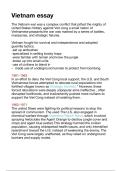
Vietnam essay
The Vietnam war was a complex con ict that pitted the mighty of
united States military against Viet cong a small nation of
Vietnamese peasants.the war was marked by a series of battles,
massacres, and strategic failures.

Vietnam fought for survival and independence and adopted
guerrilla tactics.
-set up ambushes
-specialized in setting booby traps
-were familiar with terrain and knew the jungle
-broke up into small units
-use of civilians to blend in
- made use of underground tunnels to protect from bombing
1961-1963
In an e ort to deny the Viet Cong local support, the U.S. and South
Vietnamese forces attempted to relocate rural populations into
forti ed villages known as Strategic Hamlets.” However, these
forced relocations were deeply unpopular aims ine ective , often
disrupted livelihoods, and inadvertently pushed more civilians to
support the Viet Cong instead of isolating them.

1962-1971
The united Staes were ghting for political reasons to stop the
spread of communism. The used The U.S. also engaged in
chemical warfare through Operation Ranch Hand, which involved
spraying herbicides like Agent Orange to destroy jungle cover and
crops and agent blue (water).This strategy harmed the civilian
population, causing widespread health issues, and only intensi ed
resentment toward the U.S. instead of weakening the enemy. The
Viet Cong were largely una ected, as they relied on underground
bunkers and supply routes.


fi ff fi ff fl ff fi

Document information

Schooljaar
200
Uploaded on
November 7, 2025
Number of pages
3
Written in
2025/2026
Type
Summary
R133,33

Wrong document? Swap it for free Within 14 days of purchase and before downloading, you can choose a different document. You can simply spend the amount again.
Written by students who passed
Immediately available after payment
Read online or as PDF

Sold
0
Followers
0
Items
7
Last sold
-


Why students choose Stuvia

Created by fellow students, verified by reviews

Quality you can trust: written by students who passed their exams and reviewed by others who've used these notes.

Didn't get what you expected? Choose another document

No worries! You can immediately select a different document that better matches what you need.

Pay how you prefer, start learning right away

No subscription, no commitments. Pay the way you're used to via credit card or EFT and download your PDF document instantly.

Student with book image

“Bought, downloaded, and aced it. It really can be that simple.”

Alisha Student

Working on your references?

Create accurate citations in APA, MLA and Harvard with our free citation generator.

Working on your references?

Frequently asked questions

