

07 – Human transport Biology Notes IGCSE Cambridge 2014
#69 Transport in humans - the circulatory system
The main transport system of human is
the circulatory system, a system of tubes (blood
vessels) with a pump (the heart) and valves to
ensure one-way flow of blood.
Its functions:
To transport nutrients and oxygen to the
cells.
To remove waste and carbon dioxide from
the cells.
To provide for efficient gas exchange.
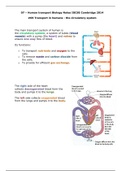
The right side of the heart
collects deoxygenated blood form the
body and pumps it to the lungs.
The left side collects oxygenated blood
from the lungs and pumps it to the body.
,The double circulation
Beginning at the lungs, blood flows into the left-hand side of the heart, and
then out to the rest of the body. It is brought back to the right-side of the
heart, before going back to the lungs again.
This is call a double circulation system, because the blood travels through
the heart twice on one complete journey around the body:
one circuit links the heart and lungs (low pressure circulation)
the other circuit links the heart with the rest of the body (high
pressure circulation).
The importance of a double circulation
Oxygenated blood is kept separate from deoxygenated blood. The
septum in the heart ensures this complete separation. Oxygenated
blood flows through the left side of the heart while deoxygenated
blood flows through the right.
The blood pressure in the systemic circulation is kept higher than
that in the pulmonary circulation. The left ventricle, with a thicker wall,
pumps blood under higher pressure to the body and delivers
oxygenated blood effectively to all parts of the body. The right
ventricle has a thinner wall and pumps blood to the lungs under lower
pressure, thereby avoiding any lung damage.
Video Circulatory system
https://www.youtube.com/watch?v=oE8tGkP5_tc
, #70 Structure and function of the heart
The function of the heart is to pump blood around the body. The right side
pumps blood to the lungs and the left side pumps blood to the rest of
the body.
#69 Transport in humans - the circulatory system
The main transport system of human is
the circulatory system, a system of tubes (blood
vessels) with a pump (the heart) and valves to
ensure one-way flow of blood.
Its functions:
To transport nutrients and oxygen to the
cells.
To remove waste and carbon dioxide from
the cells.
To provide for efficient gas exchange.
The right side of the heart
collects deoxygenated blood form the
body and pumps it to the lungs.
The left side collects oxygenated blood
from the lungs and pumps it to the body.
,The double circulation
Beginning at the lungs, blood flows into the left-hand side of the heart, and
then out to the rest of the body. It is brought back to the right-side of the
heart, before going back to the lungs again.
This is call a double circulation system, because the blood travels through
the heart twice on one complete journey around the body:
one circuit links the heart and lungs (low pressure circulation)
the other circuit links the heart with the rest of the body (high
pressure circulation).
The importance of a double circulation
Oxygenated blood is kept separate from deoxygenated blood. The
septum in the heart ensures this complete separation. Oxygenated
blood flows through the left side of the heart while deoxygenated
blood flows through the right.
The blood pressure in the systemic circulation is kept higher than
that in the pulmonary circulation. The left ventricle, with a thicker wall,
pumps blood under higher pressure to the body and delivers
oxygenated blood effectively to all parts of the body. The right
ventricle has a thinner wall and pumps blood to the lungs under lower
pressure, thereby avoiding any lung damage.
Video Circulatory system
https://www.youtube.com/watch?v=oE8tGkP5_tc
, #70 Structure and function of the heart
The function of the heart is to pump blood around the body. The right side
pumps blood to the lungs and the left side pumps blood to the rest of
the body.


