
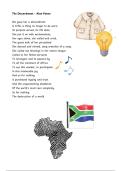
The Discardment - Alan Paton
We gave her a discardment
A trifle, a thing no longer to be worn,
Its purpose served, its life done.
She put it on with exclamations,
Her eyes shone, she called and cried,
The great bulk of her pirouetted
She danced and mimed, sang snatches of a song.
She called out blessings in her native tongue
Called to her fellow-servants
To strangers and to passers-by
To all the continent of Africa
To see this wonder, to participate
In this intolerable joy.
And so for nothing
Is purchased loyalty and trust
And the unquestioning obedience
Of the earth's most rare simplicity.
So for nothing
The destruction of a world.
, - The title highlights irony, showing how something worthless to the
giver can bring immense joy to the receiver, while also hinting at
The Discardment
the deeper loss of dignity and exploitation underlying the act. This
- opening phrase immediately sets a tone of detachment and
devaluation, as the object given is defined not by what it is but by
its rejection and uselessness. The use of “we” implies a collective
- identity of privilege and power, contrasting with “her,” who
We gaveher a receives only what is no longer wanted. The choice of the unusual
discardment noun “discardment” instead of simply “gift” or “old clothing”
- emphasizes the disparity: it is not generosity but condescension,
the act of passing down waste. This establishes the central irony
of the poem—that what is worthless to the giver becomes a source
- of immense joy to the receiver—while also foreshadowing the
critique of social and racial inequality that follows. The phrase
diminishes the object to something insignificant, emphasizing its
worthlessness in the eyes of the giver. It reflects the disparity
- between those who have the privilege to discard items casually and
those for whom even discarded goods hold immense value. The
- diction conveys a sense of dismissal and finality, suggesting the
object has outlived its usefulness, yet this very “refuse” becomes a
A trifle, a thing no longer treasure to someone else. On a deeper level, the line highlights
to beworn, - social inequality and the dehumanizing effects of material excess,
where what is trivial to one class symbolizes dignity, joy, and
opportunity to another. This line conveys finality and dismissal,
- suggesting that the object once had value but is now stripped of
meaning in the eyes of its original owner. It reflects a utilitarian
view where worth is tied only to usefulness, and once that function
- is exhausted, the item is rendered worthless. Beyond describing a
mere object, the phrase carries symbolic weight: it exposes how
people in positions of privilege can treat both material possessions
- and human relationships as disposable. In the context of the poem,
it underscores the stark inequality between the giver, who regards
Its purposeserved, its life the item as spent, and the receiver, who treasures it as a source
- of immense joy, thereby revealing the moral dissonance between
done.
material excess and deprivation.
This moment captures the servant’s unfiltered delight at receiving
- something discarded, turning what was intended as worthless into
a source of immense personal value.
Her “exclamations” reveal both her gratitude and astonishment,
contrasting the giver’s casual act with her own profound
emotional response.
The reaction underscores the disparity between the worlds of
-
privilege and poverty: what is trivial to one is transformative to
another.
She putiton with
-
exclamations,
-
We gave her a discardment
A trifle, a thing no longer to be worn,
Its purpose served, its life done.
She put it on with exclamations,
Her eyes shone, she called and cried,
The great bulk of her pirouetted
She danced and mimed, sang snatches of a song.
She called out blessings in her native tongue
Called to her fellow-servants
To strangers and to passers-by
To all the continent of Africa
To see this wonder, to participate
In this intolerable joy.
And so for nothing
Is purchased loyalty and trust
And the unquestioning obedience
Of the earth's most rare simplicity.
So for nothing
The destruction of a world.
, - The title highlights irony, showing how something worthless to the
giver can bring immense joy to the receiver, while also hinting at
The Discardment
the deeper loss of dignity and exploitation underlying the act. This
- opening phrase immediately sets a tone of detachment and
devaluation, as the object given is defined not by what it is but by
its rejection and uselessness. The use of “we” implies a collective
- identity of privilege and power, contrasting with “her,” who
We gaveher a receives only what is no longer wanted. The choice of the unusual
discardment noun “discardment” instead of simply “gift” or “old clothing”
- emphasizes the disparity: it is not generosity but condescension,
the act of passing down waste. This establishes the central irony
of the poem—that what is worthless to the giver becomes a source
- of immense joy to the receiver—while also foreshadowing the
critique of social and racial inequality that follows. The phrase
diminishes the object to something insignificant, emphasizing its
worthlessness in the eyes of the giver. It reflects the disparity
- between those who have the privilege to discard items casually and
those for whom even discarded goods hold immense value. The
- diction conveys a sense of dismissal and finality, suggesting the
object has outlived its usefulness, yet this very “refuse” becomes a
A trifle, a thing no longer treasure to someone else. On a deeper level, the line highlights
to beworn, - social inequality and the dehumanizing effects of material excess,
where what is trivial to one class symbolizes dignity, joy, and
opportunity to another. This line conveys finality and dismissal,
- suggesting that the object once had value but is now stripped of
meaning in the eyes of its original owner. It reflects a utilitarian
view where worth is tied only to usefulness, and once that function
- is exhausted, the item is rendered worthless. Beyond describing a
mere object, the phrase carries symbolic weight: it exposes how
people in positions of privilege can treat both material possessions
- and human relationships as disposable. In the context of the poem,
it underscores the stark inequality between the giver, who regards
Its purposeserved, its life the item as spent, and the receiver, who treasures it as a source
- of immense joy, thereby revealing the moral dissonance between
done.
material excess and deprivation.
This moment captures the servant’s unfiltered delight at receiving
- something discarded, turning what was intended as worthless into
a source of immense personal value.
Her “exclamations” reveal both her gratitude and astonishment,
contrasting the giver’s casual act with her own profound
emotional response.
The reaction underscores the disparity between the worlds of
-
privilege and poverty: what is trivial to one is transformative to
another.
She putiton with
-
exclamations,
-



