

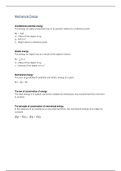
Mechanical Energy
Gravitational potential energy:
The energy an object possesses due to its position relative to a reference point.
Ep = mgh
m - Mass of the object in kg
g - 9.8 m.s-2
h - Height above a reference point
Kinetic energy:
The energy an object has as a result of the object's motion.
1
Ek = 2 m.v2
m - Mass of the object in kg
v - Velocity of the object in m.s-2
Mechanical energy:
The sum of gravitational potential and kinetic energy at a point.
Em = Ep + Ek
The law of conservation of energy:
The total energy in a system cannot be created nor destroyed; only transformed from one form
to another.
The principle of conservation of mechanical energy:
In the absence of air resistance or any external forces, the mechanical energy of an object is
constant.
(Ep + Ek)i = (Ep + Ek)f
Gravitational potential energy:
The energy an object possesses due to its position relative to a reference point.
Ep = mgh
m - Mass of the object in kg
g - 9.8 m.s-2
h - Height above a reference point
Kinetic energy:
The energy an object has as a result of the object's motion.
1
Ek = 2 m.v2
m - Mass of the object in kg
v - Velocity of the object in m.s-2
Mechanical energy:
The sum of gravitational potential and kinetic energy at a point.
Em = Ep + Ek
The law of conservation of energy:
The total energy in a system cannot be created nor destroyed; only transformed from one form
to another.
The principle of conservation of mechanical energy:
In the absence of air resistance or any external forces, the mechanical energy of an object is
constant.
(Ep + Ek)i = (Ep + Ek)f


