

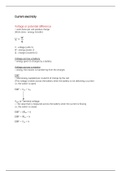
Current electricity
Voltage or potential difference
= work done per unit positive charge
(Work done - energy transfer)
𝑊
V= 𝑄
V - voltage (volts V)
W - energy (joules J)
Q - charge (coulomb C)
Voltage across a battery
= energy given to charges by a battery
Voltage across a resistor
= energy the resistor is transferring from the charges
EMF
= total energy supplied per coulomb of charge by the cell
(This voltage is taken across the battery when the battery is not delivering a current
i.e. the switch is open)
EMF = Vext + Vint
Vload or Terminal voltage
= The value that is measured across the battery when the current is flowing
i.e. the switch is closed
EMF = I(Rext + r)
EMF = IRext + Ir
EMF = Vext + Ir
, Electric current
= the rate of flow of charge
𝒒
I = ∆𝒕
I - current (ampere A)
t - time (seconds s)
q - charge (coulomb C)
Quantitation of charge
Q = n.qe
Q - charge (coulomb C)
n – integer number
qe – 1.6 x 10⁻¹⁹ C
Resistance
= a material’s opposition to the flow of charge
𝑽
R= 𝑰
R - resistance (ohm Ω)
V - voltage (volts V)
I - current (ampere A)
Resistance depends on
1. Type of material
2. Length of conductor
(length increases, resistance increases)
3. Diameter of conductor
(diameter increases, resistance decreases)
4. Temperature
(temperature increases, resistance increases)
Voltage or potential difference
= work done per unit positive charge
(Work done - energy transfer)
𝑊
V= 𝑄
V - voltage (volts V)
W - energy (joules J)
Q - charge (coulomb C)
Voltage across a battery
= energy given to charges by a battery
Voltage across a resistor
= energy the resistor is transferring from the charges
EMF
= total energy supplied per coulomb of charge by the cell
(This voltage is taken across the battery when the battery is not delivering a current
i.e. the switch is open)
EMF = Vext + Vint
Vload or Terminal voltage
= The value that is measured across the battery when the current is flowing
i.e. the switch is closed
EMF = I(Rext + r)
EMF = IRext + Ir
EMF = Vext + Ir
, Electric current
= the rate of flow of charge
𝒒
I = ∆𝒕
I - current (ampere A)
t - time (seconds s)
q - charge (coulomb C)
Quantitation of charge
Q = n.qe
Q - charge (coulomb C)
n – integer number
qe – 1.6 x 10⁻¹⁹ C
Resistance
= a material’s opposition to the flow of charge
𝑽
R= 𝑰
R - resistance (ohm Ω)
V - voltage (volts V)
I - current (ampere A)
Resistance depends on
1. Type of material
2. Length of conductor
(length increases, resistance increases)
3. Diameter of conductor
(diameter increases, resistance decreases)
4. Temperature
(temperature increases, resistance increases)


