

THE COMING OF DEMOCRACY SOUTH AFRICA
SECRET NEGOTIATIONS WITH THE ANC IN EXILE
As political and racial tensions worsened in South Africa, it became clear to white
business owners and politician that the African National Congress (ANC) could not
be ignored if a solution for the country’s problem were to be found.
In 1985, Gavin Relly, Chairman of Anglo-American Corporation, led a group of
prominent business leaders to meet Oliver Tambo and ANC leaders in Lusaka,
Zambia.
In 1987, Fredrick van Zyl Slabbert led a group of 61 Afrikaner businessmen,
academics, and professionals to Dakar, Senegal, to meet 17 ANC delegates led
by Thabo Mbeki.
These meetings focused on exploring strategies for fundamental change in South
Africa’s government structure, economy, and national unity, aiming to end apartheid
and transition to democracy.
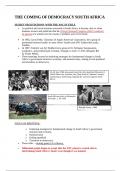
On 28 June 1986, thousands joined the Anti-Apartheid Movement’s
(AAM) March for Freedom from Hyde Park to Clapham Common,
culminating a month-long campaign for sanctions against South
Africa.
South African police at Alexandra
Township , 1 Jan 1985
Raleigh Street, 1986
FOCUS OF MEETINGS:
o Exploring strategies for fundamental change in South Africa’s government
structure and economy.
o National unity
o Ending apartheid
o Transition to democracy.
These talks turning point in S.A history.
Influential people began to accept that the ANC played a crucial role in
determining South Africa’s future even though it was banned.
, NEGOTIATIONS WITH MANDELA 1985
Under mounting domestic and international pressure and with South Africa on the
brink of civil war, President P.W. Botha authorized Minister of Justice Kobie Coetsee
to hold the first exploratory meeting with Nelson Mandela in his prison cell at
Pollsmoor.
Meeting focus
o ANC’s armed struggle and the continuing violence
Nelson Mandela rejected any offer of release unless it was unconditional.
It was clear to the government that there would be no solution to the crises faced
by South Africa while Mandela remained in jail.
1990 – 1991: UNBANNING OF RESISTANCE ORGANISATIONS AND THE
RELEASE OF NELSON MANDELA
2 FEBRUARY 1990 – President F.W. de Klerk announced major political reforms:
Unbanning of the African National Congress (ANC) , the Pan
Africanist Congress (PAC) and South African Communist Party
(SACP),
Release of political prisoners (excluding those convicted of violent crimes)
Lifting of media censorship,
Legalization of groups like the United Democratic Front (UDF) and Congress
of South African Trade Unions (COSATU) ,
Reduced detention periods under emergency laws,
The unconditional release of Nelson Mandela 11 February 1990.
Nelson Mandela (left) and his wife
Winnie Mandela (right) on 11
February, following his release from
prison after serving a 27-year
sentence.
SECRET NEGOTIATIONS WITH THE ANC IN EXILE
As political and racial tensions worsened in South Africa, it became clear to white
business owners and politician that the African National Congress (ANC) could not
be ignored if a solution for the country’s problem were to be found.
In 1985, Gavin Relly, Chairman of Anglo-American Corporation, led a group of
prominent business leaders to meet Oliver Tambo and ANC leaders in Lusaka,
Zambia.
In 1987, Fredrick van Zyl Slabbert led a group of 61 Afrikaner businessmen,
academics, and professionals to Dakar, Senegal, to meet 17 ANC delegates led
by Thabo Mbeki.
These meetings focused on exploring strategies for fundamental change in South
Africa’s government structure, economy, and national unity, aiming to end apartheid
and transition to democracy.
On 28 June 1986, thousands joined the Anti-Apartheid Movement’s
(AAM) March for Freedom from Hyde Park to Clapham Common,
culminating a month-long campaign for sanctions against South
Africa.
South African police at Alexandra
Township , 1 Jan 1985
Raleigh Street, 1986
FOCUS OF MEETINGS:
o Exploring strategies for fundamental change in South Africa’s government
structure and economy.
o National unity
o Ending apartheid
o Transition to democracy.
These talks turning point in S.A history.
Influential people began to accept that the ANC played a crucial role in
determining South Africa’s future even though it was banned.
, NEGOTIATIONS WITH MANDELA 1985
Under mounting domestic and international pressure and with South Africa on the
brink of civil war, President P.W. Botha authorized Minister of Justice Kobie Coetsee
to hold the first exploratory meeting with Nelson Mandela in his prison cell at
Pollsmoor.
Meeting focus
o ANC’s armed struggle and the continuing violence
Nelson Mandela rejected any offer of release unless it was unconditional.
It was clear to the government that there would be no solution to the crises faced
by South Africa while Mandela remained in jail.
1990 – 1991: UNBANNING OF RESISTANCE ORGANISATIONS AND THE
RELEASE OF NELSON MANDELA
2 FEBRUARY 1990 – President F.W. de Klerk announced major political reforms:
Unbanning of the African National Congress (ANC) , the Pan
Africanist Congress (PAC) and South African Communist Party
(SACP),
Release of political prisoners (excluding those convicted of violent crimes)
Lifting of media censorship,
Legalization of groups like the United Democratic Front (UDF) and Congress
of South African Trade Unions (COSATU) ,
Reduced detention periods under emergency laws,
The unconditional release of Nelson Mandela 11 February 1990.
Nelson Mandela (left) and his wife
Winnie Mandela (right) on 11
February, following his release from
prison after serving a 27-year
sentence.


