PEN1502
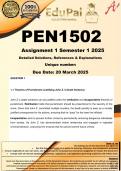
Assignment 1 Semester 1 2025
Unique Number:
Due Date: 20 March 2025
QUESTION 1
1.1 Theories of Punishment Justifying John Z.’s Death Sentence
John Z.’s death sentence can be justified under the retributive and incapacitative
theories of punishment. Retribution holds that punishment should be proportional to the
severity of the crime. Given that John Z. committed multiple murders, the death penalty is
seen as a morally justified consequence for his actions, ensuring that he “pays” for the
harm he inflicted.
Incapacitation aims to prevent further crimes by permanently removing dangerous
individuals from society. As John Z. has demonstrated violent tendencies and engaged in
repeated criminal behavior, executing him ensures that he cannot commit future crimes.
DISCLAIMER & TERMS OF USE
Educational Aid: These study notes are intended to be used as educational resources and should not be seen as a
replacement for individual research, critical analysis, or professional consultation. Students are encouraged to perform
their own research and seek advice from their instructors or academic advisors for specific assignment guidelines.
Personal Responsibility: While every effort has been made to ensure the accuracy and reliability of the information in
these study notes, the seller does not guarantee the completeness or correctness of all content. The buyer is
responsible for verifying the accuracy of the information and exercising their own judgment when applying it to their
assignments.
Academic Integrity: It is essential for students to maintain academic integrity and follow their institution's policies
regarding plagiarism, citation, and referencing. These study notes should be used as learning tools and sources of
inspiration. Any direct reproduction of the content without proper citation and acknowledgment may be considered
academic misconduct.
Limited Liability: The seller shall not be liable for any direct or indirect damages, losses, or consequences arising from
the use of these notes. This includes, but is not limited to, poor academic performance, penalties, or any other negative
consequences resulting from the application or misuse of the information provided.
, For additional support +27 81 278 3372
QUESTION 1
1.1 Theories of Punishment Justifying John Z.’s Death Sentence
John Z.’s death sentence can be justified under the retributive and incapacitative
theories of punishment. Retribution holds that punishment should be proportional to
the severity of the crime. Given that John Z. committed multiple murders, the death
penalty is seen as a morally justified consequence for his actions, ensuring that he
“pays” for the harm he inflicted.
Incapacitation aims to prevent further crimes by permanently removing dangerous
individuals from society. As John Z. has demonstrated violent tendencies and
engaged in repeated criminal behavior, executing him ensures that he cannot
commit future crimes.
Additionally, general deterrence may be a factor, as the death penalty is intended to
discourage others from committing similar crimes by demonstrating the severe
consequences. However, empirical evidence on the deterrent effect of capital
punishment remains inconclusive. Specific deterrence is also relevant, as John Z.
would no longer be a threat to others.
1.2 Proportionality of John Z.’s
The principle of proportionality in sentencing ensures that punishment corresponds
to the severity of the crime committed. In John Z.’s case, he murdered two
individuals in a particularly violent manner, which meets the criteria for the most
severe punishments. Capital punishment is generally reserved for heinous crimes,
such as premeditated murder, serial killings, or crimes involving extreme brutality.
However, proportionality also considers mitigating factors, such as John Z.’s
troubled upbringing, history of mental health issues, and substance abuse problems.
If his mental state significantly impaired his capacity to act with full intent, the
proportionality of the death penalty could be questioned.
While legally, John Z.’s actions may warrant execution, ethically, his background
might justify alternative sentencing, such as life imprisonment without parole. Thus,
Assignment 1 Semester 1 2025
Unique Number:
Due Date: 20 March 2025
QUESTION 1
1.1 Theories of Punishment Justifying John Z.’s Death Sentence
John Z.’s death sentence can be justified under the retributive and incapacitative
theories of punishment. Retribution holds that punishment should be proportional to the
severity of the crime. Given that John Z. committed multiple murders, the death penalty is
seen as a morally justified consequence for his actions, ensuring that he “pays” for the
harm he inflicted.
Incapacitation aims to prevent further crimes by permanently removing dangerous
individuals from society. As John Z. has demonstrated violent tendencies and engaged in
repeated criminal behavior, executing him ensures that he cannot commit future crimes.
DISCLAIMER & TERMS OF USE
Educational Aid: These study notes are intended to be used as educational resources and should not be seen as a
replacement for individual research, critical analysis, or professional consultation. Students are encouraged to perform
their own research and seek advice from their instructors or academic advisors for specific assignment guidelines.
Personal Responsibility: While every effort has been made to ensure the accuracy and reliability of the information in
these study notes, the seller does not guarantee the completeness or correctness of all content. The buyer is
responsible for verifying the accuracy of the information and exercising their own judgment when applying it to their
assignments.
Academic Integrity: It is essential for students to maintain academic integrity and follow their institution's policies
regarding plagiarism, citation, and referencing. These study notes should be used as learning tools and sources of
inspiration. Any direct reproduction of the content without proper citation and acknowledgment may be considered
academic misconduct.
Limited Liability: The seller shall not be liable for any direct or indirect damages, losses, or consequences arising from
the use of these notes. This includes, but is not limited to, poor academic performance, penalties, or any other negative
consequences resulting from the application or misuse of the information provided.
, For additional support +27 81 278 3372
QUESTION 1
1.1 Theories of Punishment Justifying John Z.’s Death Sentence
John Z.’s death sentence can be justified under the retributive and incapacitative
theories of punishment. Retribution holds that punishment should be proportional to
the severity of the crime. Given that John Z. committed multiple murders, the death
penalty is seen as a morally justified consequence for his actions, ensuring that he
“pays” for the harm he inflicted.
Incapacitation aims to prevent further crimes by permanently removing dangerous
individuals from society. As John Z. has demonstrated violent tendencies and
engaged in repeated criminal behavior, executing him ensures that he cannot
commit future crimes.
Additionally, general deterrence may be a factor, as the death penalty is intended to
discourage others from committing similar crimes by demonstrating the severe
consequences. However, empirical evidence on the deterrent effect of capital
punishment remains inconclusive. Specific deterrence is also relevant, as John Z.
would no longer be a threat to others.
1.2 Proportionality of John Z.’s
The principle of proportionality in sentencing ensures that punishment corresponds
to the severity of the crime committed. In John Z.’s case, he murdered two
individuals in a particularly violent manner, which meets the criteria for the most
severe punishments. Capital punishment is generally reserved for heinous crimes,
such as premeditated murder, serial killings, or crimes involving extreme brutality.
However, proportionality also considers mitigating factors, such as John Z.’s
troubled upbringing, history of mental health issues, and substance abuse problems.
If his mental state significantly impaired his capacity to act with full intent, the
proportionality of the death penalty could be questioned.
While legally, John Z.’s actions may warrant execution, ethically, his background
might justify alternative sentencing, such as life imprisonment without parole. Thus,