1
Triple Integrals
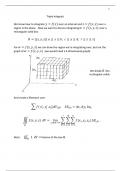
We know how to integrate 𝑦 = 𝑓(𝑥) over an interval and 𝑧 = 𝑓(𝑥, 𝑦) over a
region in the plane. Now we want to discuss integrating 𝑤 = 𝑓(𝑥, 𝑦, 𝑧) over a
rectangular solid box.
𝐵 = {(𝑥, 𝑦, 𝑧)| 𝑎 ≤ 𝑥 ≤ 𝑏, 𝑐 ≤ 𝑦 ≤ 𝑑, 𝑟 ≤ 𝑧 ≤ 𝑠}
For 𝑤 = 𝑓(𝑥, 𝑦, 𝑧) we can draw the region we’re integrating over, but not the
graph of 𝑤 = 𝑓(𝑥, 𝑦, 𝑧) (we would need a 4 dimensional graph).
Δ𝑥𝑖
Δ𝑧𝑘 We divide 𝐵 into
rectangular solids
Δ𝑦𝑗
And create a Riemann sum:
∑ 𝑓( 𝑥𝑖∗ , 𝑦𝑗∗ , 𝑧𝑘∗ )∆𝑉𝑖𝑗𝑘 ; ∆𝑉𝑖𝑗𝑘 = ∆𝑥𝑖 ∆𝑦𝑗 ∆𝑧𝑘
𝑙 𝑚 𝑛
∭ 𝑓(𝑥, 𝑦, 𝑧) 𝑑𝑉 = lim ∑ ∑ ∑ 𝑓(𝑥𝑖 , 𝑦𝑗 , 𝑧𝑘 ) ∆𝑉𝑖𝑗𝑘 .
𝑙,𝑚,𝑛→∞
𝐵 𝑘=1 𝑗=1 𝑖=1
Note: ∭𝐵 1 𝑑𝑉 =Volume of the box B.
, 2
Fubini’s Theorem
If 𝑓 is a continuous function on 𝐵 = [𝑎, 𝑏] × [𝑐, 𝑑 ] × [𝑟, 𝑠], then:
𝑧=𝑠 𝑦=𝑑 𝑥=𝑏
∭ 𝑓(𝑥, 𝑦, 𝑧) 𝑑𝑉 = ∫ [∫ [∫ 𝑓(𝑥, 𝑦, 𝑧) 𝑑𝑥 ] 𝑑𝑦] 𝑑𝑧.
𝑧=𝑟 𝑦=𝑐 𝑥=𝑎
𝐵
Ex. Evaluate ∭𝐵 𝑥𝑦 2 𝑒 𝑧 𝑑𝑉 where 𝐵 is:
𝐵 = {(𝑥, 𝑦, 𝑧)| 0 ≤ 𝑥 ≤ 2, 0 ≤ 𝑦 ≤ 3, 0 ≤ 𝑧 ≤ ln 2}.
𝑧=ln 2 𝑦=3 𝑥=2
2 𝑧
∭ 𝑥𝑦 𝑒 𝑑𝑉 = ∫ ∫ ∫ 𝑥𝑦 2 𝑒 𝑧 𝑑𝑥 𝑑𝑦 𝑑𝑧
𝑧=0 𝑦=0 𝑥=0
𝐵
𝑧=ln 2 𝑦=3 𝑥=2
𝑥2 2 𝑧
=∫ ∫ 𝑦 𝑒 | 𝑑𝑦 𝑑𝑧
𝑧=0 𝑦=0 2 𝑥=0
𝑧=ln 2 𝑦=3 𝑧=ln 2 𝑦=3
2 𝑧
2𝑦 3 𝑧
=∫ ∫ 2𝑦 𝑒 𝑑𝑦 𝑑𝑧 = ∫ 𝑒 | 𝑑𝑧
𝑧=0 𝑦=0 𝑧=0 3 𝑦=0
𝑧=ln 2
=∫ 18𝑒 𝑧 𝑑𝑧 = 18𝑒 𝑧 |z=ln
𝑧=0
2
= 36 − 18 = 18.
𝑧=0
We can calculate this integral in any order of 𝑥, 𝑦, and 𝑧. For example:
𝑥=2 𝑦=3 𝑧=𝑙𝑛2
∭𝐵 𝑥𝑦 2 𝑒 𝑧 𝑑𝑉 = ∫𝑥=0 ∫𝑦=0 ∫𝑧=0 𝑥𝑦 2 𝑒 𝑧 𝑑𝑧 𝑑𝑦 𝑑𝑥
𝑥=2 𝑦=3 𝑧=𝑙𝑛2
= ∫𝑥=0 ∫𝑦=0 𝑥𝑦 2 𝑒 𝑧 |𝑧=0 𝑑𝑦 𝑑𝑥
, 3
𝑥=2 𝑦=3
= ∫𝑥=0 ∫𝑦=0 𝑥𝑦 2 (𝑒 𝑙𝑛2 − 𝑒 0 ) 𝑑𝑦 𝑑𝑥
𝑥=2 𝑦=3
= ∫𝑥=0 ∫𝑦=0 𝑥𝑦 2 (2 − 1) 𝑑𝑦 𝑑𝑥
𝑥=2 𝑦=3
= ∫𝑥=0 ∫𝑦=0 𝑥𝑦 2 𝑑𝑦 𝑑𝑥
𝑦=3
𝑥=2 𝑥𝑦 3
= ∫𝑥=0 3 | 𝑑𝑥
𝑦=0
𝑥=2
𝑥=2 9𝑥 2
= ∫𝑥=0 9𝑥𝑑𝑥 = | = 18.
2 𝑥=0
Ex. Evaluate ∭𝐵 𝑒 (𝑥+𝑦+𝑧) 𝑑𝑉 where 𝐵 is:
𝐵 = {(𝑥, 𝑦, 𝑧)| 0 ≤ 𝑥 ≤ 1, 0 ≤ 𝑦 ≤ 1, 0 ≤ 𝑧 ≤ 2}.
𝑧=2 𝑦=1 𝑥=1
∭𝐵 𝑒 (𝑥+𝑦+𝑧) 𝑑𝑉 = ∫𝑧=0 ∫𝑦=0 ∫𝑥=0 𝑒 (𝑥+𝑦+𝑧) 𝑑𝑥 𝑑𝑦 𝑑𝑧
𝑧=2 𝑦=1 𝑥=1
= ∫𝑧=0 ∫𝑦=0 𝑒 (𝑥+𝑦+𝑧) |𝑥=0 𝑑𝑦 𝑑𝑧
𝑧=2 𝑦=1
= ∫𝑧=0 ∫𝑦=0 [𝑒 (1+𝑦+𝑧) − 𝑒 (𝑦+𝑧) ]𝑑𝑦 𝑑𝑧
𝑧=2 𝑦=1
= ∫𝑧=0 [𝑒 (1+𝑦+𝑧) − 𝑒 (𝑦+𝑧) ]|𝑦=0 𝑑𝑥
𝑧=2
= ∫𝑧=0 [(𝑒 (2+𝑧) − 𝑒 (1+𝑧) ) − (𝑒 (1+𝑧) − 𝑒 𝑧 )]𝑑𝑧
𝑧=2
= ∫𝑧=0 (𝑒 (2+𝑧) − 2𝑒 (1+𝑧) + 𝑒 𝑧 )𝑑𝑧
Triple Integrals
We know how to integrate 𝑦 = 𝑓(𝑥) over an interval and 𝑧 = 𝑓(𝑥, 𝑦) over a
region in the plane. Now we want to discuss integrating 𝑤 = 𝑓(𝑥, 𝑦, 𝑧) over a
rectangular solid box.
𝐵 = {(𝑥, 𝑦, 𝑧)| 𝑎 ≤ 𝑥 ≤ 𝑏, 𝑐 ≤ 𝑦 ≤ 𝑑, 𝑟 ≤ 𝑧 ≤ 𝑠}
For 𝑤 = 𝑓(𝑥, 𝑦, 𝑧) we can draw the region we’re integrating over, but not the
graph of 𝑤 = 𝑓(𝑥, 𝑦, 𝑧) (we would need a 4 dimensional graph).
Δ𝑥𝑖
Δ𝑧𝑘 We divide 𝐵 into
rectangular solids
Δ𝑦𝑗
And create a Riemann sum:
∑ 𝑓( 𝑥𝑖∗ , 𝑦𝑗∗ , 𝑧𝑘∗ )∆𝑉𝑖𝑗𝑘 ; ∆𝑉𝑖𝑗𝑘 = ∆𝑥𝑖 ∆𝑦𝑗 ∆𝑧𝑘
𝑙 𝑚 𝑛
∭ 𝑓(𝑥, 𝑦, 𝑧) 𝑑𝑉 = lim ∑ ∑ ∑ 𝑓(𝑥𝑖 , 𝑦𝑗 , 𝑧𝑘 ) ∆𝑉𝑖𝑗𝑘 .
𝑙,𝑚,𝑛→∞
𝐵 𝑘=1 𝑗=1 𝑖=1
Note: ∭𝐵 1 𝑑𝑉 =Volume of the box B.
, 2
Fubini’s Theorem
If 𝑓 is a continuous function on 𝐵 = [𝑎, 𝑏] × [𝑐, 𝑑 ] × [𝑟, 𝑠], then:
𝑧=𝑠 𝑦=𝑑 𝑥=𝑏
∭ 𝑓(𝑥, 𝑦, 𝑧) 𝑑𝑉 = ∫ [∫ [∫ 𝑓(𝑥, 𝑦, 𝑧) 𝑑𝑥 ] 𝑑𝑦] 𝑑𝑧.
𝑧=𝑟 𝑦=𝑐 𝑥=𝑎
𝐵
Ex. Evaluate ∭𝐵 𝑥𝑦 2 𝑒 𝑧 𝑑𝑉 where 𝐵 is:
𝐵 = {(𝑥, 𝑦, 𝑧)| 0 ≤ 𝑥 ≤ 2, 0 ≤ 𝑦 ≤ 3, 0 ≤ 𝑧 ≤ ln 2}.
𝑧=ln 2 𝑦=3 𝑥=2
2 𝑧
∭ 𝑥𝑦 𝑒 𝑑𝑉 = ∫ ∫ ∫ 𝑥𝑦 2 𝑒 𝑧 𝑑𝑥 𝑑𝑦 𝑑𝑧
𝑧=0 𝑦=0 𝑥=0
𝐵
𝑧=ln 2 𝑦=3 𝑥=2
𝑥2 2 𝑧
=∫ ∫ 𝑦 𝑒 | 𝑑𝑦 𝑑𝑧
𝑧=0 𝑦=0 2 𝑥=0
𝑧=ln 2 𝑦=3 𝑧=ln 2 𝑦=3
2 𝑧
2𝑦 3 𝑧
=∫ ∫ 2𝑦 𝑒 𝑑𝑦 𝑑𝑧 = ∫ 𝑒 | 𝑑𝑧
𝑧=0 𝑦=0 𝑧=0 3 𝑦=0
𝑧=ln 2
=∫ 18𝑒 𝑧 𝑑𝑧 = 18𝑒 𝑧 |z=ln
𝑧=0
2
= 36 − 18 = 18.
𝑧=0
We can calculate this integral in any order of 𝑥, 𝑦, and 𝑧. For example:
𝑥=2 𝑦=3 𝑧=𝑙𝑛2
∭𝐵 𝑥𝑦 2 𝑒 𝑧 𝑑𝑉 = ∫𝑥=0 ∫𝑦=0 ∫𝑧=0 𝑥𝑦 2 𝑒 𝑧 𝑑𝑧 𝑑𝑦 𝑑𝑥
𝑥=2 𝑦=3 𝑧=𝑙𝑛2
= ∫𝑥=0 ∫𝑦=0 𝑥𝑦 2 𝑒 𝑧 |𝑧=0 𝑑𝑦 𝑑𝑥
, 3
𝑥=2 𝑦=3
= ∫𝑥=0 ∫𝑦=0 𝑥𝑦 2 (𝑒 𝑙𝑛2 − 𝑒 0 ) 𝑑𝑦 𝑑𝑥
𝑥=2 𝑦=3
= ∫𝑥=0 ∫𝑦=0 𝑥𝑦 2 (2 − 1) 𝑑𝑦 𝑑𝑥
𝑥=2 𝑦=3
= ∫𝑥=0 ∫𝑦=0 𝑥𝑦 2 𝑑𝑦 𝑑𝑥
𝑦=3
𝑥=2 𝑥𝑦 3
= ∫𝑥=0 3 | 𝑑𝑥
𝑦=0
𝑥=2
𝑥=2 9𝑥 2
= ∫𝑥=0 9𝑥𝑑𝑥 = | = 18.
2 𝑥=0
Ex. Evaluate ∭𝐵 𝑒 (𝑥+𝑦+𝑧) 𝑑𝑉 where 𝐵 is:
𝐵 = {(𝑥, 𝑦, 𝑧)| 0 ≤ 𝑥 ≤ 1, 0 ≤ 𝑦 ≤ 1, 0 ≤ 𝑧 ≤ 2}.
𝑧=2 𝑦=1 𝑥=1
∭𝐵 𝑒 (𝑥+𝑦+𝑧) 𝑑𝑉 = ∫𝑧=0 ∫𝑦=0 ∫𝑥=0 𝑒 (𝑥+𝑦+𝑧) 𝑑𝑥 𝑑𝑦 𝑑𝑧
𝑧=2 𝑦=1 𝑥=1
= ∫𝑧=0 ∫𝑦=0 𝑒 (𝑥+𝑦+𝑧) |𝑥=0 𝑑𝑦 𝑑𝑧
𝑧=2 𝑦=1
= ∫𝑧=0 ∫𝑦=0 [𝑒 (1+𝑦+𝑧) − 𝑒 (𝑦+𝑧) ]𝑑𝑦 𝑑𝑧
𝑧=2 𝑦=1
= ∫𝑧=0 [𝑒 (1+𝑦+𝑧) − 𝑒 (𝑦+𝑧) ]|𝑦=0 𝑑𝑥
𝑧=2
= ∫𝑧=0 [(𝑒 (2+𝑧) − 𝑒 (1+𝑧) ) − (𝑒 (1+𝑧) − 𝑒 𝑧 )]𝑑𝑧
𝑧=2
= ∫𝑧=0 (𝑒 (2+𝑧) − 2𝑒 (1+𝑧) + 𝑒 𝑧 )𝑑𝑧