

Map work techniques
SCALE, DISTANCE, AREA
Word scale: the map distance and the ground distance it represents are written
in words (eg. 1 cm represents 500m)
Representative fraction: the unit of the map distance is the numerator and the
equivalent ground distance is the denominator (eg. 1/50 000)
Ratio scale: the unit of map distance is shown in relation to the equivalent
horizontal distance on the ground (eg. 1:50 000)
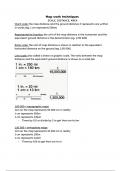
Line scale: also called a linear or graphic scale. The ratio between the map
distance and the equivalent ground distance is shown as a scale bar
1:50 000 = topographic maps
1cm on the map represents 50 000 cm in reality
1 cm represents 500m
1 cm represents 0,5km
- Times by 0,5 or divide by 2 to get from cm to km
1:10 000 = orthophoto maps
1cm on the map represents 10 000 cm in reality
1 cm represents 100m
1 cm represents 0,1km
- Times by 100 to get from cm to m
,NB: a small scale map (large number in ratio scale) shows a larger area with less
detail
Estimating area of a rectangle
- Length x breadth
- Convert to same units
Hectares
1 ha (hectare) = 10 000m²
100 ha = 1km²
- To convert km² to ha : multiply answer by 100
- To convert m² to ha : divide answer by 10 000
, DIRECTION
Direction = the description of the position of one place in relation to another
True north
- All lines of longitude converge at this point
Magnetic north
- Earth's magnetic field pulls magnetic needle of a compass
- Drifts over time
- Will be given on a map
True bearing
- Angle from one place to another measured from true north line
- Is read clockwise from 0* on North-South line
, Magnetic declination
- Angular difference between magnetic north and true north
- MD can be calculated as long as angle between true north and magnetic
north is known
- Angle of difference is recorded at bottom of map
Magnetic bearing
- MB = true bearing + magnetic declination
Grid referencing
Alphanumeric grid:
- May be placed on topographic map to assist
with location of points and places
- Letter before number
Grid reference:
- In SA, all places are South of the equator and
East of greenwich meridian
- Always written in * (degrees) ‘ (minutes) “
(seconds)
- Always written as __*__’__” S __*__’__” E
NB: read latitude reference first (south) (going down) then read longitude
reference (east) (across)
SCALE, DISTANCE, AREA
Word scale: the map distance and the ground distance it represents are written
in words (eg. 1 cm represents 500m)
Representative fraction: the unit of the map distance is the numerator and the
equivalent ground distance is the denominator (eg. 1/50 000)
Ratio scale: the unit of map distance is shown in relation to the equivalent
horizontal distance on the ground (eg. 1:50 000)
Line scale: also called a linear or graphic scale. The ratio between the map
distance and the equivalent ground distance is shown as a scale bar
1:50 000 = topographic maps
1cm on the map represents 50 000 cm in reality
1 cm represents 500m
1 cm represents 0,5km
- Times by 0,5 or divide by 2 to get from cm to km
1:10 000 = orthophoto maps
1cm on the map represents 10 000 cm in reality
1 cm represents 100m
1 cm represents 0,1km
- Times by 100 to get from cm to m
,NB: a small scale map (large number in ratio scale) shows a larger area with less
detail
Estimating area of a rectangle
- Length x breadth
- Convert to same units
Hectares
1 ha (hectare) = 10 000m²
100 ha = 1km²
- To convert km² to ha : multiply answer by 100
- To convert m² to ha : divide answer by 10 000
, DIRECTION
Direction = the description of the position of one place in relation to another
True north
- All lines of longitude converge at this point
Magnetic north
- Earth's magnetic field pulls magnetic needle of a compass
- Drifts over time
- Will be given on a map
True bearing
- Angle from one place to another measured from true north line
- Is read clockwise from 0* on North-South line
, Magnetic declination
- Angular difference between magnetic north and true north
- MD can be calculated as long as angle between true north and magnetic
north is known
- Angle of difference is recorded at bottom of map
Magnetic bearing
- MB = true bearing + magnetic declination
Grid referencing
Alphanumeric grid:
- May be placed on topographic map to assist
with location of points and places
- Letter before number
Grid reference:
- In SA, all places are South of the equator and
East of greenwich meridian
- Always written in * (degrees) ‘ (minutes) “
(seconds)
- Always written as __*__’__” S __*__’__” E
NB: read latitude reference first (south) (going down) then read longitude
reference (east) (across)



